Kurdistan oilfields now sit under a direct federal claim. Indeed, that matters for the northern barrel. On 24 November 2026, Prime Minister Ali al-Zaidi ordered the federal Oil Ministry to run fields under Kurdish security control. The order covers four provinces. He also told the Kurdistan Regional Government to approve crude and product exports only through the Oil Ministry. Our news story on the federal orders set out the directives. For traders, however, the risk is title and approval, not geology.
What Baghdad wants from the Kurdistan oilfields
The orders cover fields in Diyala, Kirkuk, Salahaddin and Nineveh. In addition, al-Zaidi put all of the region’s border crossings under the federal Border Ports Authority. Meanwhile, Energy Police are to take control of oilfields and watch them with cameras. Oil Ministry staff will also man checkpoints on the roads into Erbil, Sulaimani and Duhok.
The directives followed a committee report on suspected oil smuggling at the state-owned North Oil Company. As a result, al-Zaidi suspended the company’s director general and deputies pending an investigation. According to The National, no prime minister has taken such steps against the region since the 2003 US-led invasion.
Erbil, however, rejected the move at once. Kurdistan Region Prime Minister Masrour Barzani called the orders “in no way acceptable”. He also said they went “against the talks we have held with Baghdad’s authorities”. Previously, the two men had met in Baghdad on 9 November 2026 to discuss running the fields under the constitution.
Why Ceyhan already matters
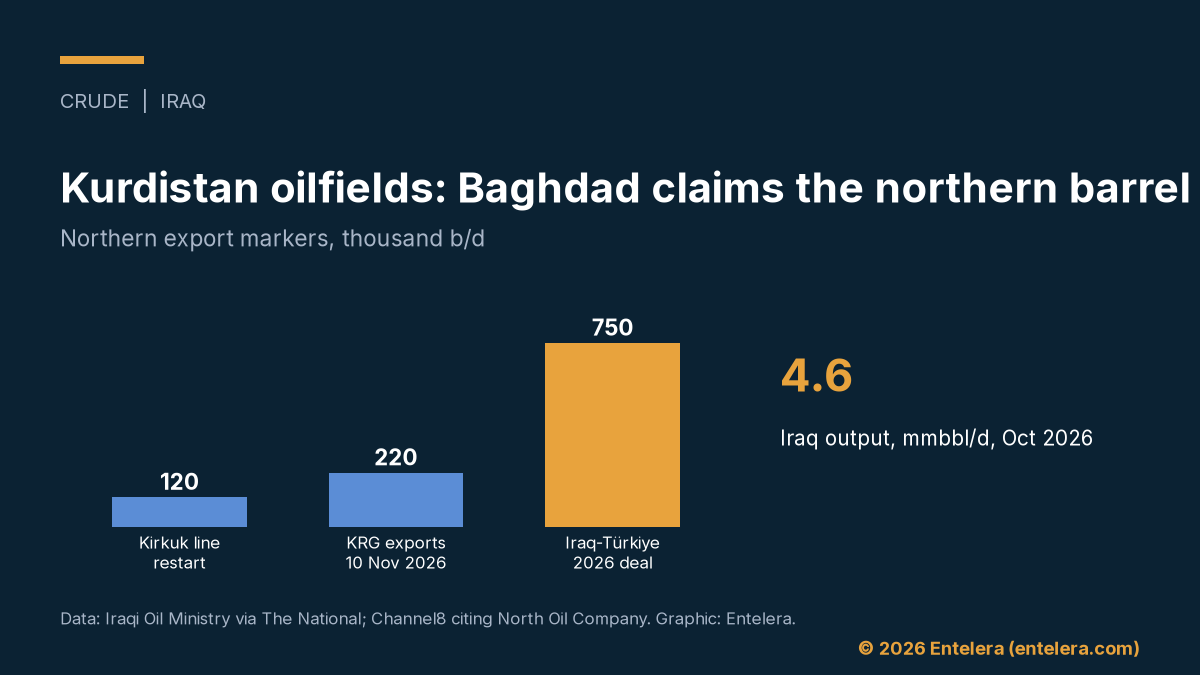
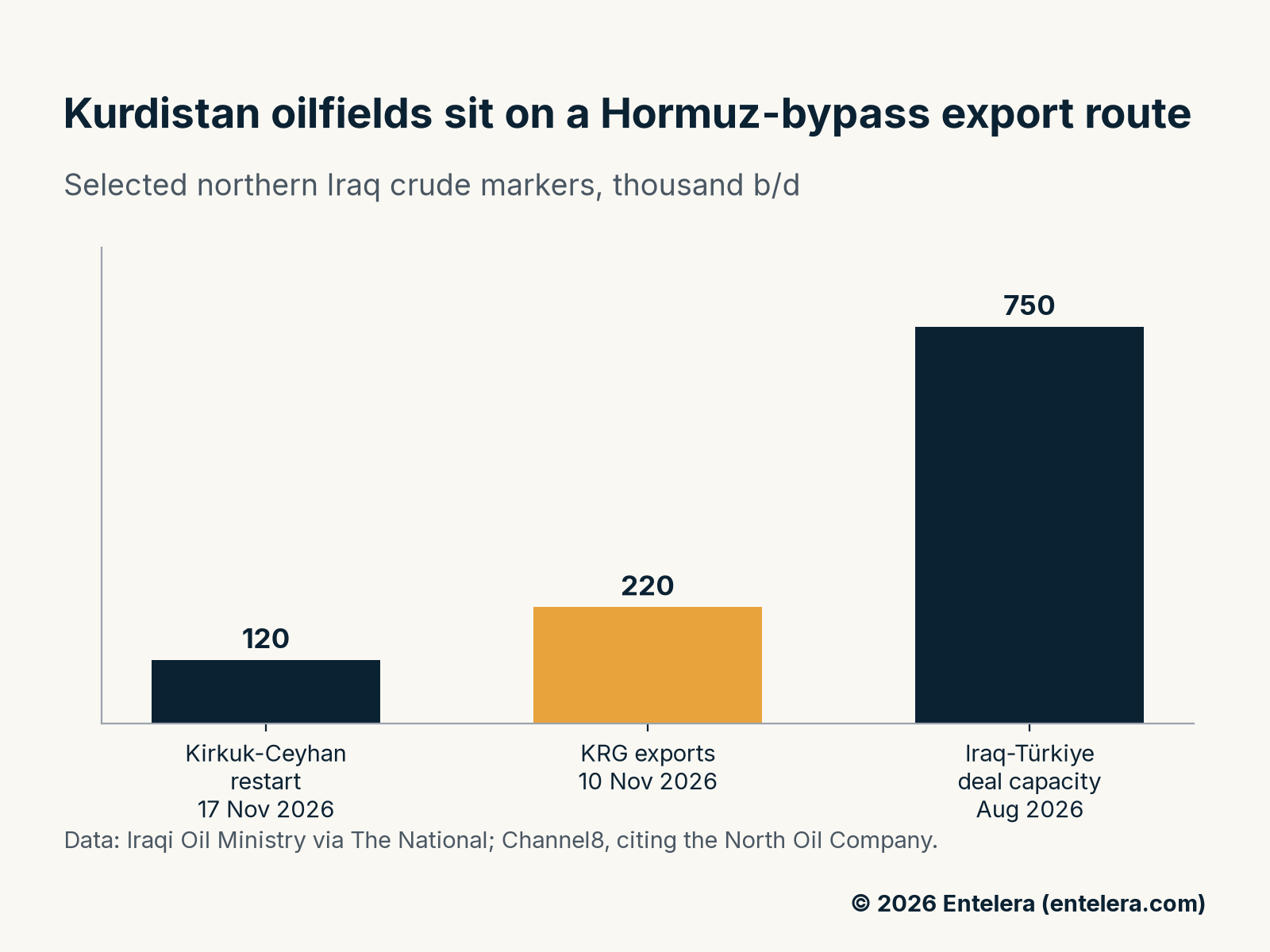
The trading issue, therefore, sits on the northern export route. First, Iraq restarted the federal Kirkuk-Ceyhan line on 17 November 2026 at 120,000 b/d. We covered that in our analysis of Kirkuk crude exports. The oil minister wants 500,000 b/d on that line. Moreover, an August 2026 deal with Türkiye provides for 750,000 b/d through Ceyhan.
Meanwhile, Kurdistan Region barrels are already moving on the same corridor. Channel8, citing the North Oil Company, put KRG exports at 220,000 b/d on 10 November 2026. Combined shipments that day, including Basra and Kirkuk crude, were 372,000 b/d. In addition, the route averaged more than 400,000 b/d over the previous ten days. On 1 November 2026 it then reached 506,000 b/d.
Baghdad already oversees Kurdish exports through Türkiye, with the money going to the federal treasury. However, a dispute over sales without federal approval halted the pipeline for more than two years. The two sides only agreed in September 2025 to restart flows. We then reported the latest Kirkuk-Ceyhan restart on 18 November 2026.
What Kurdistan oilfields control means for traders, portfolio players and buyers
Traders: the risk on Kurdistan oilfields is a stop or delay in approvals, not a sudden loss of reserves. Therefore, watch Ceyhan loadings and SOMO’s export sign-off. A stand-off could tighten Mediterranean sour just as Gulf flows recover.
Spread traders: northern Iraqi sour is a Hormuz-bypass barrel. If Ceyhan volumes stall, Mediterranean sour differentials should firm. Still, if federal control actually steadies flows, the opposite applies.
Portfolio players: producers in the region now face a sharper federal claim over export rights. Consequently, contract and payment risk sits with whoever lifts the crude, until the two governments settle the orders.
Buyers: Iraq pumped 4.6 mmbbl/d in October 2026, its highest in seven years, the IEA said. So any loss of northern barrels would matter, even in a looser global market.
What to watch next
Whether federal forces actually move onto fields guarded by Kurdish units.
Ceyhan loadings and SOMO approvals in the days after the orders.
Kurdish steps at the crossings with Türkiye and Iran.
Finally, any legal challenge from Erbil, given the unresolved fight over Article 112 and the 2022 court ruling.
Sources
Rudaw, Zaidi orders federal takeover of Kurdistan Region border crossings, oilfields under Kurdish security control, 24 November 2026: rudaw.net
The National, Iraqi PM orders federal takeover of Kurdistan oil exports, border crossings and oilfields in disputed areas, 24 November 2026: thenationalnews.com
Al Jazeera, Iraq orders takeover of oilfields in areas under Kurdish control, 24 November 2026: aljazeera.com
Rudaw, Kurdistan Region PM rejects Baghdad’s move to centralise oilfields, border control, 24 November 2026: rudaw.net
Channel8, Kurdistan Oil Exports to Ceyhan Reach 220,000 Barrels Daily, 10 November 2026: channel8.com
Seoul Economic Daily (IEA), IEA Sees First Oil Surplus Since War in Fourth Quarter, 14 November 2026: sedaily.com
Free account
Sign up free to read the full analysis
Create a free Entelera account to read every analysis in full. It takes less than a minute; no payment details needed.
Entelera Research is the editorial team behind Entelera. We cover crude, LNG, power, renewables, policy and geopolitics, looking at energy the way companies have to: supply, demand, margins, policy and risk, with every number linked to its source and a close eye on India and its place in global markets.
Brazil oil supply climbs to a 2.9 mmbbl/d Petrobras plateau to 2031. What the $122bn plan means for crude differentials, diesel imports and 2027 balances.