Brazil Oil Supply: What Petrobras’s 2.9 mmbbl/d Plateau Means for Crude and Diesel
Brazil oil supply climbs to a 2.9 mmbbl/d Petrobras plateau to 2031. What the $122bn plan means for crude differentials, diesel imports and 2027 balances.
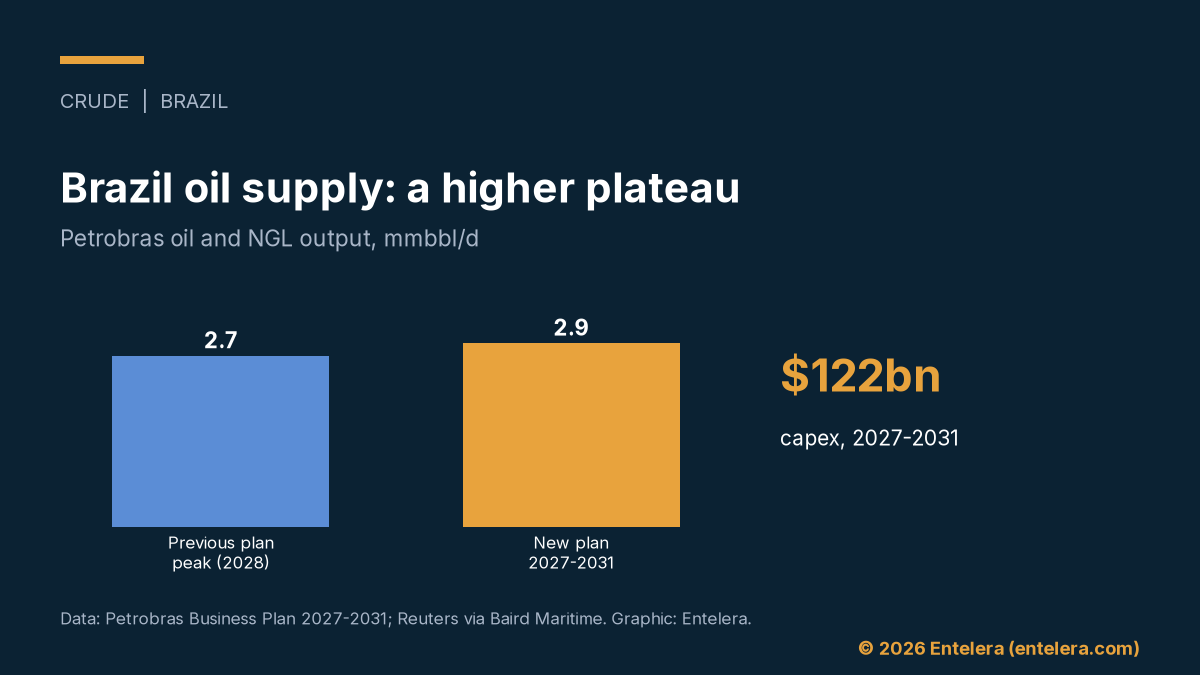
Brazil oil supply now has a higher and flatter path. Petrobras approved a $122bn business plan for 2027-2031 on 23 November 2026. It expects oil and NGL output to reach 2.9 mmbbl/d and hold there to 2031. Our news story on the Petrobras business plan covered the headline numbers. Here we look at what the plan means for crude flows, diesel imports and a market that banks already expect to be in surplus.
Brazil oil supply: a plateau, not a peak
The previous plan peaked at 2.7 mmbbl/d in 2028 and then declined, Reuters reported. By contrast, the new one adds 200,000-300,000 b/d of average output over that plan. Moreover, nine new production systems drive the growth, and eight already have contracts. In addition, about 50 complementary projects should supply ~10% of output.
The money also arrives early. Capex rises to $29.5bn in 2027 and $28.3bn in 2028, against $21bn and $20.5bn in the previous plan. Analysts had expected $115bn-120bn in total. However, in our view, front-loaded spending is what makes the plateau credible. Petrobras also declared a BRL15.6bn ($2.6bn) extraordinary dividend.
What it means for crude differentials
For crude traders, the extra barrels land in a crowded Atlantic Basin. In October 2026, Kpler said a large share of November-loading Brazilian cargoes was still unsold. Then Tupi delivered to Shandong fell to about $17 a barrel over ICE Brent, from almost $26. Meanwhile, Guyana is pushing exports towards 1 mmbbl/d.
So more Brazilian supply means sellers must keep differentials sharp. Our analysis of Petrobras crude exports showed the US share jumping to 12% in Q3 2026, while China stayed the largest outlet. Moreover, JPMorgan expects a 1.6 mmbbl/d global surplus in 2027, with Brent at $72. In that market, steady non-OPEC growth also adds pressure on OPEC+ quotas for 2027.
Brazil oil supply meets more home refining
The downstream plan matters as much. First, refining capacity rises from 1.813 mmbbl/d to 2.173 mmbbl/d by 2031, adding 360,000 b/d at existing plants. Both the Boaventura Complex at REDUC and RNEST Train 2 start up in 2029. Therefore, more Brazilian crude should run at home late in the decade, which slows export growth.
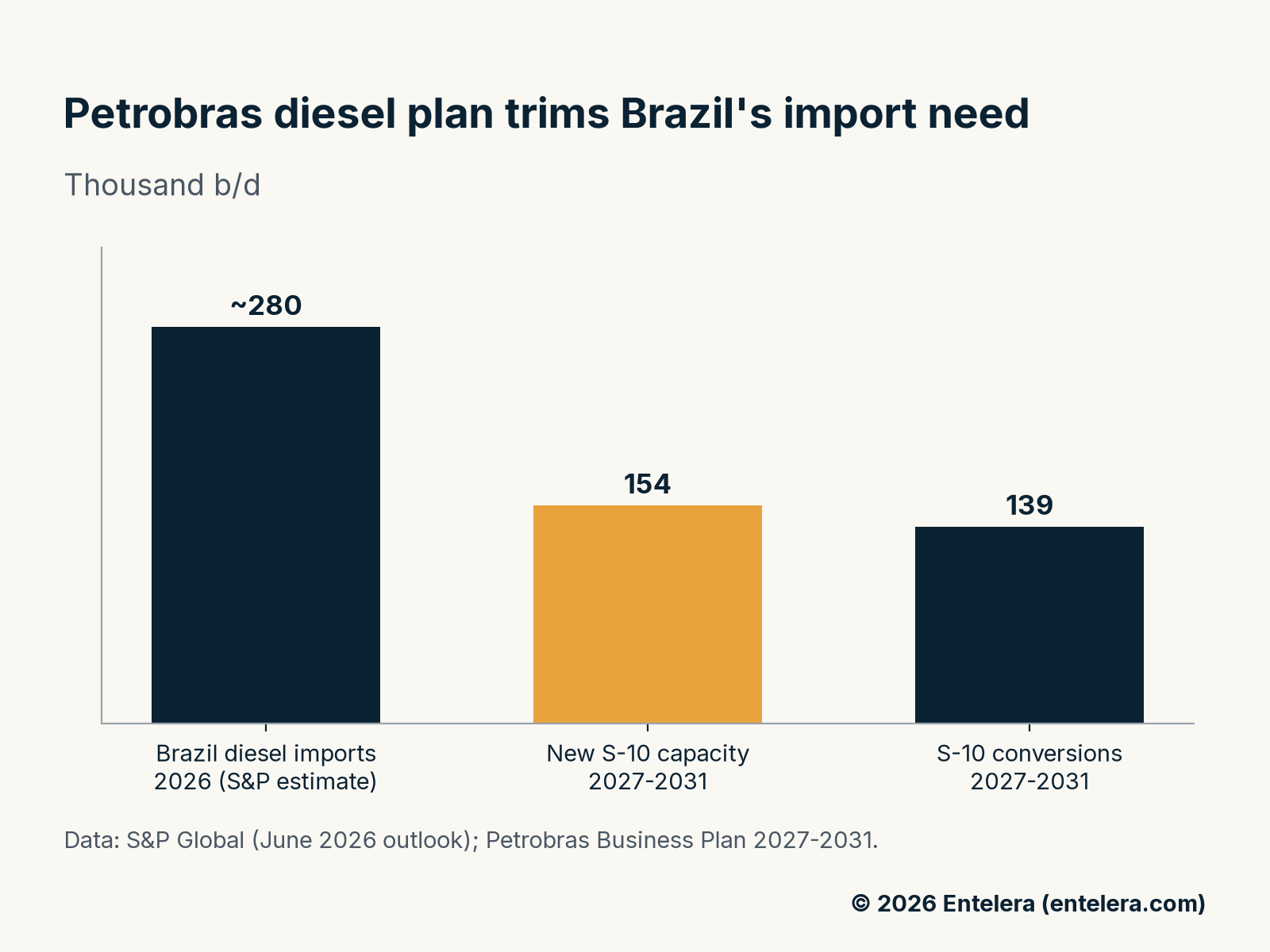
Diesel is the sharper trade. Specifically, Petrobras plans 293,000 b/d of extra S-10 diesel capacity in 2027-2031. Of that, 154,000 b/d is new capacity, while 139,000 b/d converts existing output. For comparison, S&P Global estimated Brazil’s 2026 diesel imports at 280,000 b/d. Meanwhile, US sellers supplied 74% of those imports in September 2026, according to Comex Stat data.
In our view, that points to a slow squeeze on US Gulf Coast diesel sales into Brazil after 2029, not a sudden loss. We looked at the other big regional outlet in our Mexico fuel imports analysis.
What Brazil oil supply means for traders, portfolio players and buyers
Crude traders: a steady 2.9 mmbbl/d keeps pre-salt grades plentiful. So expect Tupi and Búzios differentials to stay under pressure while freight stays high.
Diesel traders: 154,000 b/d of new S-10 capacity trims Brazil’s import call but does not erase it. Gulf Coast exporters keep the outlet for now.
Portfolio players: operating cash flow of $230bn-250bn leans on price. Santander also sees ordinary dividends in 2027 and 2028 below the previous plan.
Buyers: Asian refiners gain a reliable non-Gulf supplier. Brazilian routes avoid Gulf chokepoints, Kpler noted, which keeps these barrels attractive even with costly freight.
What to watch next
First-oil dates for the new production systems in 2027.
Tupi delivered Shandong against Brent as December 2026 cargoes clear.
Brazil’s monthly diesel import schedules and the US share.
Finally, Equatorial Margin drilling results, which shape supply after 2031.
Sources
Petrobras, Petrobras approves Business Plan 2027–2031, 23 November 2026: agencia.petrobras.com.br
Baird Maritime (Reuters), High oil prices fuel $122b Petrobras spending plan, 24 November 2026: bairdmaritime.com
UOL (Reuters), Ação da Petrobras sobe com dividendos extras, apesar de cautela com capex maior, 24 November 2026: economia.uol.com.br
Kpler, Weak demand leaves Brazilian November cargoes unsold, October 2026: kpler.com
ENGIE EnergyScan, Brent Breaks $90 as Cold Snap Lifts European Gas and Power (JPMorgan forecast), 24 November 2026: energyscan.engie.com
S&P Global, Brazil scrambles for diesel as Russian ban, Middle East shocks bite, 23 July 2026: spglobal.com
CPG Click Petróleo e Gás, Brazil diesel import data citing Comex Stat, 21 November 2026: clickpetroleoegas.com.br
Banque de France, ECB euro reference rates (BRL and USD, 23 November 2026): banque-france.fr
Free account
Sign up free to read the full analysis
Create a free Entelera account to read every analysis in full. It takes less than a minute; no payment details needed.
Entelera Research is the editorial team behind Entelera. We cover crude, LNG, power, renewables, policy and geopolitics, looking at energy the way companies have to: supply, demand, margins, policy and risk, with every number linked to its source and a close eye on India and its place in global markets.