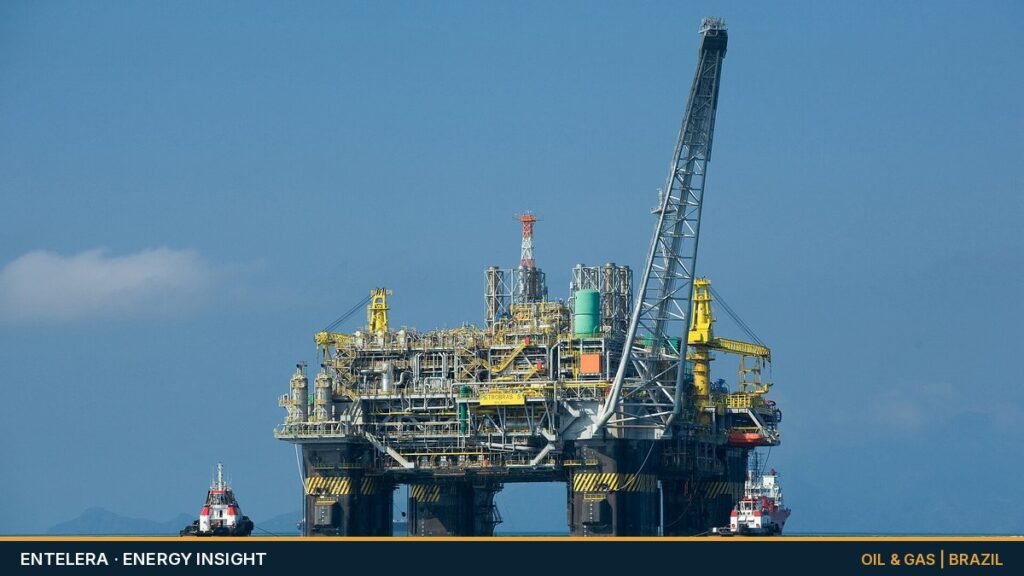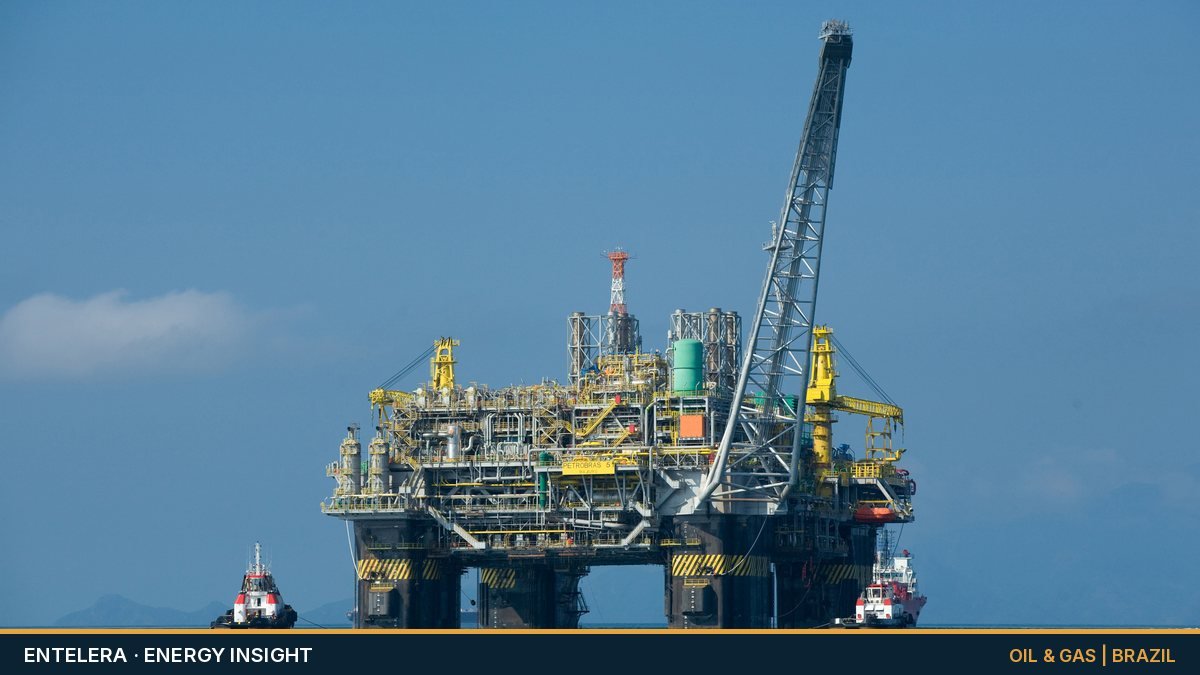
The Petrobras business plan for 2027 to 2031 commits $122bn of capital spending. That is about 12% more than the previous five-year plan. The board of Brazil’s state-controlled oil company approved it on 23 November 2026. At the same time, Petrobras declared an extraordinary dividend of BRL15.6bn ($2.6bn). It also raised its five-year ordinary dividend estimate to $55bn-60bn.
The headline numbers in the Petrobras business plan
Of the $122bn, Petrobras puts $113bn into projects it has already decided to execute. The other $9bn sits in an “under evaluation” portfolio of less mature options. Exploration and production takes more than 70% of the total: $83bn of firm spending plus about $3bn under evaluation.
Pre-salt fields take 60% of the firm upstream budget. Meanwhile, post-salt fields take 23% and exploration 12%. The company plans about 50 exploration wells for $10bn, including in the Equatorial Margin off northern Brazil.
As a result, oil and natural gas liquids output should reach 2.9 mmbbl/d and stay there through 2031. That is 200,000 to 300,000 barrels a day above the previous plan. By contrast, the old plan peaked at 2.7 mmbbl/d in 2028 and then declined. Including gas, commercial output rises to 3.1mn boe/d in 2027 and 3.2mn boe/d from 2028.
Nine new production systems drive the growth, and eight of them already have contracts. In addition, about 50 smaller “complementary” projects add roughly 100 wells in mature Campos and Santos Basin fields. Together, they should supply about 10% of output.
Chief executive Magda Chambriard called it “an ambitious plan” with “capital discipline and rigour in every decision”. She added that Petrobras will back only projects that stay profitable “even under the most challenging scenarios”.
Why the market hesitated
The total roughly matched press reports. However, the timing surprised analysts. Petrobras now plans cash capex of $29.5bn in 2027 and $28.3bn in 2028. The previous plan had $21bn and $20.5bn for those years. Before the release, analysts had expected $115bn-120bn in total.
Itaú BBA said the 2027 and 2028 figures came in “well above market expectations”. Similarly, Santander estimated that implied ordinary dividends for 2027 and 2028 fall below the previous plan. In its view, payouts pick up only from 2029. JP Morgan, for its part, said a flat 2.9 mmbbl/d offers limited growth for the extra money.
Even so, the surprise extra dividend helped. Petrobras’s preferred shares rose more than 1% by midday in São Paulo on 24 November 2026. That followed an early dip and an 8.8% fall over the previous five sessions.
Refining, diesel and a return to ethanol
Downstream, the company plans $23bn of firm spending plus $1bn under evaluation. Refining capacity rises from 1.813 mmbbl/d to 2.173 mmbbl/d by 2031. That adds 360,000 barrels a day without any new refinery. Instead, the gains come from the Boaventura Complex at REDUC and a second train at the Abreu e Lima (RNEST) refinery. Both should start up in 2029.
The goal is self-sufficiency in diesel. Petrobras plans 405,000 barrels a day of extra S-10 low-sulphur diesel capacity by 2031. Of that, 293,000 barrels a day arrive between 2027 and 2031.
Low-carbon spending stays modest. Gas and low-carbon energy get $4bn firm plus $4bn under evaluation, and all transition items total about $13.5bn. Still, Petrobras also agreed on 23 November 2026 to buy 42% of corn-ethanol producer Neomille. It will pay CerradinhoBio BRL2.8bn (about $470mn), which marks its return to ethanol.
What the Petrobras business plan means
In our view, the Petrobras business plan swaps short-term payouts for a longer production plateau. Brazil should add steady pre-salt barrels through 2031, so buyers in China and Europe gain a reliable supplier. Moreover, those barrels arrive just as banks such as JPMorgan forecast a supply surplus in 2027.
For traders, the key signal is volume certainty. Nine contracted systems make the 2.9 mmbbl/d path more credible than a typical plan target. Therefore, Brazilian exports should keep competing hard with West African and Guyanese grades for Asian refiners.
For shareholders, the plan leans heavily on price. Operating cash flow of $230bn-250bn assumes strong oil prices. Meanwhile, gross debt stays under a $75bn ceiling that falls towards $65bn. If Brent drops towards JPMorgan’s $72 forecast for 2027, the dividend range would feel the pressure first, not capex. Our earlier report on Petrobras’s record Q3 2026 results showed how much of today’s cash comes from high prices.
What to watch next
First, watch first-oil dates for the new production systems in 2027. Next, watch whether Petrobras lifts spending again in 2028, as it has under Chambriard. Finally, watch the Equatorial Margin drilling results, which could shape the Petrobras business plan after 2031.
For a deeper analysis, read: Brazil Oil Supply: What Petrobras’s 2.9 mmbbl/d Plateau Means for Crude and Diesel
Sources
- Petrobras: Petrobras approves Business Plan 2027–2031
- Baird Maritime (Reuters): High oil prices fuel $122b Petrobras spending plan
- UOL (Reuters): Ação da Petrobras sobe com dividendos extras, apesar de cautela com capex maior
- ENGIE EnergyScan: Brent Breaks $90 as Cold Snap Lifts European Gas and Power
- Petrobras: Petrobras acquires stake in corn ethanol producer