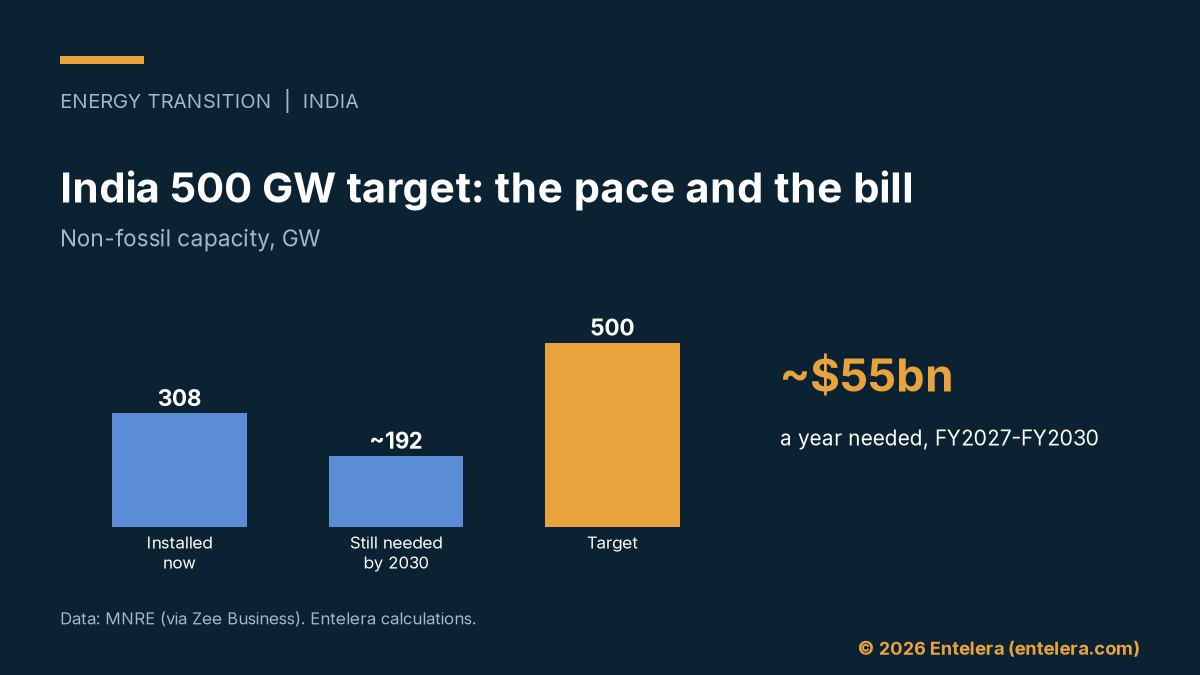
India’s 500 GW target for non-fossil power capacity now has a price tag. MNRE Secretary Santosh Sarangi said on 24 October that it needs about $220bn of clean energy investment from FY2027 to FY2030. So far, India has installed 308 GW.
This analysis looks at two questions. First, can India build fast enough? Second, can the money and the grid keep up?
The 500 GW target in numbers
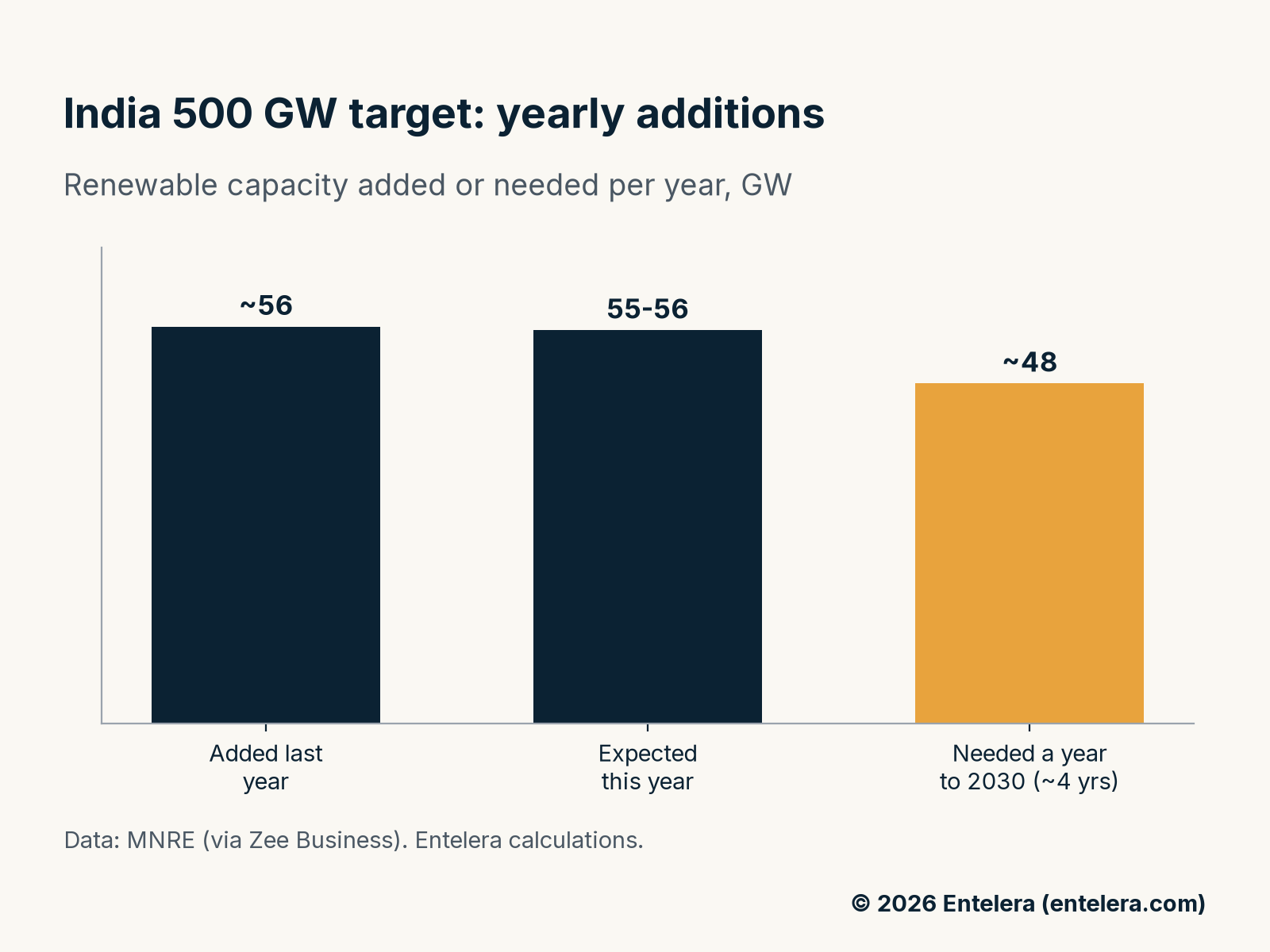
To reach 500 GW, India needs ~192 GW more. Over the four years to 2030, that is ~48 GW a year, on our estimate. By comparison, India added about 56 GW of renewable capacity last year, the ministry said. In addition, it expects another 55 to 56 GW this year.
In other words, the build rate is already above what the 500 GW target needs. On that measure alone, India looks on track.
The money: ~$55bn a year
The bill is the harder part. Spread over four years, $220bn is ~$55bn a year. By contrast, the sector has attracted about $64bn so far, including $6.3bn of foreign direct investment, Sarangi said. Therefore, India needs to raise in roughly one year what it has drawn in total to date.
That is why the ministry is courting long-term capital. For example, it is planning an investment summit with nine countries and 15 Indian states. Banks and private equity firms will also attend. Meanwhile, work has started on a listing for the Solar Energy Corporation of India, although there is no timeline yet.
Why the grid decides the 500 GW target
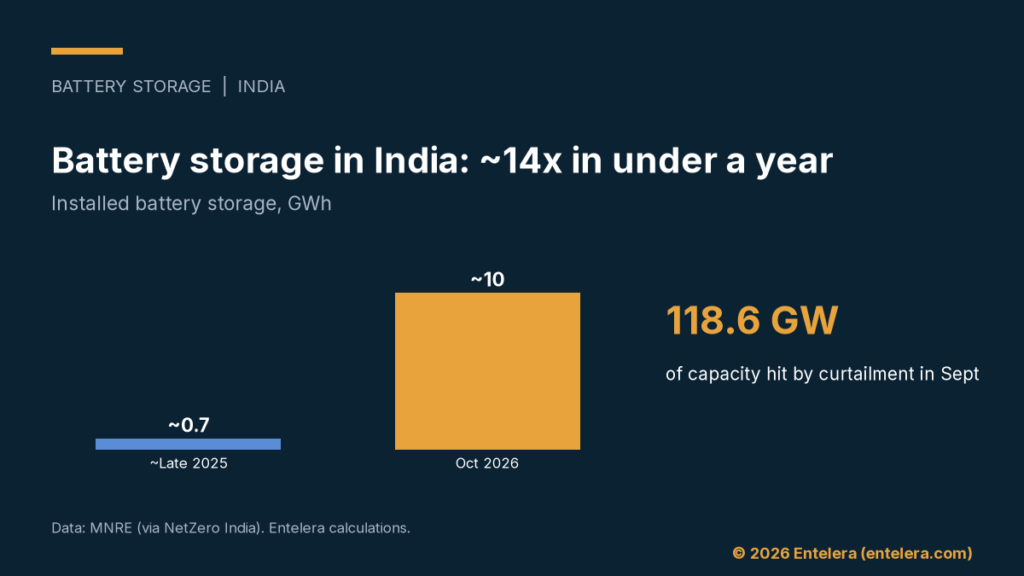
Capacity on paper is not power on the grid. In September, curtailment affected 118.6 GW of renewable capacity, an MNRE official said. Transmission lines take about 36 months to build, against 12 to 18 months for a solar or wind project. As a result, plants can be ready before the lines are.
In our view, the 500 GW target needs much of the $220bn to go into wires and storage, not only panels. Otherwise, faster additions will simply mean more curtailment. For the grid problem in detail, see our analysis of the grid bottleneck.
What to watch next
- The investment summit, and how much long-term money it commits.
- The SECI listing, once the ministry sets a timeline.
- Monthly curtailment data, to see whether new lines close the gap.
- Coal’s share of generation, which still dominates supply.
In short, India can build the plants for its 500 GW target. Funding them, and connecting them, will decide whether 500 GW arrives on time. For the news, see our report on the $220bn estimate. For context on coal, read our power mix analysis.
Sources
- Zee Business, India installs 308 GW non-fossil capacity; $220 billion investment needed by 2030: MNRE Secretary, 24 October 2026: zeebiz.com
- NetZero India (Elets), Insights from JVN Subramanyam, Joint Secretary, MNRE, 24 October 2026: netzero.eletsonline.com