
Two statements from Indian ministers in the same week seem to tell opposite stories. One says thermal power’s share of the power mix in India has jumped to 83%. The other says India has reached 308 GW of renewable capacity.
Yet both can be true at once. In fact, the gap between them is the biggest lesson in the sector right now. Installed capacity is not the same as firm supply.
What happened to the power mix in India
Union Minister for Coal and Mines G. Kishan Reddy spoke in Hyderabad on 16 October. He said the country faced heightened pressure on thermal generation. The reasons, he said, were a sharp rise in electricity demand and lower hydroelectric output caused by El Niño conditions.
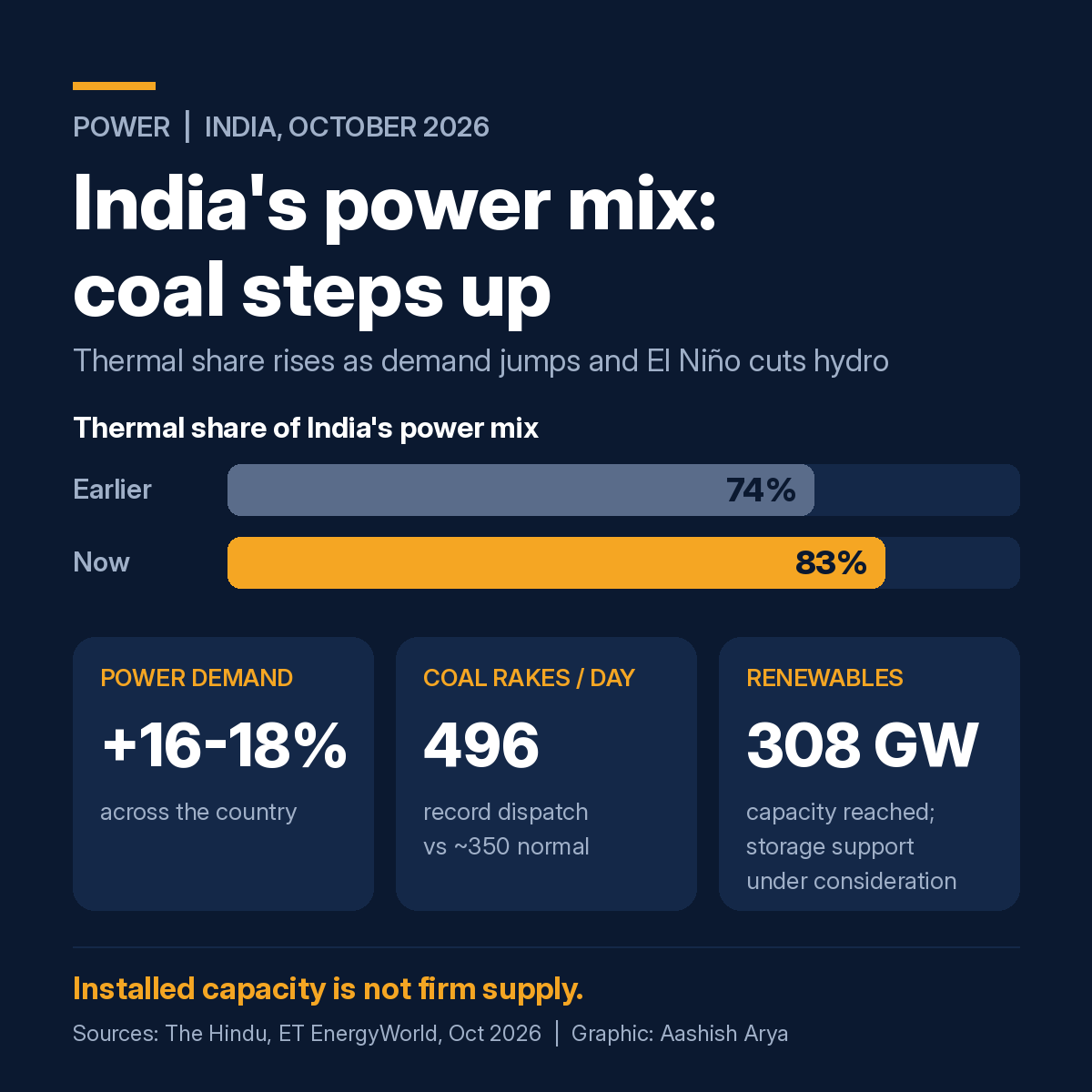
According to The Hindu, he said power demand had risen by 16-18% across the country. In addition, thermal power’s share of the national energy mix had risen from 74% to 83%, he said.
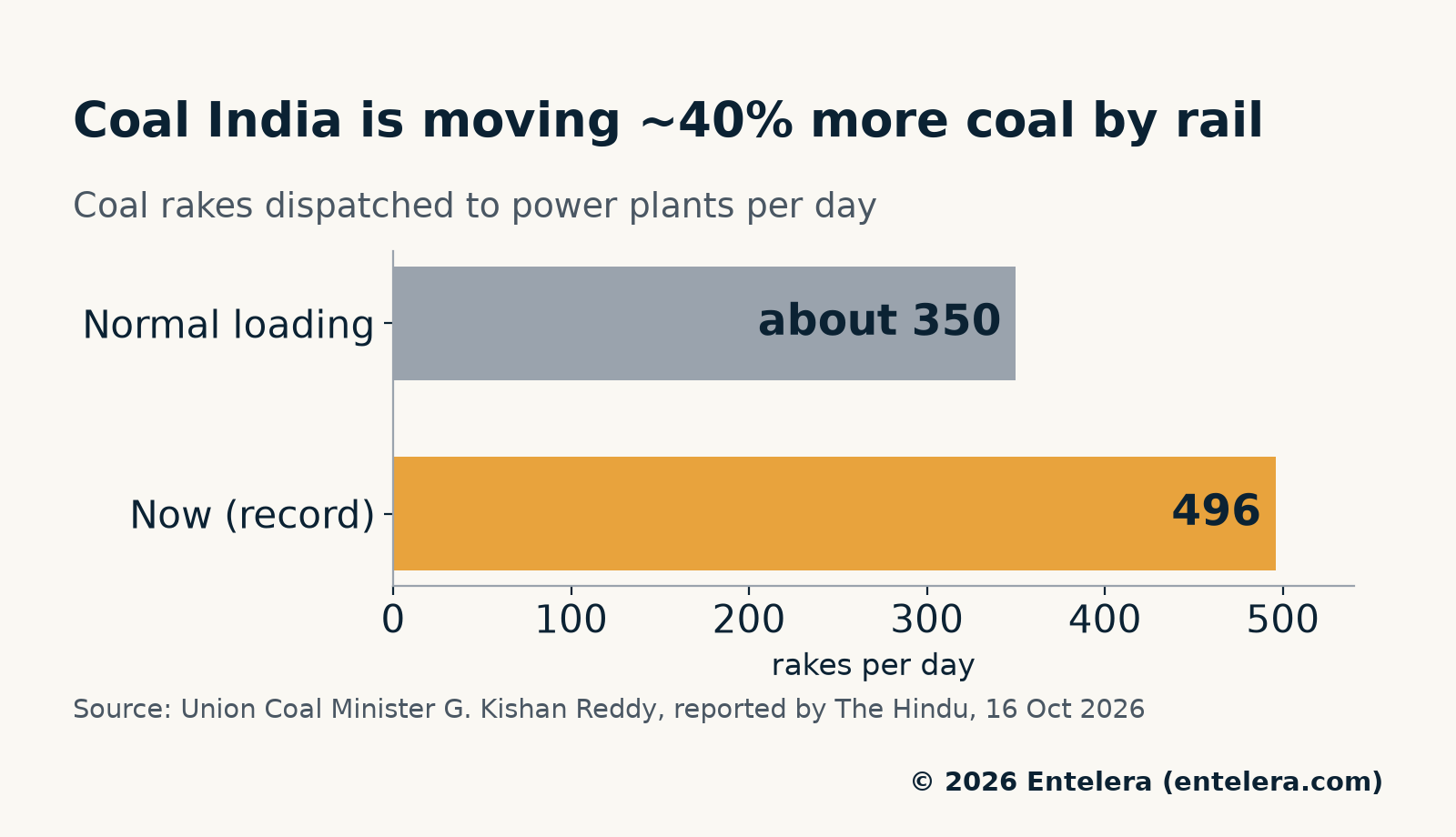
Coal India, he said, was making extraordinary efforts. Normal loading is about 350 railway rakes of coal a day. By contrast, a record 496 rakes a day were now going to power plants. Meanwhile, he added, Prime Minister Narendra Modi was reviewing coal production, transport and stock levels daily.
States are asking for assured coal
The pressure is visible at state level. In Telangana, Mr Reddy said directions were in place to arrange coal linkages for the Yadadri Thermal Power Plant. The coal could come from Mahanadi Coalfields or Western Coalfields.
This followed a call from Chief Minister A. Revanth Reddy. Earlier, he had flagged supply disruptions linked to reduced production at Singareni Collieries Company Limited. To avert a possible shortage, he also sought coal from Coal India.
In Punjab, Chief Minister Bhagwant Mann met Union Power Minister Manohar Lal Khattar. Mr Mann sought uninterrupted coal and power supplies. Afterwards, he said the Centre had given that assurance. The state was also in touch with Coal India and the Jharkhand government over supplies from the Pachhwara coal mines.
Renewables reached 308 GW, but storage is missing
Separately, India has reached 308 GW of renewable energy capacity. That figure came from Shripad Naik, Minister of State for Power and New and Renewable Energy. He also said the government was considering ways to facilitate battery storage, “including subsidies and other measures”. This is because, he said, solar and wind output varies, and solar does not generate at night.
Why coal still leads the power mix in India
A gigawatt of solar and a gigawatt of coal count the same way in capacity statistics. However, they do different jobs. Solar produces during daylight, and wind varies with the weather. Hydro is normally a flexible balancing resource, but it depends on rainfall. This year, however, El Niño has reduced it.
When demand rises sharply and hydro underdelivers, the system turns to whatever it can dispatch at scale and on demand. In India today, that is coal, above all after sunset when solar output falls away. So the rise in thermal share does not mean renewable capacity has stopped growing. Instead, it shows that renewables without storage cannot cover the hours that matter most.
Installed capacity is not firm supply. The evening peak decides the value of solar, and storage is what moves it there.
Mr Naik’s own remarks point the same way, too. He said the system generally meets demand during the day. He also said battery storage can help make renewable electricity available when demand peaks.
The key numbers on the power mix in India
- 74% to 83%: the rise in thermal power’s share of the national mix, according to the Coal Minister.
- 16-18%: the increase in power demand across the country, by the same account.
- 496 vs about 350: coal rakes dispatched per day now, against normal loading. That is roughly 40% above the usual rate.
- 308 GW: India’s renewable energy capacity, according to the Minister of State.
The ministers did not give a time window or a precise definition for the 74% and 83% figures. Therefore, treat them as a sign of direction and scale, not a formal statistic. Still, every other signal in these reports points the same way for the power mix in India. These include record rake dispatch, a daily review by the Prime Minister and states lobbying hard for assured coal.
Coal logistics are now an energy security issue
The Telangana episode shows where stress builds first. A shortfall at one captive supplier, Singareni, put one plant’s fuel at risk. As a result, the Union minister had to step in to arrange alternative linkages. Punjab’s case, meanwhile, shows the cross-state dependence. Its supply talks involve both Coal India and the Jharkhand government, over coal from the Pachhwara mines.
When dispatch runs about 40% above normal, the binding constraints shift from mining to moving coal. These include rail rakes, wagon turnaround and plant-level stock. They are less visible than generation capacity. Yet in a demand spike, they decide whether the lights stay on.
Planners should therefore treat rail logistics and linkage allocation as seriously as generation adequacy.
The global link: why coal looks like insurance
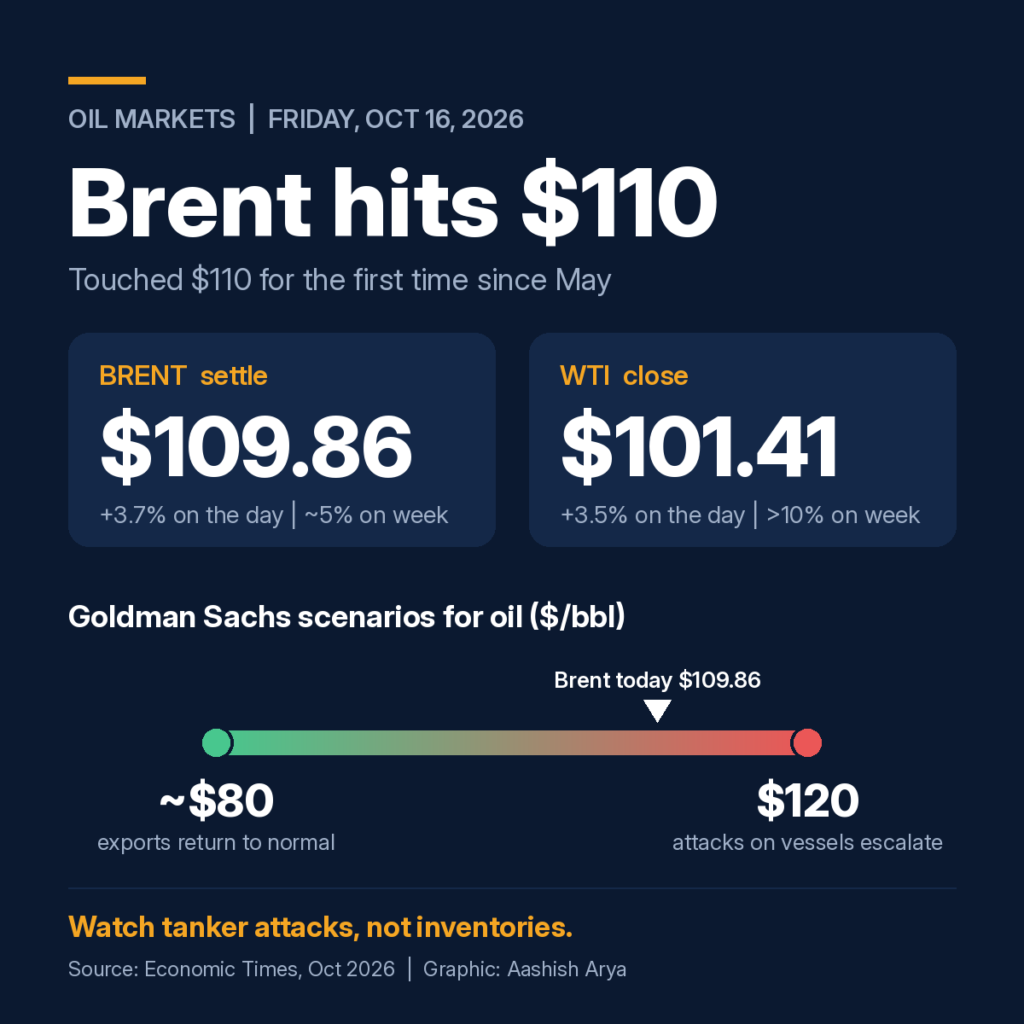
The domestic coal call also comes against a difficult international backdrop. Brent settled at $109.86 a barrel on 16 October. In addition, Goldman Sachs has said it expects natural gas and refined fuel prices to rise. As a result, imported gas is an expensive way to firm up a power system. We also explain the oil move in our analysis of Brent at $110.
Domestic coal, whatever its emissions cost, therefore looks to planners like insurance against both price and supply risk. That is not a climate win. It is, however, an understandable choice for a system operator. After all, its first duty is to keep supply secure during a demand surge and a weak hydro year.
What this means for the power mix in India and beyond
For India’s transition: In India, the bottleneck in the power mix is moving from adding capacity to firming it. Each new gigawatt of solar without storage adds more daytime energy. However, it does little for the evening peak, which is when the grid calls on coal.
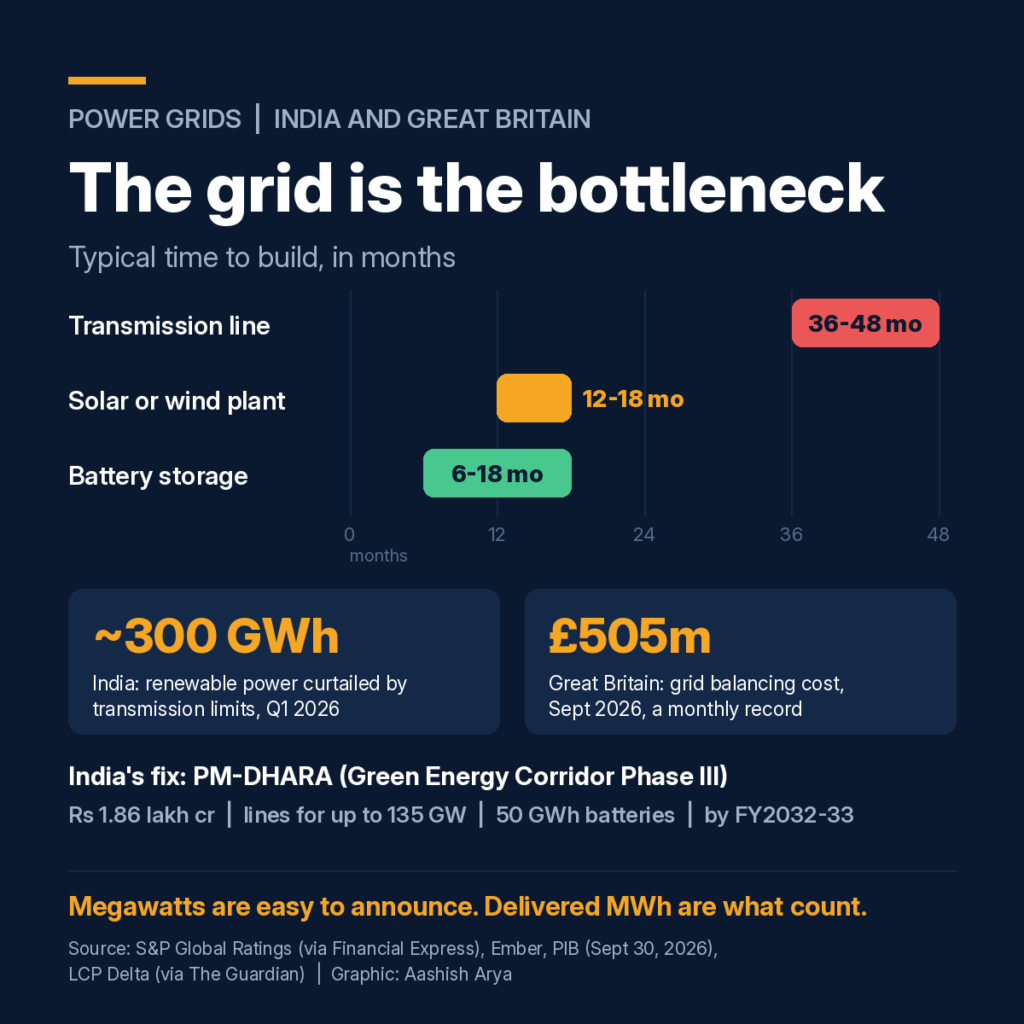
For investors and developers: The ministry says it is “considering” storage subsidies, and that is the policy signal to track. A concrete scheme with clear volumes and support levels would change project economics. That applies to storage as well as to hybrid solar-plus-storage bids. Our analysis of the grid bottleneck and PM-DHARA also looks at the same storage question from the transmission side.
For coal and rail: Coal India and the railways are operating at exceptional intensity. That raises operational risk if demand stays high for longer. It also makes state-level linkage decisions politically sensitive.
For Europe and the US: In short, India’s experience is a reminder for other markets with fast solar growth. When hydro or wind underperforms, the system falls back on whatever firm capacity is available. Where that capacity is gas, importers face the same global price pressure now visible in oil.
What to watch next
- Storage policy moving from “considering” to a notified scheme, with volumes, support mechanisms and timelines.
- Rake dispatch rates and plant coal stocks, especially at plants that depend on a single supplier.
- Further state requests for assured coal. These would show stress spreading beyond Telangana and Punjab.
- Hydro recovery as El Niño conditions evolve, which would ease the pressure on thermal plants.
The open question is whether this is a temporary El Niño episode. The alternative is that storage now limits India’s energy transition. So far, the evidence suggests both. The weather triggered the squeeze. However, the lack of storage made coal the only practical choice for the power mix in India.
Sources
- The Hindu, “Coal linkages being arranged for Yadadri power plant, says Kishan Reddy”, 16 October 2026: thehindu.com
- ETEnergyWorld (ANI), “AI to help deliver uninterrupted electricity to every household: Union MoS Shripad Naik”, 16 October 2026: energy.economictimes.indiatimes.com
- ETEnergyWorld (PTI), “Punjab not to face electricity shortage as Centre assures uninterrupted coal, power supplies: Bhagwant Mann”, 16 October 2026: energy.economictimes.indiatimes.com
- The Economic Times (ETMarkets), Brent settlement and Goldman Sachs outlook, 17 October 2026: economictimes.indiatimes.com