US refining capacity is now a matter of national defence, according to the White House. On 22 October, President Trump signed a determination under Section 303 of the Defense Production Act. It covers oil production, refining, pipelines, storage and marine terminals. As a result, the government can buy, commit to buy or fund new capacity.
The aim is lower fuel prices before the 3 November midterm elections, Reuters reported. However, refineries take years to build or expand. This analysis looks at what the order does and how much capacity the money could add.
What the Defense Production Act order does
The memo builds on the national energy emergency that Trump declared on 20 January 2025. It says industry cannot add capacity in time because of constrained financing, long lead times, permitting delays and supply chain limits. Then it waives the usual Section 303 conditions, so funding can move faster. It directs the Secretary of War to carry it out and to publish it in the Federal Register.
Notably, the memo names no projects and no budget. Legislation signed last year included $1bn of Defense Production Act funding for energy projects, Reuters said. So far, the only named project is Delek’s refinery in Tyler, Texas. Vice President JD Vance said on 13 October that it would expand. It processes ~74,000 barrels a day, and neither side has said how much capacity it will add or what it will cost.
How much US refining capacity has been lost
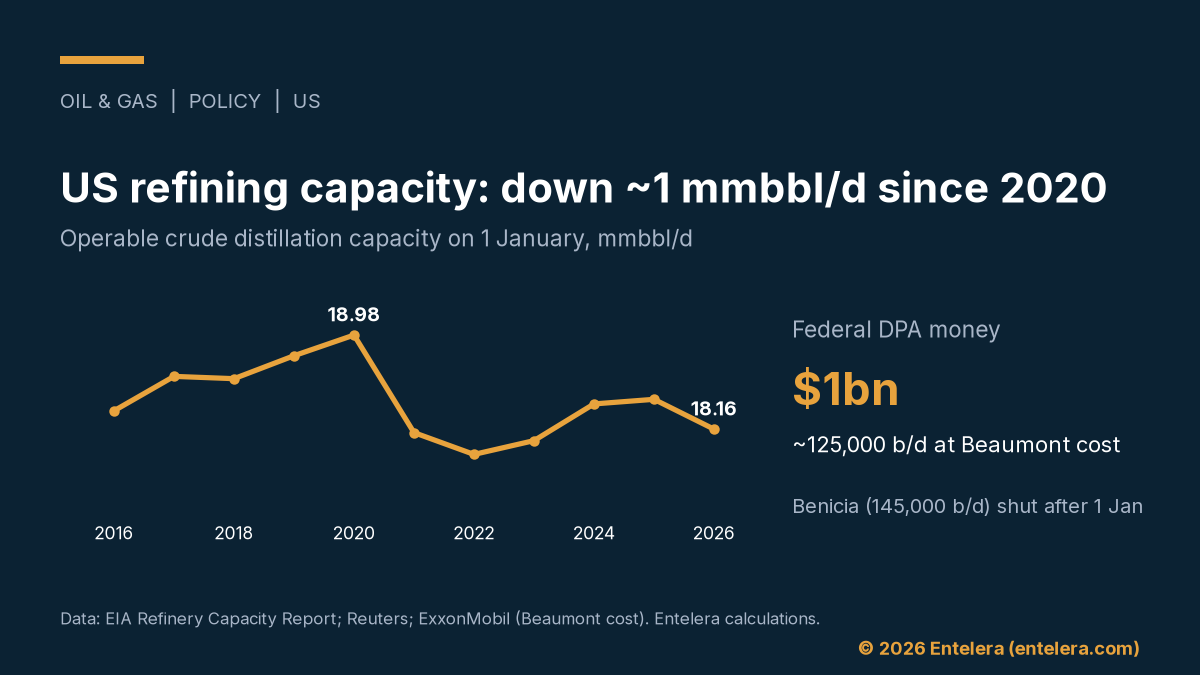
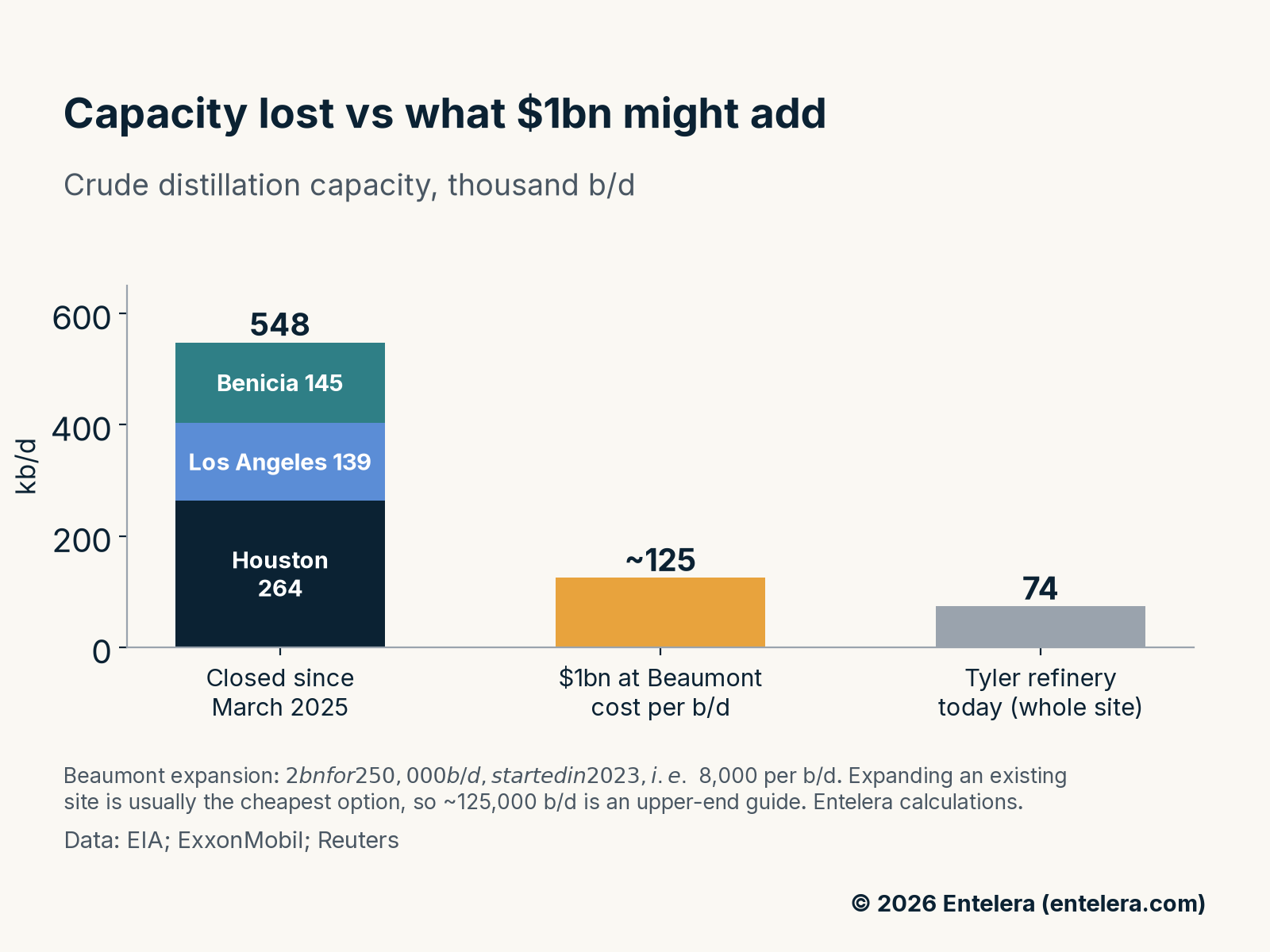
The starting point is a shrinking fleet. US refining capacity stood at 18.16 mmbbl/d on 1 January 2026, down from 18.98 mmbbl/d at the start of 2020, EIA data show. Two plants shut in 2025: LyondellBasell’s Houston refinery, at ~264,000 barrels a day, and Phillips 66’s Los Angeles plant, at ~139,000. In addition, Valero’s 145,000 barrel-a-day Benicia refinery in California has stopped refining since January.
Taken together, those three closures removed ~548,000 barrels a day. On our estimate, capacity is now ~18.0 mmbbl/d, or ~1 mmbbl/d below the 2020 level. The West Coast is hit hardest, because few pipelines bring fuel there from the Gulf Coast, the EIA noted.
Why existing US refining capacity is stretched
Moreover, existing plants have little room to run harder. US refinery utilisation reached 98.0% in the last week of August, weekly EIA data show. It eased to 93.4% in the week to 16 October, with gross inputs of 16.86 mmbbl/d. In our view, that is mostly the usual autumn maintenance.
So more crude alone does not solve the fuel problem. The US already pumped ~13.6 mmbbl/d of crude in 2025, more than any other country. Instead, the bottleneck is turning that crude into diesel, jet fuel and petrol. For the diesel squeeze on the East Coast, see our analysis of the heating oil reserve release.
What $1bn buys in US refining capacity
A recent expansion gives a rough price. ExxonMobil added 250,000 barrels a day at its Beaumont refinery in Texas for $2bn, starting up the new unit in March 2023. That is ~$8,000 per barrel a day of capacity. At the same cost, $1bn would add ~125,000 barrels a day, or ~0.7% of US refining capacity.
In practice, it may buy less. Beaumont was a large expansion at an existing site, which tends to cost less per barrel than smaller or new projects, in our view. Even at the Beaumont price, $1bn would replace less than a quarter of the capacity lost since 2025.
Timing is the bigger limit. Refinery expansions usually take many months, if not years, Reuters noted. Therefore, any barrels funded now would arrive long after the midterms.
Who could benefit
In our view, the likely winners are smaller refiners with sites that can grow quickly, such as Delek. Pipeline, storage and terminal owners may also gain, since the order covers logistics. By contrast, large refiners have recently closed plants rather than expand them, mainly in California. There, state rules and costs drove the decisions, and federal money alone may not change them. Reuters reported this month that the White House was also preparing to push officials to bypass state and local rules that block energy projects.
What to watch next
- Publication in the Federal Register and the first funding awards.
- Details of the Tyler expansion: size, cost and start date.
- Any move on state and local rules, which the White House is also targeting.
- Weekly EIA refinery data, as plants return from autumn maintenance.
- Diesel and petrol prices before 3 November, the test the White House has set itself.
In short, the order makes federal money available, but it cannot create refinery capacity quickly. US refining capacity is ~1 mmbbl/d below 2020, and $1bn would close only a small part of that gap. For the order itself, see our news report on the Defense Production Act.
Sources
- The White House, Presidential Determination Pursuant to Section 303 of the Defense Production Act on Domestic Petroleum Production, Refining, and Logistics Capacity, 22 October 2026: whitehouse.gov
- Reuters via Investing.com, Trump invokes Cold War-era Defense Production Act for oil production, refining, 22 October 2026: investing.com
- Reuters via Investing.com, Trump administration to expand a Delek Texas refinery using Defense Production Act, 13 October 2026: investing.com
- EIA, US refining capacity decreased during 2025, 29 June 2026: eia.gov
- EIA, US operable crude oil distillation capacity as of 1 January: eia.gov
- ExxonMobil, $2bn Beaumont refinery expansion, 16 March 2023: investor.exxonmobil.com
- EIA, US refinery utilisation, weekly: eia.gov
- EIA, US gross inputs to refineries, weekly: eia.gov