
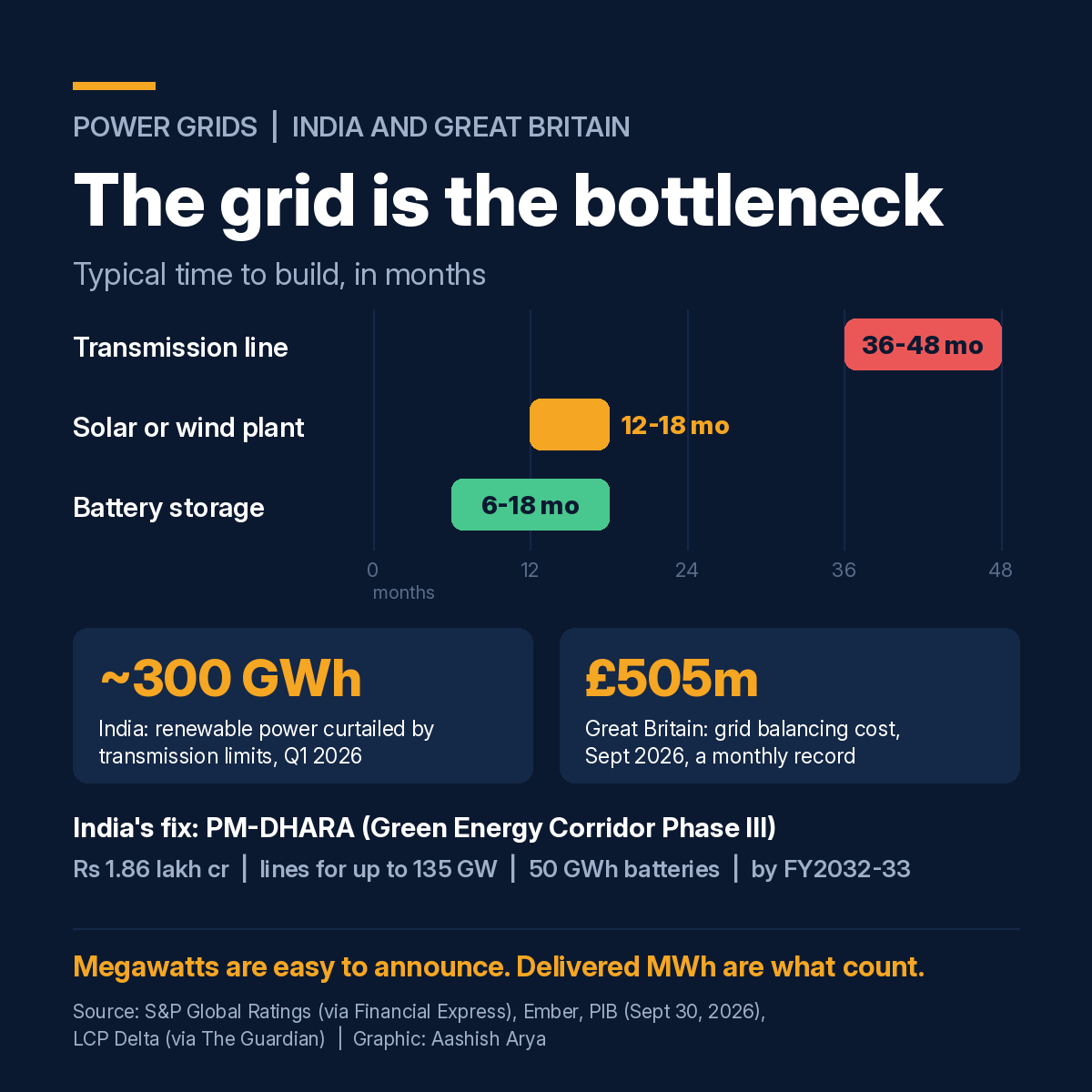
Developers can bring a solar farm online in 12 to 18 months. However, the transmission line it needs typically takes three to four years. That mismatch is the grid bottleneck. India’s new PM-DHARA scheme funds the fix, but its timeline shows the problem will outlast the 2030 targets.
The bottleneck already costs money on two continents. For example, Great Britain is paying record sums to switch wind farms off. Meanwhile, India is losing renewable output to grid congestion.
For this decade, therefore, the answer is batteries. Developers should also start valuing grid connection dates as highly as tariffs.
What happened
Great Britain
According to The Guardian, the cost of balancing Great Britain’s power grid reached £505m in September. That is the highest monthly figure on record.
In fact, on Wednesday 14 October alone, the grid operator paid £47.9m. The money turned wind farms off where there was too much electricity. It also turned gas plants on where supply was tight. That day, wind farms and hydropower plants with about 9 GW of capacity took payments not to generate. The figure comes from the consultancy LCP Delta.
India
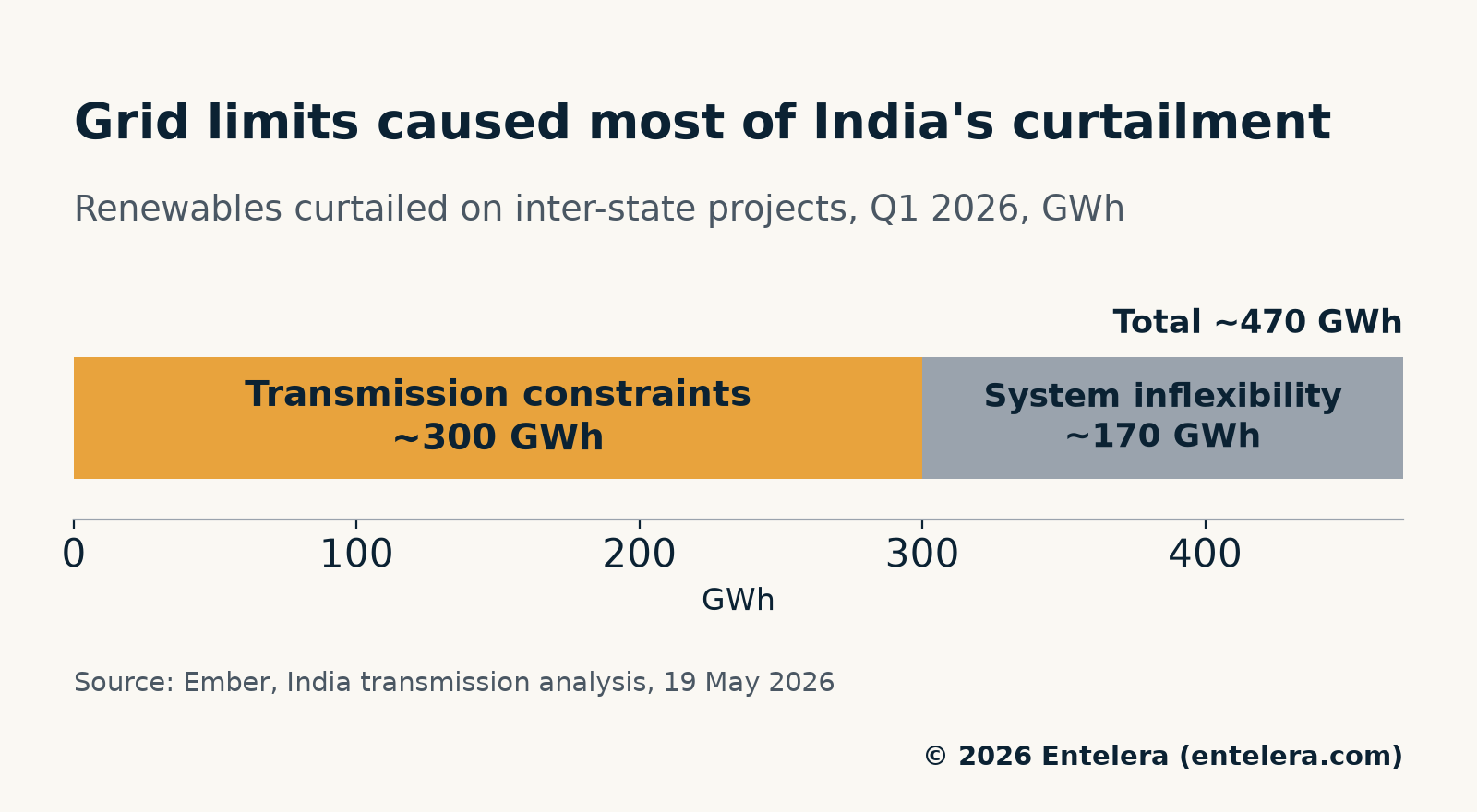
India curtailed about 300 GWh of renewable energy in January to March 2026 because of transmission constraints, according to Ember. Ember observed about 470 GWh of curtailment across inter-state projects, so transmission limits caused nearly two-thirds of the total. Ember also linked the remaining 170 GWh to system inflexibility.
The policy response: PM-DHARA
On 30 September, the Union Cabinet approved Green Energy Corridor Phase III, now known as PM-DHARA. The scheme aims to strengthen intra-state transmission and also deploy battery storage.
Why it matters: the system was not short of power
Britain’s case is instructive because it was not a supply shortage. “The system overall wasn’t tight in terms of power supplies,” LCP Delta’s head of power trading, Shivam Malhotra, told The Guardian. “It’s the age-old story of a lack of infrastructure to transport power to where it’s needed.”
Typically, Scottish wind farms receive payments to turn off. This is because there is not enough high-voltage cabling to carry their output south, where demand is growing.
India’s problem has the same shape, too. Ember notes that India’s utility-scale solar and wind capacity sits mainly in Rajasthan and Gujarat. As a result, long queues have formed at key pooling stations. In both countries, developers are building generation faster than the wires that deliver it.
Megawatts are easy to announce. However, delivered megawatt-hours are what count.
The numbers behind the grid bottleneck
- 12-18 months: typical time for renewable projects to come online in India (Ember).
- 3-4 years: typical time to commission a transmission project (S&P Global Ratings, reported by Financial Express).
- 6-18 months: typical time to commission a battery project (S&P, reported by Financial Express).
- 1-1.5%: S&P’s estimate of renewable generation curtailed nationally in India. Some individual projects face curtailment of 40-50% in their early stages.
- About 80%: the share of annual transmission targets India has met over the past five years, according to Ember.
- One in four: the share of inter-state schemes facing a delay of a year or more, also according to Ember.
- £3.2bn: the expected cost of balancing Great Britain’s grid over the next year, as reported by The Guardian.
PM-DHARA: large, well targeted and late
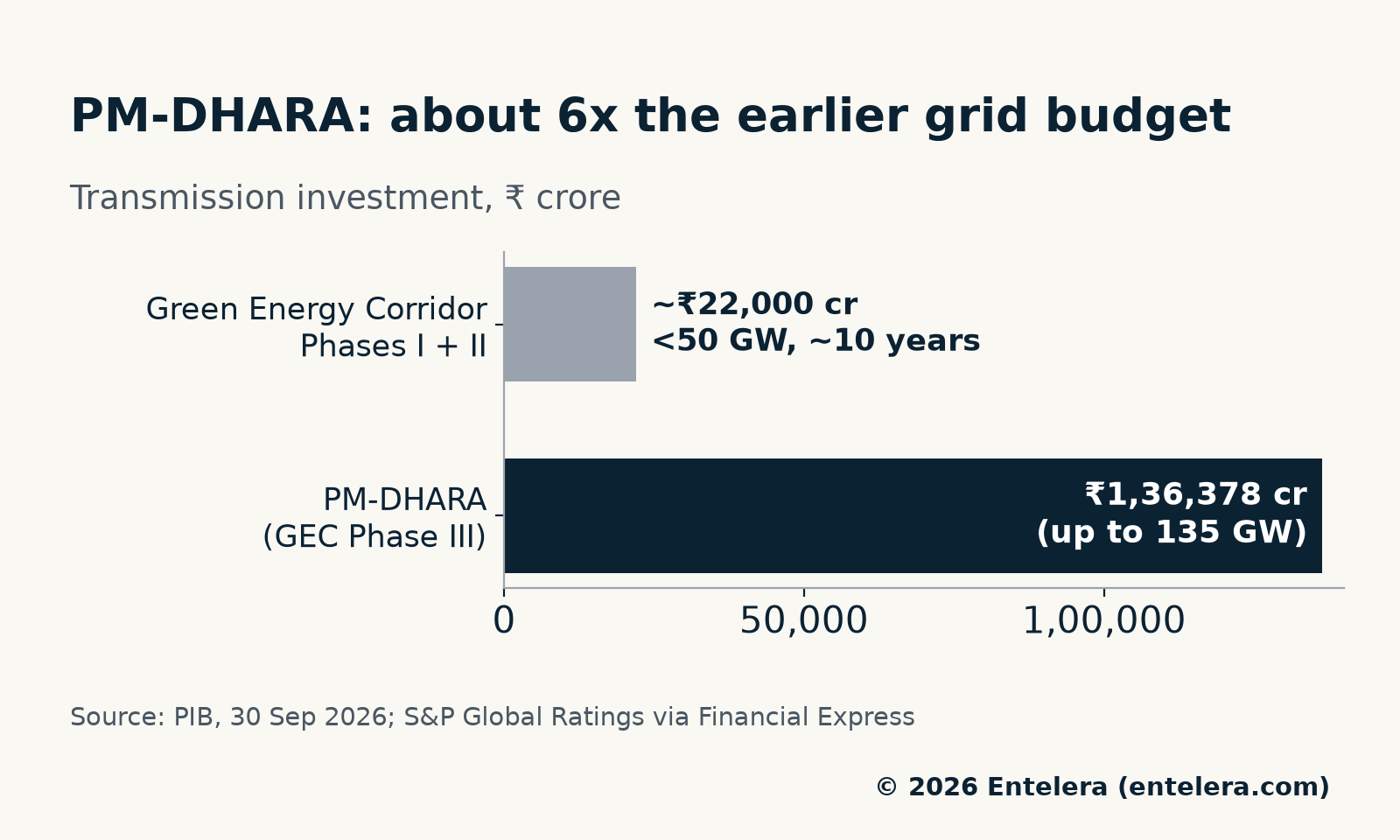
According to the Press Information Bureau, PM-DHARA has a total outlay of ₹1,86,405 crore (about ₹1.86 lakh crore). The release names two components:
- ₹1,36,378 crore for intra-state transmission systems, to evacuate up to 135 GW of renewable energy
- ₹50,000 crore for 50 GWh of battery energy storage systems
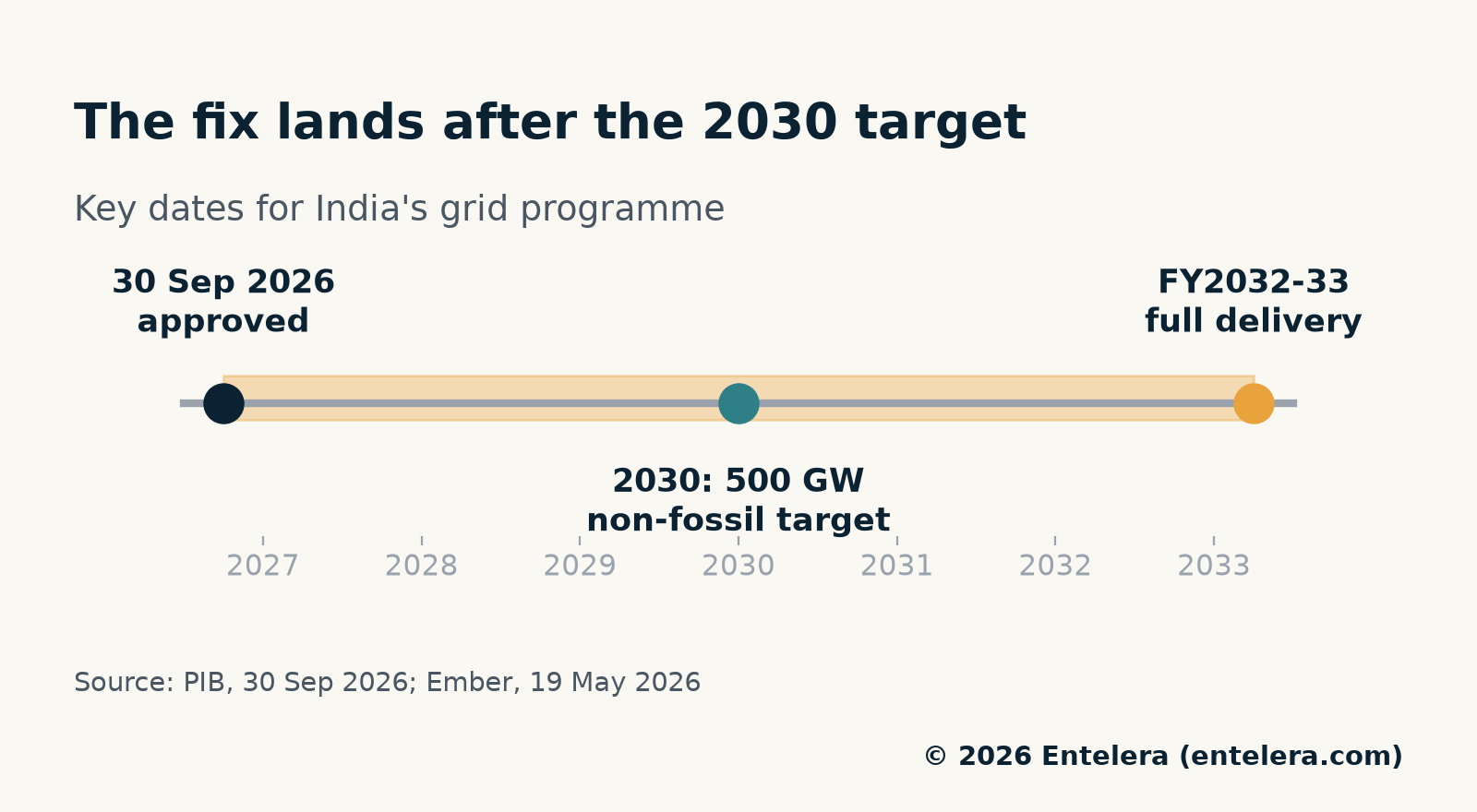
Together, these two items add up to ₹1,86,378 crore, so the release leaves ₹27 crore of the total unexplained. In addition, the scheme carries central financial support of ₹54,082 crore. It targets completion by FY 2032-33.
The scale is significant. S&P says the first two phases of the Green Energy Corridor integrated less than 50 GW over about a decade. Together, the two phases also saw roughly ₹22,000 crore of transmission investment. That is about one-sixth of the transmission budget in the new plan.
Why PM-DHARA arrives too late for 2030
However, timing is the weakness. Full implementation lands after the 2030 goal of 500 GW of non-fossil capacity. S&P expects renewable additions to keep running ahead of grid connectivity until then. It said that “the planned new capacity and spending may not be enough to close the gap by 2030”.
S&P also cautioned that “it’s not only about funding”. For example, it cited right-of-way disputes and supply-chain disruptions. In addition, S&P sees the intra-state networks as the weaker link. Financially stretched state transmission companies run most of them.
Batteries are the bridge
By contrast with transmission, developers can commission a battery project in six to 18 months. As a result, batteries are the only grid-side tool that fits inside the 2030 window. In fact, Ember calls battery storage at pooling stations “the most credible near-term lever”.
Ember estimates that roughly 3-4 GW of two-hour storage would absorb most of the curtailed generation. At the same time, major pooling stations already offer 236 GW of battery connectivity headroom. So, on Ember’s figures, the technical pieces are in place. However, the remaining gap is regulatory and commercial, Ember says.
The economics are also attractive. For example, Ember estimates that stored solar can reach buyers at ₹7-8/kWh, including transmission charges. By contrast, many states face peak procurement costs of around ₹9-10/kWh. However, S&P adds a caution: aggressive tender pricing has already contributed to cancellations of storage projects.
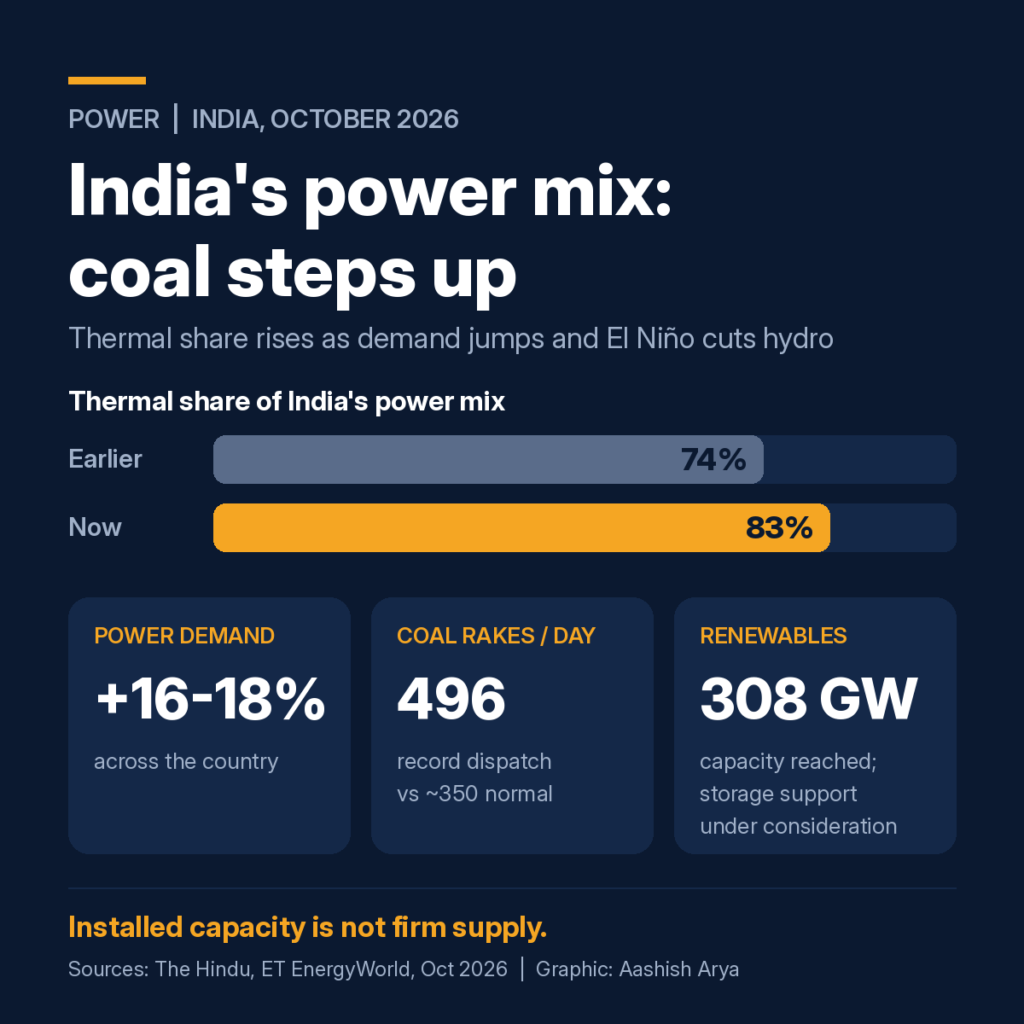
Evening supply is also a pressing issue in India. Our analysis of why coal’s share rose to 83% shows what happens when storage is missing.
Implications for developers, states and Britain
For developers in India: Grid connection now matters as much as the tariff. For instance, Ember estimates that a 6-12 month delay can cut a solar project’s internal rate of return by 100-200 basis points. In addition, plants connected under temporary network access earn no compensation when curtailed. Developers should therefore weigh site selection, connectivity status and co-located storage alongside bid prices.
For Indian states and discoms: The scheme’s money flows through state transmission utilities. So state execution capacity, not central funding, will decide how quickly the 135 GW of evacuation capacity becomes real.
For Great Britain and Europe: Balancing costs end up on household energy bills, according to The Guardian. Meanwhile, the National Energy System Operator (NESO) has named its single biggest opportunity to cut these costs. It is the timely delivery of new infrastructure by transmission owners. In fact, NESO says this could halve balancing costs by the end of the decade. Yet Great Britain’s £150bn networks upgrade is not keeping pace with new renewable connections, The Guardian reports.
For investors: Value is shifting towards anything that relieves congestion quickly. That includes storage and grid-enhancing technologies, as well as the supply chains for transmission equipment. Ember notes that dynamic line rating and reconductoring can raise the transfer capacity of existing lines by 25-50% or more. Often, these upgrades take only one to three years.
What to watch next on PM-DHARA
- Tendering by state transmission utilities, and how quickly the first awards arrive.
- Regulatory changes in India that would let utilities procure storage as a transmission asset, as Ember proposes.
- Curtailment data for later quarters, to see whether Q1 2026 was a peak or the start of a trend.
- Monthly balancing costs in Great Britain through the winter, against the £3.2bn forward estimate.
- Battery tender outcomes, given S&P’s warning about unviable pricing.
The transition’s next constraint is not generation but delivery. Countries that connect plants as fast as they build them will capture the full value of their renewables.
Sources
- Press Information Bureau, “Cabinet approves Green Energy Corridor Phase-III scheme for Development of Intra-State Transmission System with Battery Energy Storage Systems”, 30 September 2026: pib.gov.in
- Ember, “Transmission gaps are beginning to constrain India’s rapid renewables integration”, 19 May 2026: ember-energy.org
- Financial Express, “India’s renewable energy paradox: More capacity, but not enough grid to deliver power” (on S&P Global Ratings’ 12 October report), 17 October 2026: financialexpress.com
- Financial Express, “Can Rs 1.86 lakh cr fix the grid? Infrastructure lag threatens India’s 2030 renewable goals”, 13 October 2026: financialexpress.com
- The Guardian, “Cost of balancing Great Britain’s power grid reaches nearly £50m a day”, 15 October 2026: theguardian.com