The Qatar LNG supply gap will last at least until the end of the year. QatarEnergy has extended force majeure on deliveries to Italy’s Edison and to buyers in Pakistan and Bangladesh to the end of December 2026, Reuters reported on 28 October 2026. India’s Petronet LNG also faces force majeure for November 2026.
This analysis estimates how many cargoes are missing, who is likely to fill the gap and what it means for prices.
How big is the Qatar LNG supply gap?
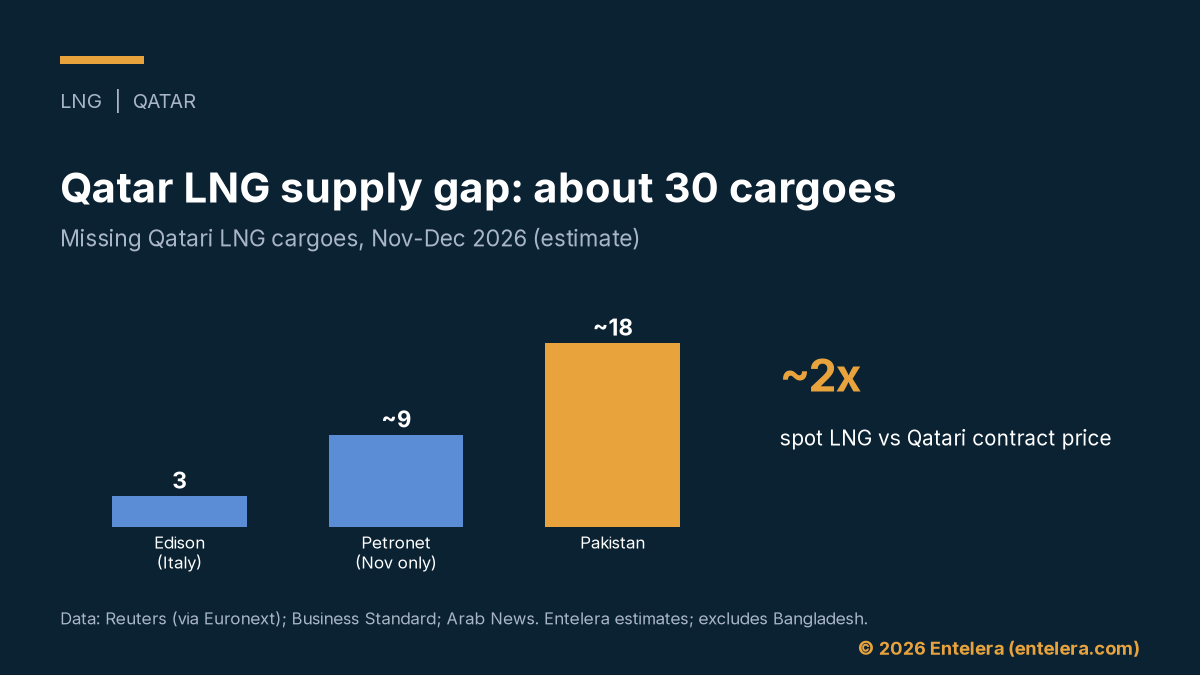
Pakistan normally receives about nine Qatari cargoes a month under long-term government-to-government deals. Petronet holds a contract for 7.5mtpa at its Dahej terminal. By August 2026, the force majeure had hit 56 of its cargoes, or roughly nine a month. Meanwhile, Edison said three more of its cargoes will not arrive.
Put together, the Qatar LNG supply gap is about 30 cargoes in November and December 2026, on our estimate. That is around 18 for Pakistan, nine for Petronet in November 2026 and three for Edison. Bangladesh comes on top, but Petrobangla has not given a figure. Moreover, Edison’s contract alone is 6.4bcm a year, about 10% of Italy’s gas use.
Who replaces the cargoes
Qatar cannot close the Qatar LNG supply gap soon. Its cargoes must pass through the Strait of Hormuz. In addition, QatarEnergy said Iranian strikes on Ras Laffan cut its LNG production by 17%, with repairs taking up to five years, Al Jazeera reported. Its new deals to buy up to 4mtpa of US LNG from Cheniere start only in 2031.
Therefore, the replacement gas comes from the spot market and from suppliers outside the Gulf. Petronet said Indian buyers are importing from the US, Oman and Nigeria. Pakistan’s winter plan foresees 12 Qatari cargoes and 10 spot cargoes from November 2026 to February 2027, at a cost of more than $1bn. However, the Qatari part of that plan now looks unlikely before January 2027.
What the Qatar LNG supply gap means for prices
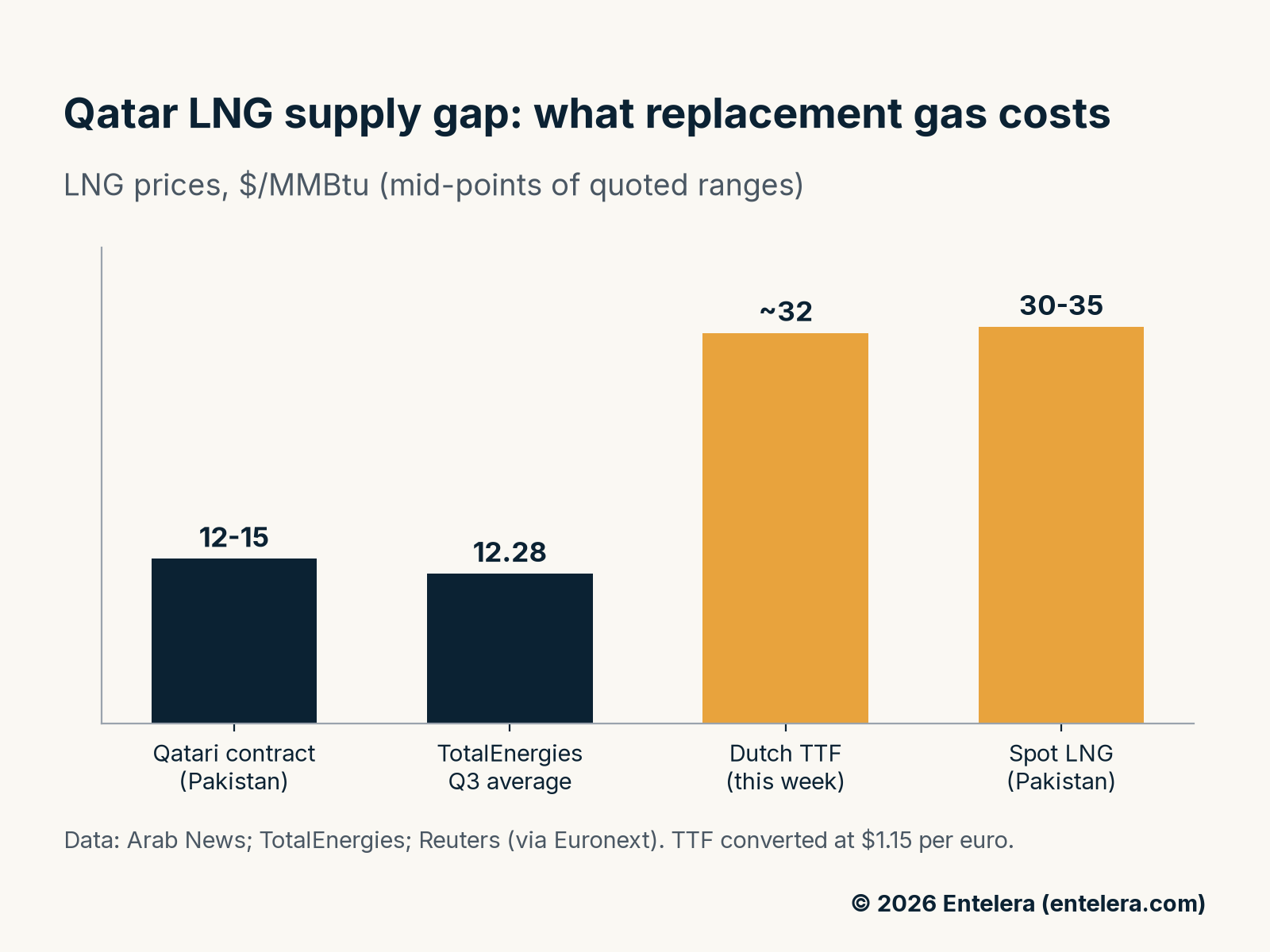
The cost gap is large. A Pakistani official put spot LNG at $30-35/MMBtu, against $12-15/MMBtu under the Qatari contract. That makes a spot cargo $80-100mn, against up to $50mn for a contract cargo. If all 30 cargoes were replaced at those prices, buyers would pay roughly $0.9-1.5bn more, on our estimate.
Europe sets the bar. The Dutch TTF benchmark rose above €95/MWh this week, or about $32/MMBtu at $1.15 per euro. That is close to its highest since December 2022. By contrast, TotalEnergies’ average LNG price was $12.28/MMBtu in the third quarter of 2026. This shows how far spot gas has moved above contract levels.
In our view, South Asia will lose the contest to fill the Qatar LNG supply gap. Europe can pay $30/MMBtu or more, while Pakistan and Bangladesh largely cannot. As a result, they are more likely to cut gas to power plants and industry than to outbid Europe. Indeed, Petrobangla says spot buying is putting “considerable pressure” on its finances. For Europe’s side, see our analysis of EU gas storage.
What to watch next
- QatarEnergy’s notices for January 2027, which would push the shortfall into peak winter.
- Petronet’s December 2026 allocation, usually notified at the end of the month before.
- TTF and Asian spot prices, and whether South Asian buyers step back.
For the news, read our report on the force majeure extension.
Sources
- Reuters via Euronext Live, Edison, South Asian gas buyers face QatarEnergy supply halt until year-end, 28 October 2026: live.euronext.com
- insigtX, Sources: Qatar Extends Force Majeure on Petronet LNG Cargoes to November, 28 October 2026: insigtx.com
- Business Standard, Petronet LNG awaits clarity on Sep Qatar cargoes amid shipping disruption, 13 August 2026: business-standard.com
- Arab News, Islamabad seeks 24 LNG cargoes as Pakistan braces for winter shortages, 13 October 2026: arabnews.pk
- Al Jazeera, How war on Iran turned Pakistan’s LNG surplus into a looming shortage, 3 April 2026: aljazeera.com
- Qatar News Agency, QatarEnergy Signs Long-Term Agreements to Purchase 4 MTPA of U.S. LNG, 22 October 2026: qna.org.qa
- TotalEnergies, Third Quarter 2026: Main Indicators, October 2026: vfb.be