Brent crude settled at $117.64 a barrel on 30 October 2026, its highest close since April 2026. The trigger was a limpet mine attack on a tanker near Khasab, Oman, late on 29 October 2026. Yet futures show only part of the damage. For many buyers, Hormuz shipping costs now matter almost as much as the oil itself.
This analysis looks at what the attack changes for freight and war-risk insurance, and why those costs may outlast any fall in Brent.
A new kind of threat to tankers in the strait
The attack used a cheap, old tactic. A small boat drew alongside the outbound tanker Louise 1 and fixed two explosive devices to its hull, UKMTO and maritime security sources said. The blasts started an engine-room fire, but the crew was safe. It was the first successful limpet mine strike in the strait since the war began in February 2026.
That matters because escorts and mine clearance do not stop it. Risk firm Marisks called the method “cheap, low tech and very efficient”. In addition, EOS Risk Group warned that ships waiting at anchor are most exposed.
How much Hormuz shipping costs add to a barrel
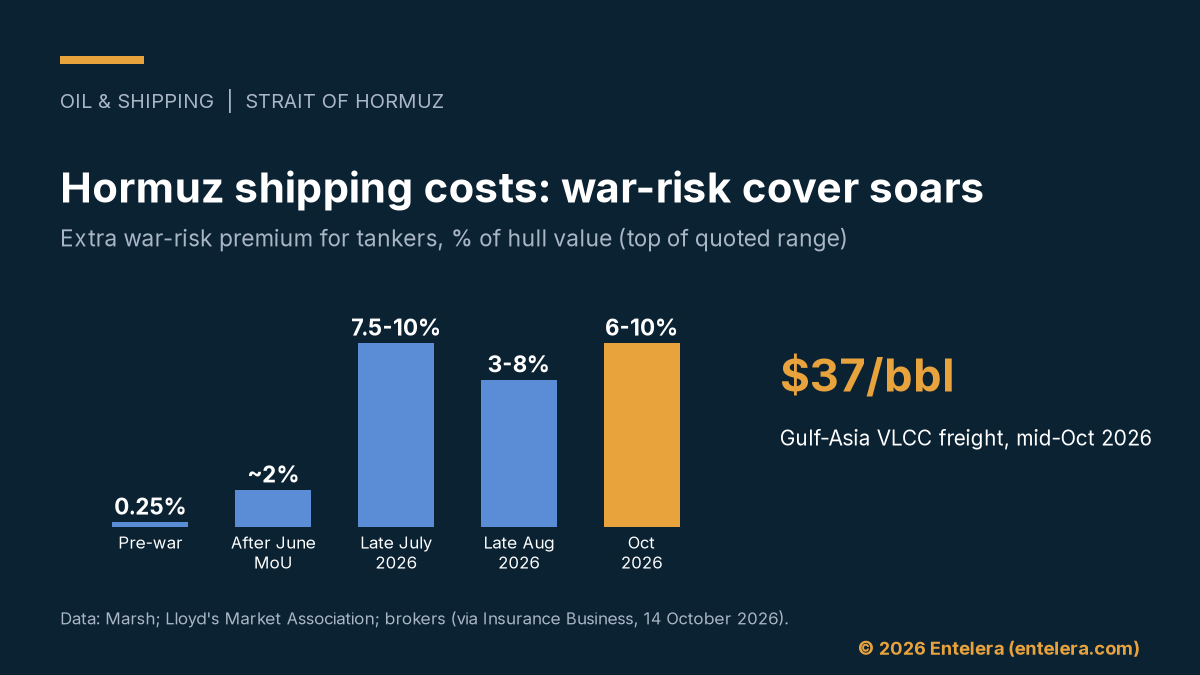
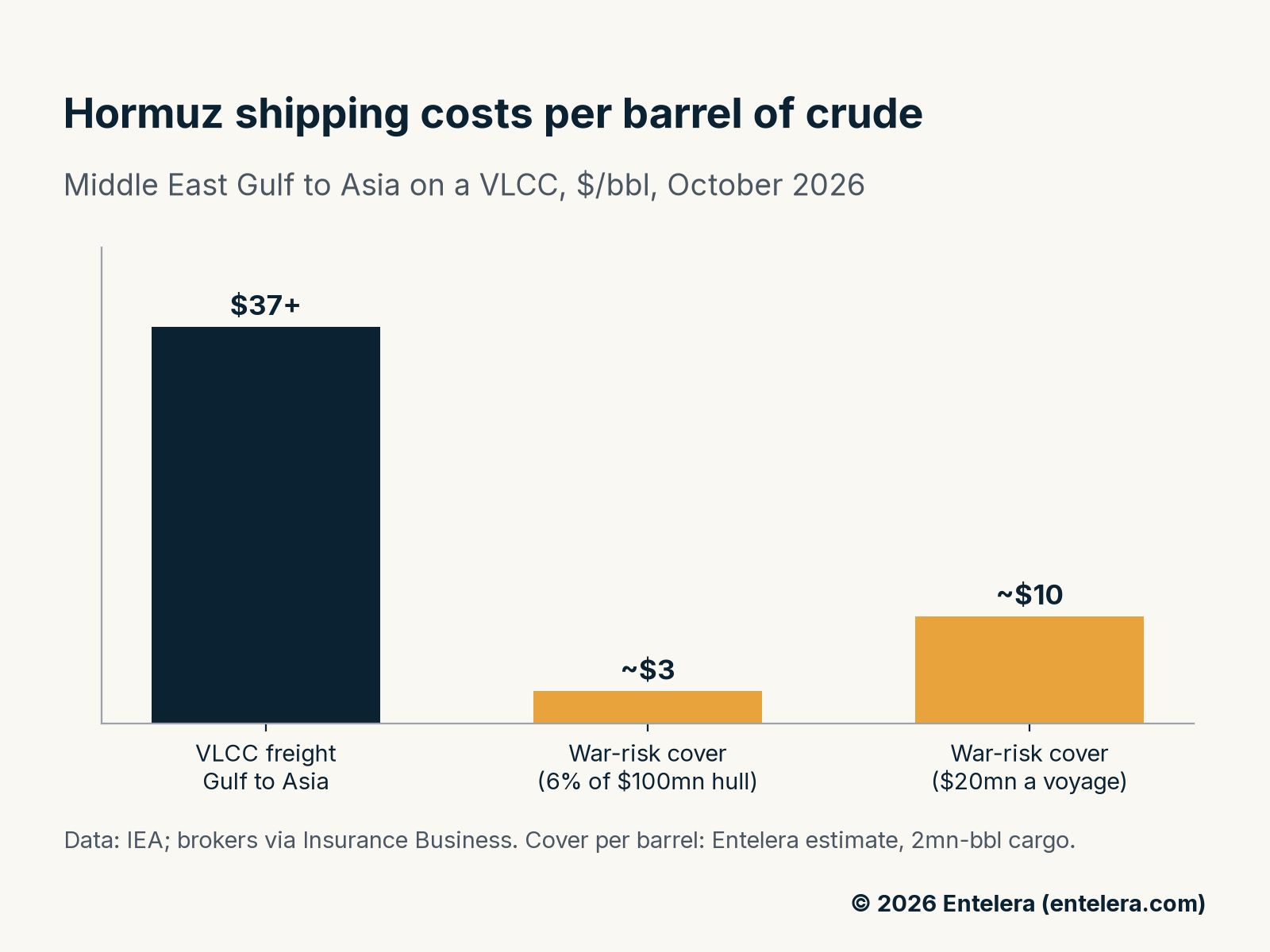
Freight was already at records before the attack. By mid-October 2026, shipping crude from the Middle East Gulf to Asia on a very large crude carrier (VLCC) cost over $37 a barrel, the IEA said. That is more than five times the pre-war level.
War-risk insurance comes on top. Brokers put the extra premium for tankers at 6% to 10% of hull value per voyage in October 2026, against ~0.25% before the war. That can reach $20mn for one supertanker voyage. Assuming a $100mn hull and a 2mn-barrel cargo, cover adds ~$3 a barrel at the low end and up to $10 at $20mn, on our estimate. Together, therefore, Hormuz shipping costs can exceed $40 a barrel on the Asia route.
Premiums have tracked each new threat. They eased to ~2% after the US-Iran memorandum in June 2026, then jumped to 7.5-10% by late July 2026. In our view, the first successful limpet mine strike gives underwriters a reason to stay near the top of the range.
What the attack means for supply and price
Fewer ships are willing to pay. Crude exports through Hormuz averaged ~8.5mmbbl/d in the week to 12 October 2026, nearly 40% below pre-war levels, according to Kpler data. On 4 October 2026, Windward counted just 13 vessels crossing, against ~135 a day before the war.
As a result, the physical market is tighter than futures suggest. In mid-October 2026, the IEA said North Sea Dated crude traded ~$134 a barrel, against ~$107 for Brent futures. Higher delivered costs also pushed margins negative for Asian refiners running Middle East crude in September 2026.
Why Hormuz shipping costs may outlast a ceasefire
A peace deal could cut Brent quickly, and Qatari mediators returned to Tehran on 30 October 2026. However, insurers move more slowly. The Joint War Committee still lists the entire Persian Gulf as a high-risk area. It wants sustained incident-free passage and verified demining before it changes that, and limpet mines make both harder to prove.
Therefore, we expect Hormuz shipping costs to stay high for longer than the futures price. Saxo Bank already sees crude at $70-90 a barrel after the conflict, against $60-70 before it. For the bypass routes, see our analysis of the East-West pipeline. For the futures side, see how much of Brent is risk premium.
What to watch next
- War-risk quotes after the Louise 1 attack, and whether brokers move to the top of the 6-10% range.
- Daily transits through the strait, and any attacks on ships waiting at anchor.
- The US midterm elections on 3 November 2026, and any US action against Iran afterwards.
For the news, read our report on Brent crude at a six-month high.
Sources
- Reuters via Euronext Live, Oil jumps 2%, settles at 6-month highs on fears of escalation in Iran, 30 October 2026: live.euronext.com
- Reuters via gCaptain, Tanker in Strait of Hormuz hit by limpet mines, security sources say, 30 October 2026: gcaptain.com
- gCaptain, Tanker hit by limpet mines in Strait of Hormuz as new threat to shipping emerges, 30 October 2026: gcaptain.com
- Insurance Business, Hormuz sinking hands marine war underwriters another total loss as attacks surge, 14 October 2026: insurancebusinessmag.com
- IEA, The soaring cost of shipping is lifting the price of oil for consumers, 21 October 2026: iea.org
- IEA, Oil Market Report, October 2026: iea.org