OPEC+ Quotas: Why Iraq’s Capacity Fight Matters for Brent and Basrah Crude
OPEC+ quotas for 2027 hinge on a capacity number Iraq rejects. What the row means for Brent, the curve and Basrah discounts before the 29 November meeting.
OPEC+ quotas for 2027 now hinge on a number that Iraq refuses to accept. Baghdad has rejected a consultants’ review that puts its maximum sustainable capacity below 5 mmbbl/d, Bloomberg reported on 24 November 2026. Instead, oil minister Basim Mohammed Khudair wrote to OPEC to claim 5.2 mmbbl/d. Our news story on the Iraq OPEC capacity row set out the dispute. Here we look at what it means for Brent, the curve and Basrah barrels before ministers meet online on 29 November 2026.
Why capacity now drives OPEC+ quotas
This year, for the first time, OPEC+ hired outside consultants to measure each member’s capacity. DeGolyer and MacNaughton assessed most countries, while India’s Shri Chandra Energy & Data Processing covered Russia and Venezuela, Reuters reported. The group then plans to use the results to calibrate 2027 targets. So a higher assessed figure gives a member a stronger claim to a bigger share.
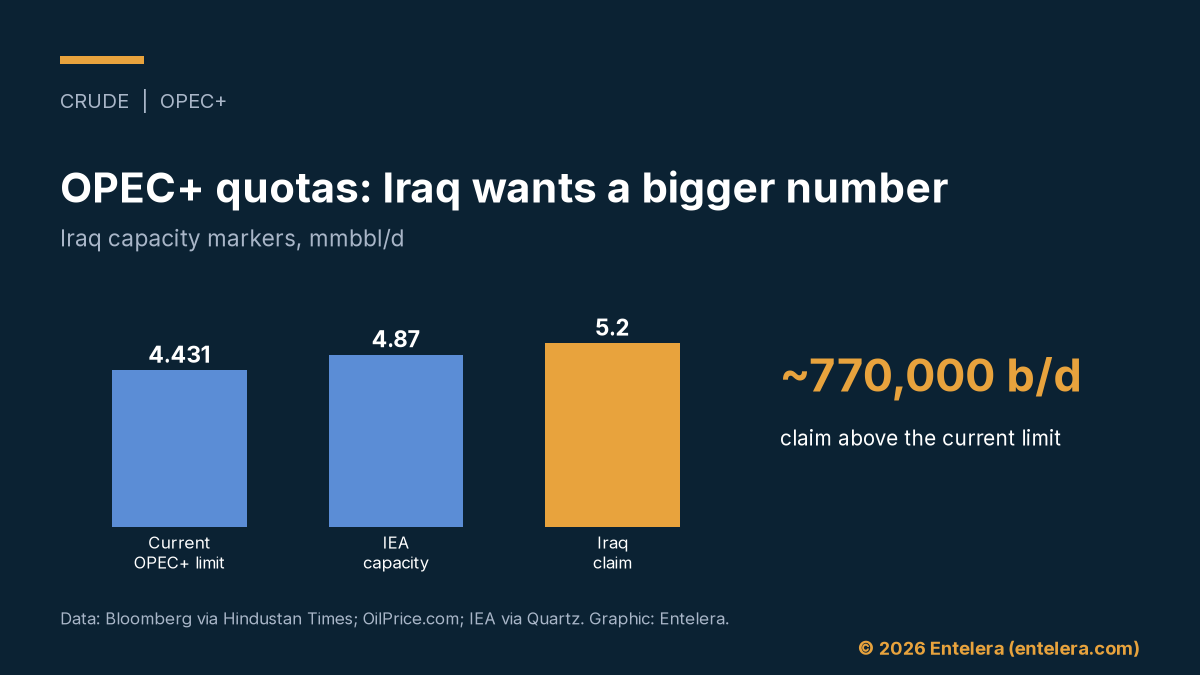
Iraq’s current limit is 4.431 mmbbl/d. Its 5.2 mmbbl/d claim therefore sits about 770,000 b/d above that level. By contrast, the IEA puts Iraq’s sustainable capacity at 4.87 mmbbl/d. OilPrice.com even reported that Baghdad wants recognition of around 6 mmbbl/d.
Three numbers for the same barrels
The output data are just as contested. Iraq told OPEC it pumped 4.888 mmbbl/d in October 2026, a wartime high. However, OPEC’s secondary sources put the figure at 4.491 mmbbl/d, almost 400,000 b/d lower. The IEA, for its part, estimated 4.6 mmbbl/d, the highest since September 2019.
Even the lowest estimate sits about 60,000 b/d above quota. In our view, that is the real test for Sunday. A target below what Iraq already pumps only works if Baghdad actually cuts. Also, Iraq threatened earlier this year to quit OPEC, then withdrew the warning. Since the UAE left the group, it has lifted output to records.
What OPEC+ quotas mean for Brent and the curve
The flat price is already fragile. Brent settled at $91.40 a barrel on 24 November 2026, up $2.03, after an intraday low of $88.10. WTI settled at $82.05. Then on 25 November 2026, Brent slipped $1.35 to $90.05 by 04:10 GMT. LSEG’s Zhenqiang Seto pointed to uncertainty over OPEC’s 2027 policies, the UAE’s freedom from OPEC+ limits and Iraq’s capacity push.
Supply forecasts add weight. JPMorgan expects a 1.6 mmbbl/d surplus in 2027, with Brent averaging $72. Yet Brent’s January-December 2027 spread still held at about $14 on 23-24 November 2026, Oil Curve Tracker data show. As our oil surplus analysis argued, the surplus sits in the flat price more than in the curve. Loose OPEC+ quotas would test that split.
Basrah barrels already price in a fight
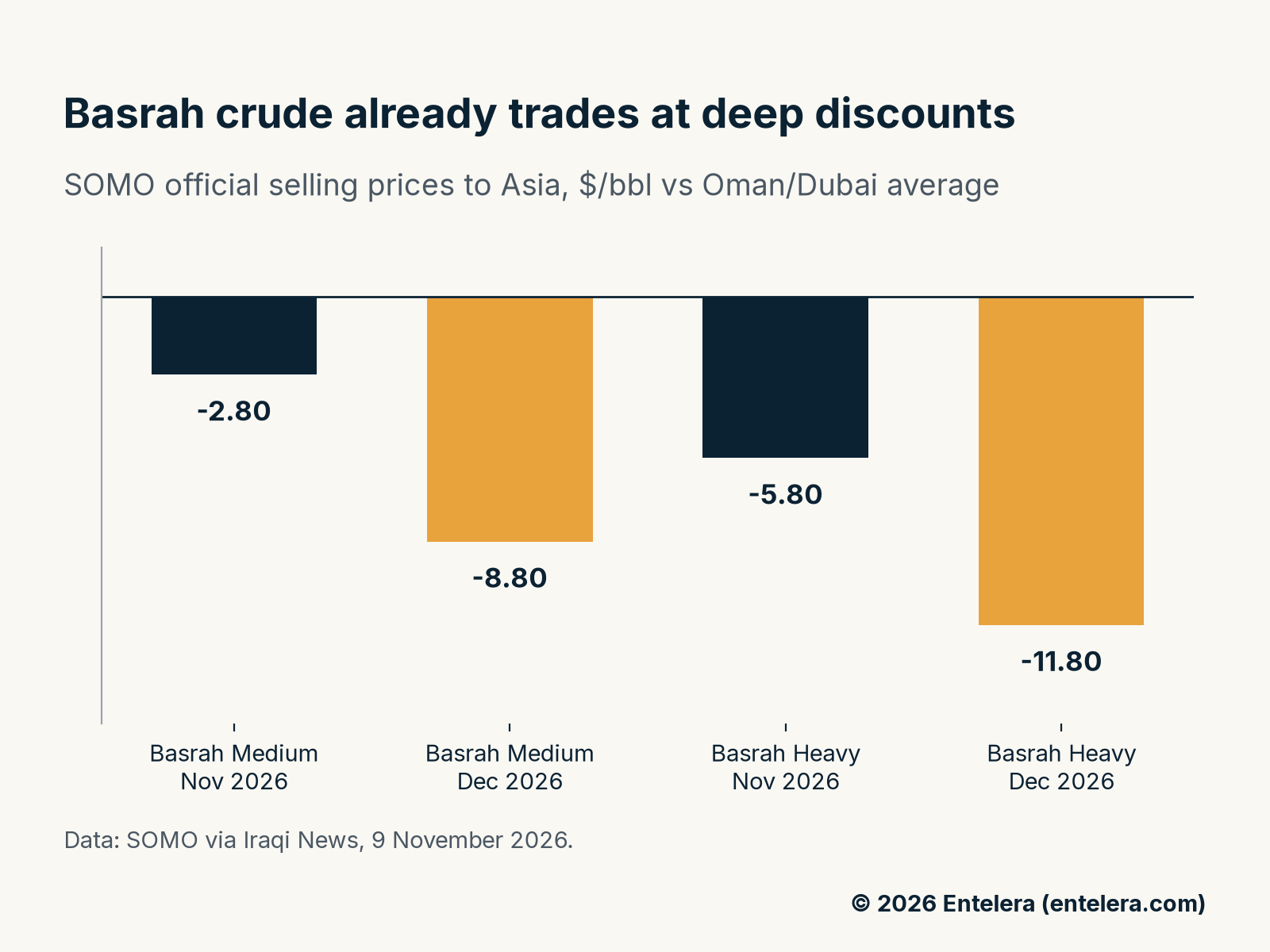
Physical prices tell the same story. SOMO cut its December 2026 Basrah Medium price to Asia by $6, to $8.80 below Oman/Dubai, Iraqi News reported. It also set Basrah Heavy at -$11.80, from -$5.80 for November. Those discounts sit beside the deep Gulf cuts in our Qatar crude OSP analysis.
Northern turmoil adds a second layer. Prime Minister Ali al-Zaidi has also ordered federal control of oilfields in Kurdish-held areas, as our Kurdistan oilfields analysis explains.
What OPEC+ quotas mean for traders, portfolio players and buyers
Traders: a deal that lifts Iraq’s 2027 target would weigh on Basrah differentials and the back of the Brent curve. A firm ‘no’, however, risks a fresh exit threat and more headline risk in prompt spreads.
Spread traders: watch Dubai-linked grades against Brent. Deeper SOMO discounts already show Iraq competing for Asian demand on price.
Portfolio players: the precedent matters more than Iraq alone. If OPEC+ grants Baghdad’s figure, other members could press similar claims. That fits our view of a heavy OPEC+ supply overhang.
Buyers: Asian refiners hold the leverage in early 2027 term talks while Basrah Medium sits at -$8.80. Still, a real Iraqi cut could narrow those discounts quickly.
What to watch next
The 29 November 2026 meeting, and whether ministers adopt the consultants’ figures unchanged.
Iraq’s response if OPEC+ rejects its 5.2 mmbbl/d claim.
SOMO’s January 2027 OSPs, due in early December 2026.
Finally, Iraqi export loadings in late November and December 2026.
Sources
Hindustan Times (Bloomberg), Iraq rejects OPEC review that puts oil production capacity below 5 million barrels a day, 25 November 2026: hindustantimes.com
Quartz, Iraq is challenging OPEC+’s assessment of its oil production capacity, 24 November 2026: qz.com
OilPrice.com, Iraq Refuses to Accept OPEC+ Assessment of its Production Capacity, 24 November 2026: oilprice.com
EnergyNow (Reuters), OPEC Officials Meet to Discuss Oil Production Capacity Review, 16 November 2026: energynow.com
Yahoo Finance (Reuters), Oil settles up $2 as traders weigh continued Hormuz ship attacks, 24 November 2026: finance.yahoo.com
StreetInsider (Reuters), Oil slips over 1% as supply glut prospect offsets Middle East disruption fears, 25 November 2026: streetinsider.com
Iraqi News, Iraqi oil price for Asian markets reduced by $6 per barrel, 9 November 2026: iraqinews.com
ENGIE EnergyScan, Brent Breaks $90 as Cold Snap Lifts European Gas and Power (JPMorgan forecast), 24 November 2026: energyscan.engie.com
Oil Curve Tracker, Brent and WTI futures curves and spreads, 23-24 November 2026: tbysmll.github.io
Free account
Sign up free to read the full analysis
Create a free Entelera account to read every analysis in full. It takes less than a minute; no payment details needed.
Entelera Research is the editorial team behind Entelera. We cover crude, LNG, power, renewables, policy and geopolitics, looking at energy the way companies have to: supply, demand, margins, policy and risk, with every number linked to its source and a close eye on India and its place in global markets.
Brazil oil supply climbs to a 2.9 mmbbl/d Petrobras plateau to 2031. What the $122bn plan means for crude differentials, diesel imports and 2027 balances.