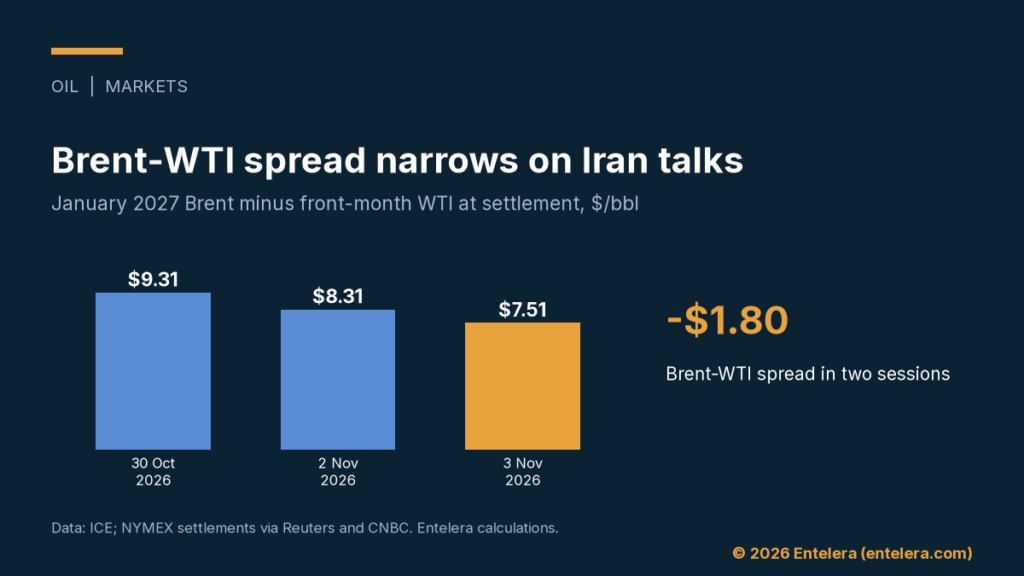
Talk of an oil supply overhang is back. On 1 November 2026, seven core OPEC+ members kept their December 2026 targets at ~31 mmbbl/d, unchanged since September 2026. A day later, Brent fell 7.6% on hopes of US-Iran talks. If the Strait of Hormuz reopens, the barrels now shut in could return fast. However, Aramco’s chief executive argues the world would soak them up.
This analysis compares the two numbers that will shape the oil curve in 2027.
How big the oil supply overhang is
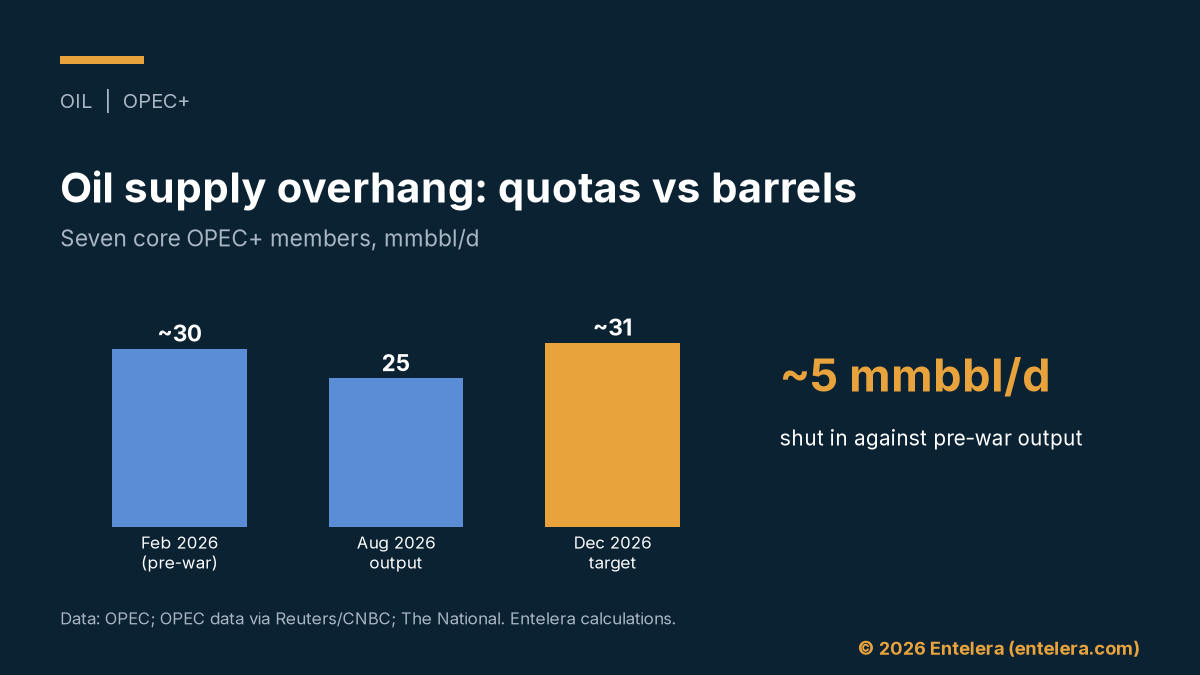
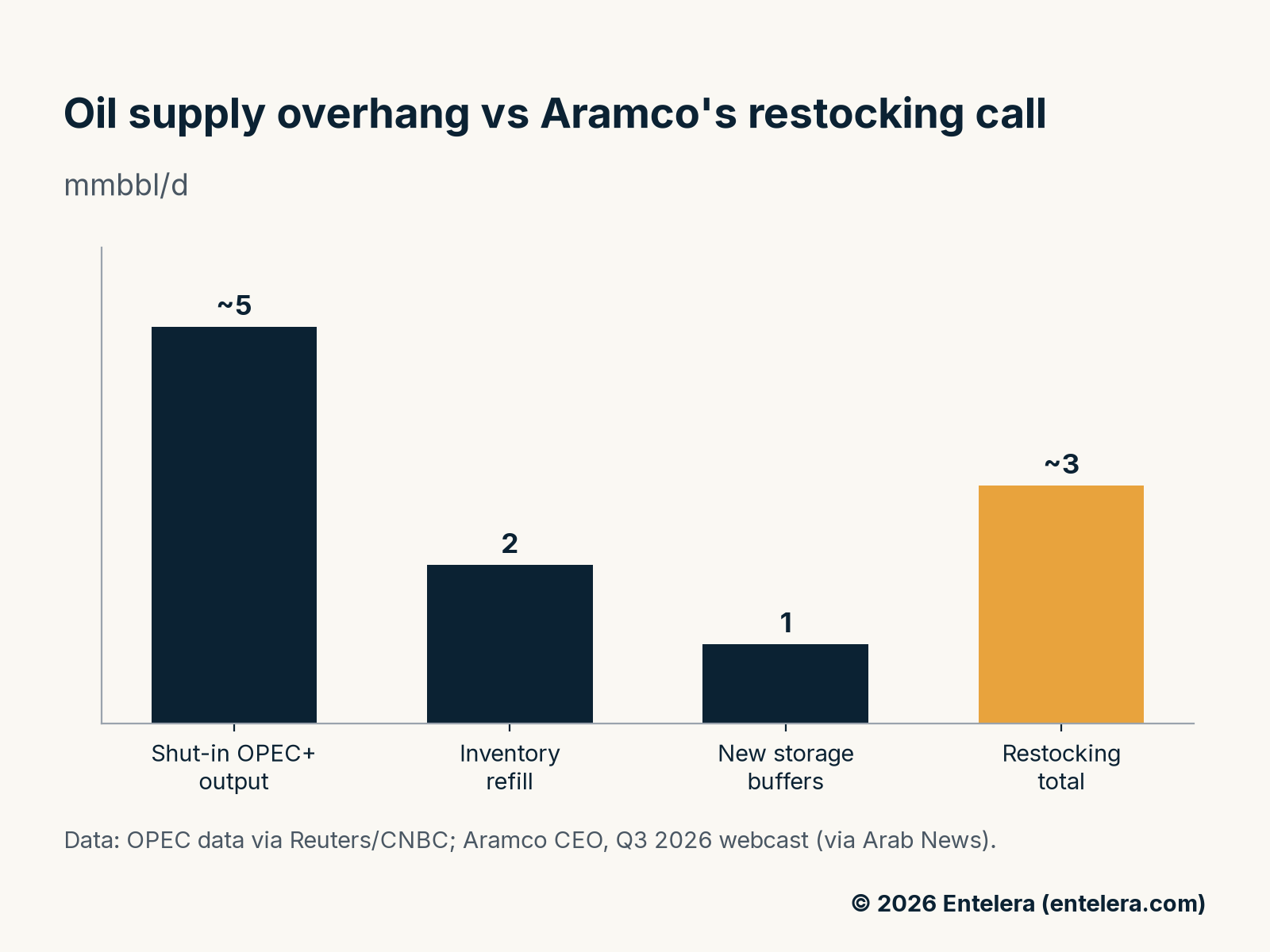
The quotas are mostly on paper. Saudi Arabia’s target is 10.478 mmbbl/d, Russia’s 9.949 mmbbl/d and Iraq’s 4.431 mmbbl/d. Together with Kuwait, Kazakhstan, Algeria and Oman, the seven add up to ~31 mmbbl/d. Yet they pumped 25 mmbbl/d in August 2026, according to OPEC data cited by Reuters. That was roughly 5 mmbbl/d below February 2026, before the war.
Gulf exports have also run at only 60% to 80% of normal. So, on our reading, ~5 mmbbl/d is the shut-in supply, and the gap to the targets is ~6 mmbbl/d. In addition, ~2 mmbbl/d of cuts agreed in 2022 stay in place until the end of 2026, while the war has delayed the capacity review for 2027 quotas.
Aramco’s restocking call
Aramco sees the other side. Even if markets returned to normal now, the world would need an extra 2 mmbbl/d for two years to rebuild stocks, CEO Amin Nasser said on 3 November 2026. A further 1 mmbbl/d could go into new storage as countries and companies build buffers. He also said refined-product stocks are alarmingly low, especially for diesel.
Logistics would slow any return, too. Nasser said more than 130 attacks had taken nearly 15% of the ~540-ship VLCC fleet out of use. With efficiency losses, effective fleet capacity is down by almost 40%. Meanwhile, Aramco is working on plans to lift East-West Pipeline capacity from 7 mmbbl/d to 10 mmbbl/d. For the risks on that route, read The East-West Pipeline: Why Saudi Arabia’s Hormuz Bypass Is Now the Market’s Weak Point.
What the oil supply overhang means for the curve
Put the two numbers side by side. Restocking of ~3 mmbbl/d would absorb most, but not all, of the ~5 mmbbl/d shut in, on our estimate. Moreover, OPEC+ would not need a new decision to add barrels, since output already sits ~6 mmbbl/d below target.
In our view, that points to a curve that flattens rather than flips. If Hormuz reopens, prompt spreads should ease first, since the urgent bid for barrels now would fade. By contrast, restocking demand would support prices further out. For buyers, diesel looks tighter than crude, so middle-distillate cracks may stay firm even if Brent falls.
What to watch next
- The OPEC+ meeting on 29 November 2026, for any signal on 2027 quotas and the 2022 cuts.
- Monthly OPEC production data, for signs that Gulf output is recovering.
- Tanker availability and Hormuz transits, which would set the pace of any return.
Sources
- OPEC, Press release, 1 November 2026: opec.org
- The National, Opec+ holds December oil output targets steady as Iran war disrupts supply, 1 November 2026: thenationalnews.com
- CNBC (Reuters), OPEC+ agrees to keep November oil output targets steady, 4 October 2026: cnbc.com
- Arab News, Aramco’s Q3 profit jumps 34.5% to $36.3bn, 3 November 2026: arabnews.com
- CNBC, Crude oil prices sell off more than 7% on Iran peace talk hopes ahead of U.S. midterms, 2 November 2026: cnbc.com