UK gas production is about to get a rare boost. On 21 October, the government agreed that the regulator could grant consent for the Jackdaw field in the North Sea. Adura, the Shell and Equinor joint venture, can now produce gas from as early as the end of this month. At its peak, the field should lift domestic output by ~6%, the government says.
That is welcome news for a basin in decline. Even so, the numbers show how far one field can go. This analysis sets Jackdaw against UK supply, demand and imports.
UK gas production is at a 50-year low
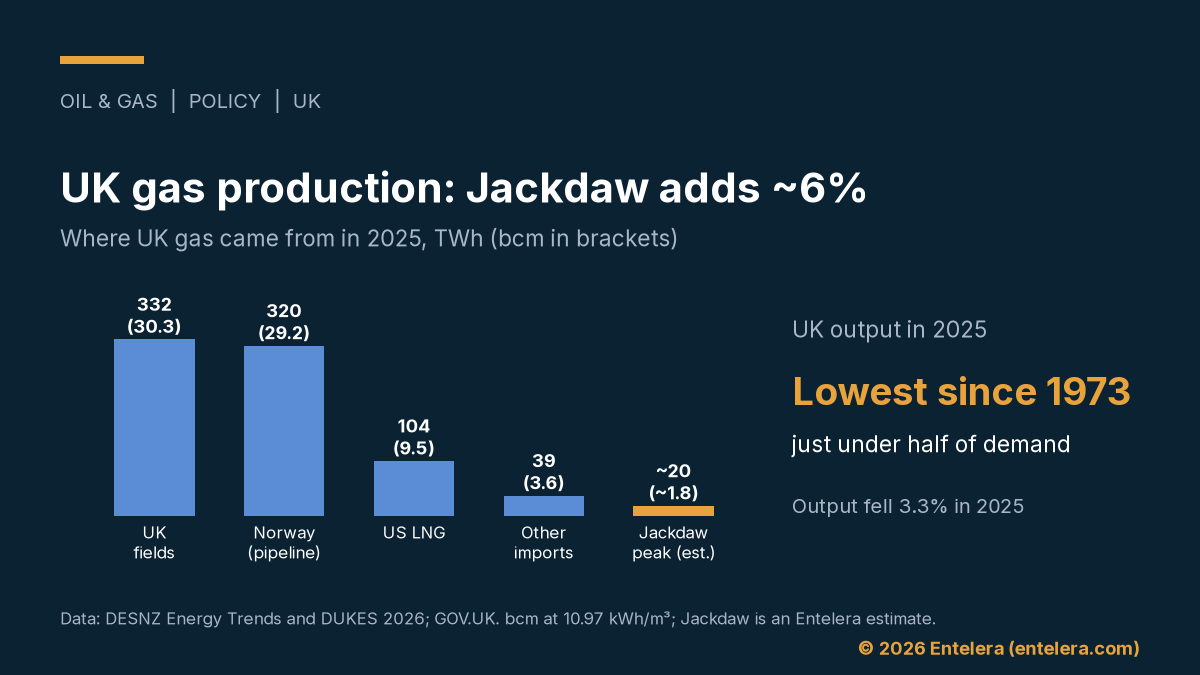
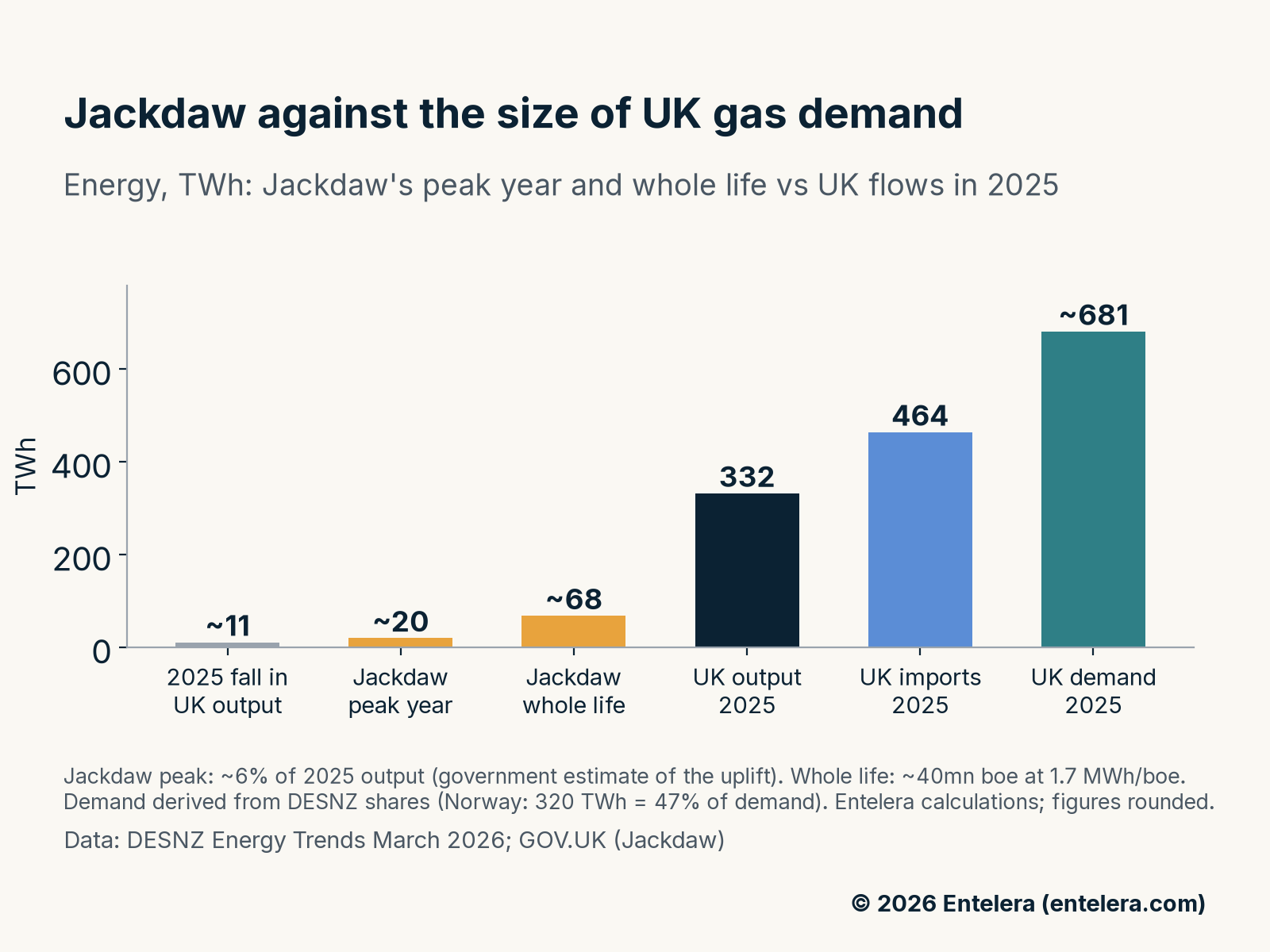
First, the starting point. UK gas production fell by 3.3% in 2025 to 332 TWh (~30.3 bcm), official data show. That was the lowest level since 1973. Output peaked in 2000, and the UK has been a net importer of gas since 2004. Still, production covered just under half of demand.
Imports filled the rest. In 2025, the UK imported 464 TWh (~42.3 bcm). Norway supplied 320 TWh by pipeline, ~70% of imports and 47% of demand. Meanwhile, US liquefied natural gas (LNG) supplied 104 TWh, or 15% of demand. The decline also sped up late in the year, as output fell 7.1% in the fourth quarter.
What Jackdaw adds to UK gas production
On the government’s figure, Jackdaw adds ~6% to domestic output at its peak. Based on 2025 levels of UK gas production, that is ~20 TWh (~1.8 bcm) a year, on our estimate. Over a life of up to 11 years, it should produce gas equal to ~40mn barrels of oil. At 1.7 MWh per barrel of oil equivalent, that is ~68 TWh (~6.2 bcm).
In other words, Jackdaw’s whole output equals ~10% of one year’s UK demand, or ~5 weeks of it. Its peak year would cover ~3% of demand. However, it would offset almost two years of decline at the 2025 rate, when output fell by ~11 TWh.
In addition, the field uses existing infrastructure, and its emissions intensity is well below the UK average, the North Sea Transition Authority said. The developer expects it to add ~£2.9bn ($3.9bn) to the UK economy, create 27 direct jobs and safeguard 273 more.
Why the approval took so long
Jackdaw first won consent in 2022. Then, in 2024, the Supreme Court ruled in the Finch case that environmental assessments must include emissions from burning the fuel produced. In January 2025, Scotland’s Court of Session quashed the Jackdaw and Rosebank consents on that basis. Work could continue, but no gas could flow until ministers decided again.
After the government issued new guidance, Adura submitted further information, which went through public notice. Energy Secretary Miatta Fahnbulleh then concluded that the project will not stop the UK from meeting its carbon limits. Consequently, the regulator granted consent on 21 October.
What falling UK gas production means for imports
For supply this winter, Jackdaw helps at the margin. However, the UK will still rely on Norway and LNG for more than half of its gas. LNG trades on a global market, and recent events in the Middle East have pushed up bills, the government said. So, in our view, the field improves security of supply more than it lowers prices.
Policy still points one way. The government will issue no new exploration licences. Instead, it plans Transitional Energy Certificates for tiebacks near licensed fields, and it has asked the regulator to consider urgent cases now. At the same time, a new Energy Wealth Fund will start with £2bn ($2.7bn) and reinvest North Sea tax revenue in low-carbon projects. For the wider European picture, see our analysis of EU gas storage.
What to watch next
- First gas from Jackdaw, due from the end of October, and how fast output ramps up.
- Quarterly UK gas data, to see whether Jackdaw slows the decline.
- Rosebank, whose consent the Court of Session quashed in the same ruling.
- Urgent tieback cases under the planned Transitional Energy Certificates.
- The Budget, for the design of the Energy Wealth Fund and North Sea taxes.
In short, Jackdaw matters, but mostly as a brake on decline. UK gas production will keep falling, and imports will keep filling most of the gap. For the approval itself, see our news report on Jackdaw.
Sources
- GOV.UK, Jackdaw gas field gets green light, 21 October 2026: gov.uk
- North Sea Transition Authority, NSTA grants consent for Jackdaw, 21 October 2026: nstauthority.co.uk
- DESNZ, Energy Trends March 2026, section 4: gas: assets.publishing.service.gov.uk
- DESNZ, Digest of UK Energy Statistics 2026, chapter 4: natural gas: assets.publishing.service.gov.uk
- Judiciary of Scotland, Petitions of Greenpeace Ltd and Uplift for judicial review (Jackdaw and Rosebank), 30 January 2025: judiciary.scot
- Dow Jones via Morningstar, Sterling gains 0.04% to $1.3399 (exchange rate used), 22 October 2026: morningstar.com