EU methane rules will not bite on LNG cargoes until 2029. On 19 November 2026, EU governments and the European Parliament agreed a two-year delay for oil, gas and coal importers, as our news story on the EU methane regulation delay reported. For traders, the deal removes a compliance risk from a market that already runs on US LNG.
What the deal changes
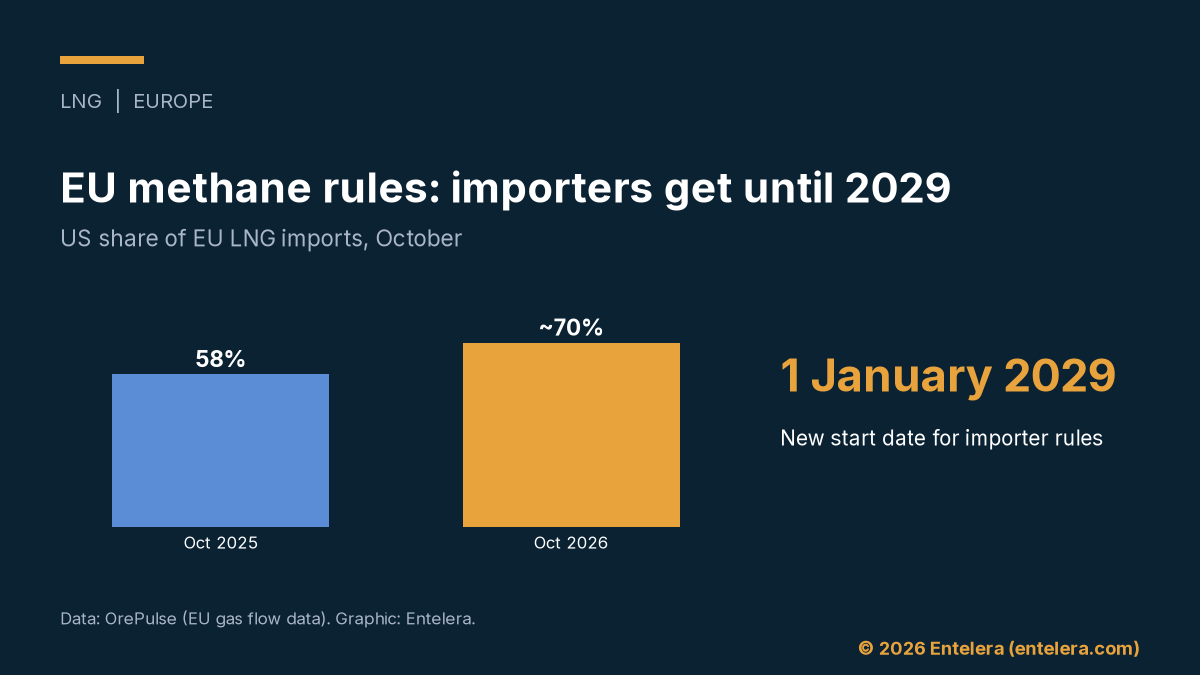
Importer rules now start on 1 January 2029 instead of 1 January 2027, EUobserver reported. In addition, methane intensity reporting moves to 5 August 2030. The Commission had proposed one year, while Parliament voted for three in October 2026.
Crucially, the text drops the option to extend again. Instead, the Commission will review the rules in early 2028, and any further delay would need a new law. Negotiators also dropped a plan to keep the rules for Russian imports, POLITICO reported. Since our first analysis of the delay in October 2026, that cliff-edge has now moved two years out.
EU methane rules and the US LNG share
Here is why the timing matters. The US shipped 5.98mn tonnes of LNG to the EU in October 2026, close to 70% of total imports, up from 58% a year earlier, OrePulse data show. Meanwhile, Qatar has sent no LNG to the EU since May 2026.
Moreover, US LNG now covers around 30% of total EU gas supply, ACER said. Yet many US suppliers do not yet track methane to EU standards, as our news story noted. So the 2027 start date risked squeezing the one source Europe cannot replace this winter.
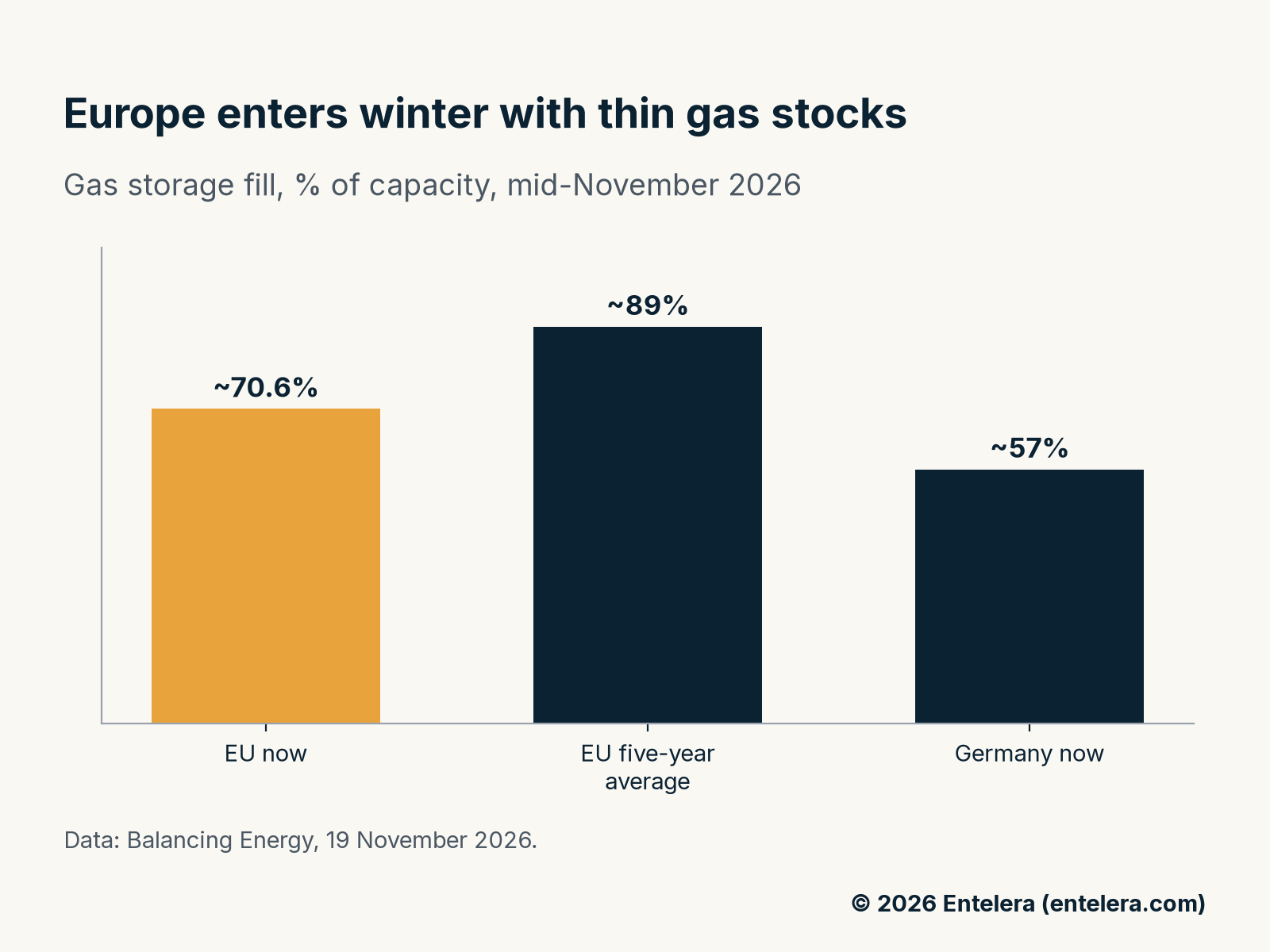
The balance looks thin. EU storage stood at about 70.6% in mid-November 2026, against a five-year average of roughly 89%, Balancing Energy said. Germany was at about 57%. In addition, the EU ban on Russian LNG takes full effect in January 2027.
As a result, TTF traded at €84.45/MWh (~$27.18/MMBtu) on 20 November 2026, against Henry Hub at $3.23, LNG Insights data show. The derived US Gulf netback to Europe was ~$24.78/MMBtu, against a full FOB cost of ~$6.72. That margin keeps US cargoes flowing east across the Atlantic.
By contrast, the cost of compliance is small. Rystad Energy put it at a few euro cents per MMBtu, about 0.3% of the gas price. In other words, the delay is about paperwork risk, not price.
What EU methane rules mean for traders, portfolio players and buyers
Traders: 2027 and 2028 cargoes into Europe no longer face a methane compliance risk. That removes one reason to divert US LNG to Asia, where JKM sits close to TTF.
Portfolio players: the 2029 date is now firm. Sellers that build measurement and verification early can market certified low-methane LNG into Europe at a premium later.
Buyers: European term buyers should write methane reporting clauses into new contracts now. A review in early 2028 leaves little time before the rules apply.
Risk managers: ENTSOG sees EU storage at 13% by end-March 2027 if LNG supply to Europe falls 20%, against 29% in the better case. Winter TTF still carries that risk.
What to watch next
The Parliament vote next week, and member states’ sign-off before year-end.
EU storage withdrawals as colder weather arrives from around 20 November 2026.
The US share of EU LNG imports for November 2026.
The Commission’s early-2028 review, the next test for EU methane rules.
Sources
EUobserver, EU gives oil and gas importers until 2029 on methane checks, rules out more delay, 19 November 2026: euobserver.com
POLITICO Europe, EU extends delay of key methane rules to two years after US pressure, 19 November 2026: politico.eu
OrePulse, Algeria overtakes Russia as EU’s No. 2 LNG supplier in October, 16 November 2026: orepulse.com
ACER, Key developments in European gas wholesale markets: summer 2026, 2026: acer.europa.eu
Balancing Energy, TTF rises 0.8% as colder forecasts and Hormuz risk offset LNG supply, 19 November 2026: balancing.energy
LNG Insights, LNG benchmark pricing, 20 November 2026: lnginsights.com
Free account
Sign up free to read the full analysis
Create a free Entelera account to read every analysis in full. It takes less than a minute; no payment details needed.
Entelera Research is the editorial team behind Entelera. We cover crude, LNG, power, renewables, policy and geopolitics, looking at energy the way companies have to: supply, demand, margins, policy and risk, with every number linked to its source and a close eye on India and its place in global markets.
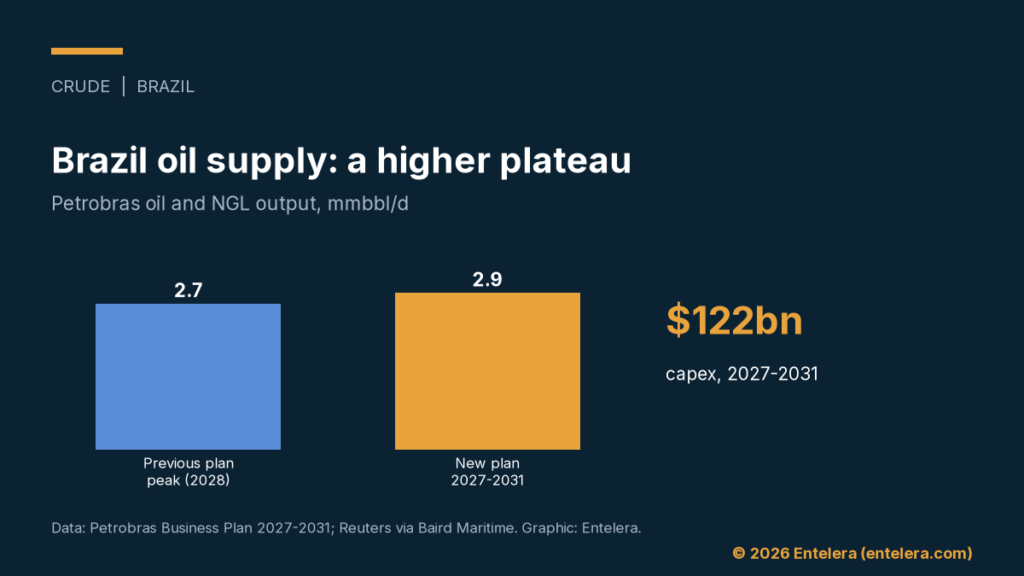
Brazil oil supply climbs to a 2.9 mmbbl/d Petrobras plateau to 2031. What the $122bn plan means for crude differentials, diesel imports and 2027 balances.