The EU methane regulation is about to get a one-year delay. On 20 October, the European Parliament agreed to fast-track the Commission’s proposal by urgency procedure. MEPs vote on the text at midday on Thursday 22 October. After that, the Council must also agree.
The Commission describes this as a one-year postponement. However, the legal text does a little more than that. In our reading, it means that cargoes delivered in 2027 never face the first importer test. This analysis explains what moves, what stays and who gains, above all US LNG exporters.
What the EU methane regulation requires today
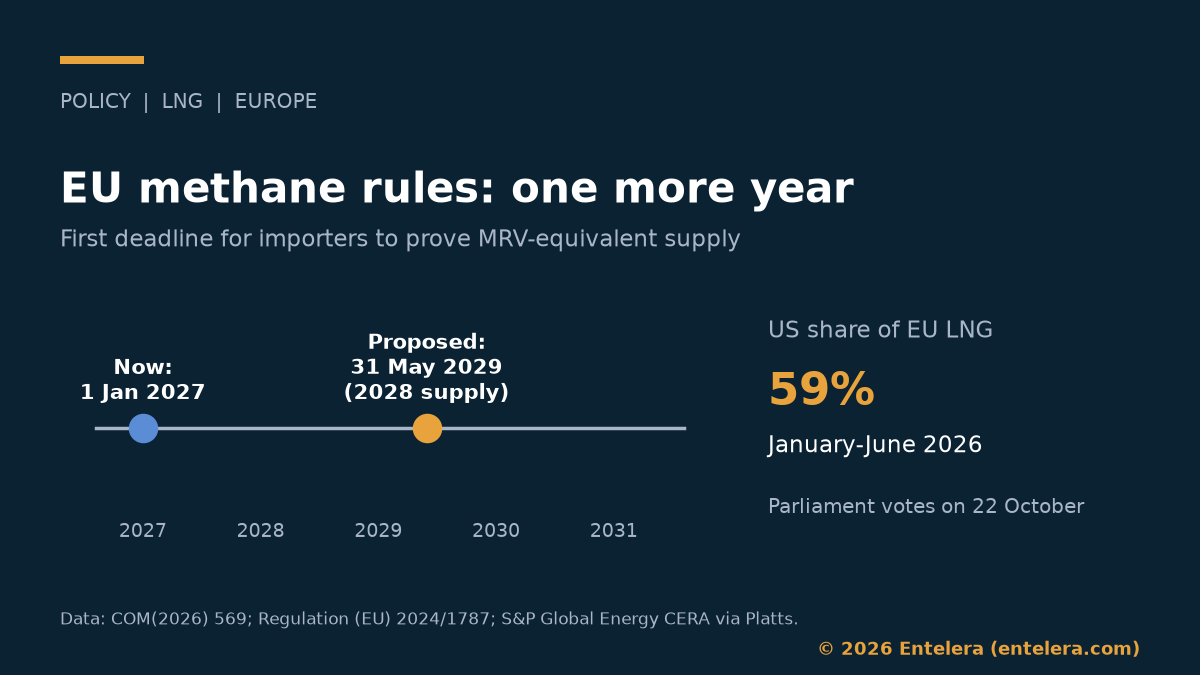
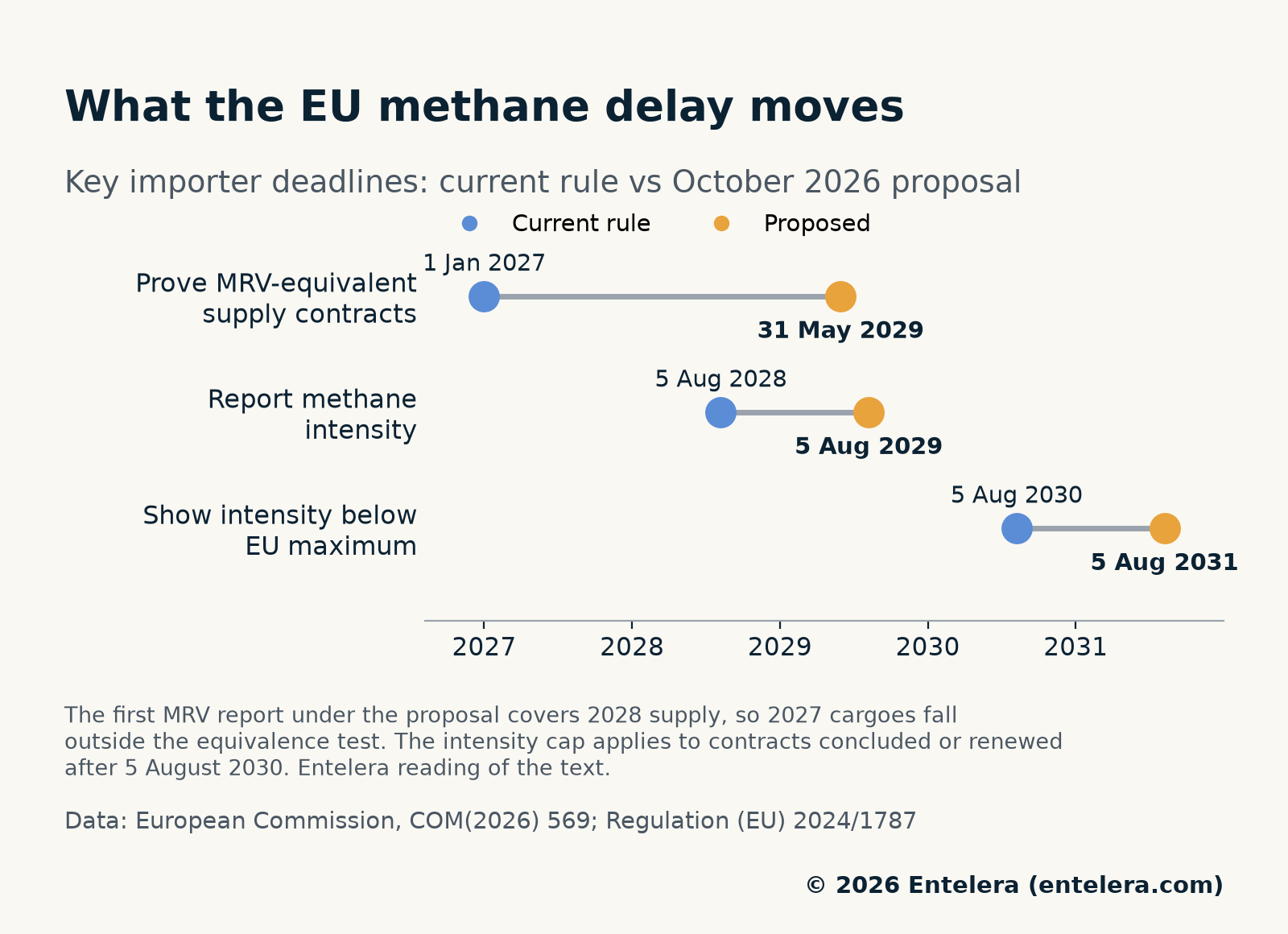
Regulation (EU) 2024/1787 sets out obligations for importers in stages. Since 5 May 2025, they have had to send national authorities information on methane controls at their suppliers. Then, from 1 January 2027, they must prove a new point. Contracts concluded or renewed after 4 August 2024 must cover only oil, gas or coal under monitoring, reporting and verification (MRV) rules equivalent to the EU’s.
Later stages go further. By 5 August 2028, producers and importers must report the methane intensity of what they sell into the EU. Then, by 5 August 2030, they must show that intensity is below a maximum value. The Commission will set that cap later, by delegated act.
What the EU methane regulation delay changes
The proposal, COM(2026) 569, rewrites Articles 28 and 29. Instead of a test from 1 January 2027, importers must report by 31 May 2029, and every year after that. Each report covers the previous calendar year’s supply. So the first test applies to 2028 deliveries.
In effect, 2027 supply under the EU methane regulation falls outside the MRV-equivalence check. That is our reading of the text, not a Commission statement. Likewise, methane-intensity reporting moves to 5 August 2029. The intensity cap moves to 5 August 2031, for contracts concluded or renewed after 5 August 2030.
Notably, US exporters asked for something close to this. In May, their national lobby asked the EU to delay enforcement until compliance rules are clear, Reuters reported. Since the first report now covers 2028 supply, exporters win much of the breathing room they wanted.
Why Brussels is delaying the EU methane regulation
The Commission gives one main reason: supply. According to the proposal, the Strait of Hormuz has suffered acute disruption since 27 February 2026. That has hit about 20% of global LNG supply and 25% of seaborne oil trade. Moreover, lost Gulf oil exports have exceeded 13 mmbbl/d. The Commission also expects cumulative supply losses of about 2.8bn barrels by the end of 2026.
The squeeze shows up in Europe’s gas balance. As our EU gas storage analysis showed, stocks entered winter well below last year. Meanwhile, importers told the Commission they might not secure enough compliant supply from 1 January 2027. In addition, member states still need to adopt penalty regimes and accredit verifiers, the proposal notes.
The EU methane regulation also faced pressure from outside. In June, energy ministers from the US, Qatar, Nigeria and Algeria wrote to EU leaders. They warned that “nearly all” EU oil imports and a “significant quantity” of gas imports would be non-compliant from January 2027. They asked for a “stop the clock” mechanism, grandfathering of new contracts and no penalties in a transition period. Then, in July, the Commission issued recommendations on compliance solutions and on penalties.
Who gains: US LNG and Europe’s importers
The US is now Europe’s main LNG supplier by far. In January-June 2026, it shipped 31.6mn t, or 59% of EU LNG imports, according to S&P Global Energy CERA. A year earlier, its share was about 55%. Russia came second with 18%, and Nigeria third with about 6%.
Next year, that share looks set to rise. Under Regulation (EU) 2026/261, Russian LNG under existing long-term contracts must stop from 1 January 2027. So the US will probably cover even more of Europe’s LNG next year. Without the delay, much of that supply would have faced the new test from the start.
Above all, the delay lowers contract risk. US exporters had warned that the rules were holding back long-term deals with European buyers, Reuters reported in May. Now, buyers and sellers have more time to agree on MRV terms. Even so, a one-year shift does not make these rules go away.
What stays in the EU methane regulation
Several things stay the same. First, contracts concluded or renewed after 4 August 2024 remain in scope. Second, the information duty that began in May 2025 continues. Third, the intensity cap still comes; it is simply a year later. In addition, the Commission says the change does not affect the ambition, integrity or scope of the regulation.
Equally, the climate case for the EU methane regulation still stands. The Commission cites IEA estimates that flaring, venting and leaks wasted more than 350 bcm of gas worldwide in 2024. That is three times the supply that the Hormuz closure has removed. In our view, that figure explains why Brussels has delayed the rules rather than dropping them.
The political risk
Not every MEP supports the delay. One Greens MEP said she would vote against the urgency procedure, Agence Europe reported. She urged others to resist “an administration that is telling us to change our regulations”. So the vote may be closer than the show of hands on Tuesday suggested.
What to watch next
- Thursday’s plenary vote on 22 October, and any amendments to the dates.
- The Council’s position, since both co-legislators must agree before the regulation enters into force.
- MRV clauses in new US LNG contracts with European buyers.
- The delegated act on maximum methane-intensity values, which decides how strict the 2031 test will be.
- National penalty regimes, which several member states have yet to adopt.
In short, the EU methane regulation delay buys Europe’s importers a clean 2027 and its suppliers more time. The harder tests are still on the calendar. For the news behind this piece, see our report on the urgency vote.
Sources
- European Commission, proposal COM(2026) 569 amending Regulation (EU) 2024/1787: energy.ec.europa.eu (PDF)
- European Commission press release via Insight EU Monitoring, 14 October 2026: ieu-monitoring.com
- Agence Europe, Parliament urgency procedure, 20 October 2026: agenceurope.eu
- European Commission, methane emissions policy page: energy.ec.europa.eu
- US Department of Energy, joint letter with Qatar, Nigeria and Algeria, 24 June 2026: energy.gov
- Reuters, US gas exporters ask to push back EU methane regulation, May 2026: reuters.com
- Reuters, EU waives penalties for oil and gas firms that breach methane law, 20 July 2026: reuters.com
- Hellenic Shipping News (Platts, S&P Global Energy CERA data), 3 July 2026: hellenicshippingnews.com
- Regulation (EU) 2026/261 on Russian gas imports: eur-lex.europa.eu