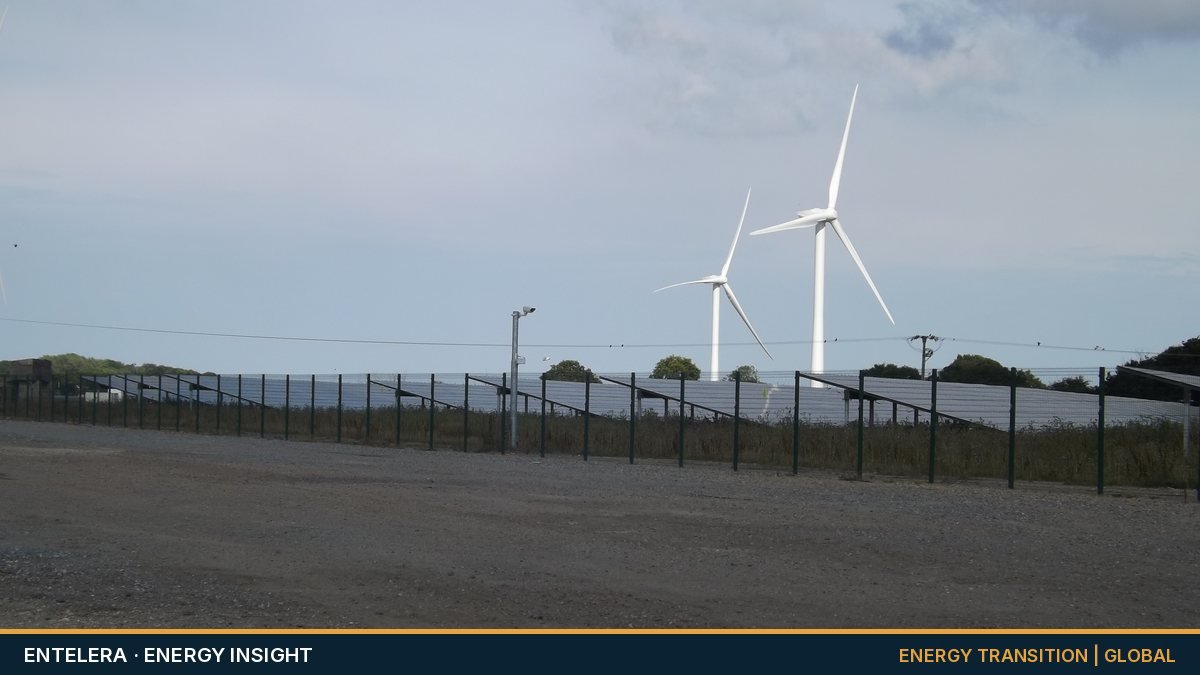
A new Ember firm power study says solar and batteries are already competitive in much of the world. Adding wind makes reliable renewable electricity cheaper still. The UK-based think tank puts the median cost of meeting 90% of demand at $105 a megawatt-hour without wind. However, with wind that cost falls to $86/MWh. The reduction is nearly one-fifth.
What the Ember firm power numbers show
The 16 November 2026 report, “Harnessing the winds”, models 10 years of weather, region by region and hour by hour. It asks how much it would cost to meet 80%, 90% and 99% of a flat baseload. The mix in the model is solar, wind and batteries. For the headline comparison, Ember uses a uniform 7% cost of capital.
The $20/MWh saving comes mainly from a smaller battery requirement. In Canada, the storage needed for 90% coverage falls from 24 hours of demand to 10 hours. Meanwhile, the United States and Europe drop from 20 hours to 12 hours. Likewise, China falls from 18 hours to 12 hours. By contrast, India stays at 14 hours, because wind helps less on this measure.
With wind included, regions representing three-quarters of global electricity demand could reach 90% coverage for less than $100/MWh. Without wind, that share is only about half.
Why wind helps Ember firm power costs
The two technologies often produce at different times of day and in different seasons. In Europe, for example, wind delivers 44% of its annual output between November and February, against just 12% for solar. North of 45° latitude, adding wind cuts the median 90% cost by 40%, from $164/MWh to $99/MWh.
Prolonged lulls rarely arrive together. Ember defines a low-generation week as seven days in which output stays below half its 10-year average. A low-solar week occurs about four times a year, and a low-wind week about eight times. However, a week in which both are weak at once arrives, on a demand-weighted average, only once every four years.
Planned coal and gas, and the path to 2050
The finding has a direct bearing on new fossil plants. Ember counts 845 GW of coal- and gas-fired capacity in the planning stage. With wind in the mix, solar, wind and batteries could replace 90% of that total, or 706 GW. The cost in those regions would stay under $100/MWh. However, without wind the share falls to 71%, or 520 GW.
Looking further out, Ember puts today’s median cost of firm solar-and-wind power at $89/MWh, with batteries and a little backup. It sees that falling to $52/MWh by 2050 on its regional cost assumptions. The report is a model, not a project bid. Real financing costs and grid constraints will therefore differ. Still, it strengthens the case for pairing solar with wind rather than leaning only on batteries. We have also tracked that theme in large solar project announcements such as Masdar’s floating plants.
What to watch
First, watch whether auction results start to reflect these hybrid costs, especially in northern markets. Then look at how much planned coal and gas still wins approval. Focus on regions where Ember already puts firm renewables below $100/MWh. Finally, the model’s 7% capital-cost assumption is generous for some emerging markets. In addition, national financing terms will decide how far the headline $86/MWh figure travels.