
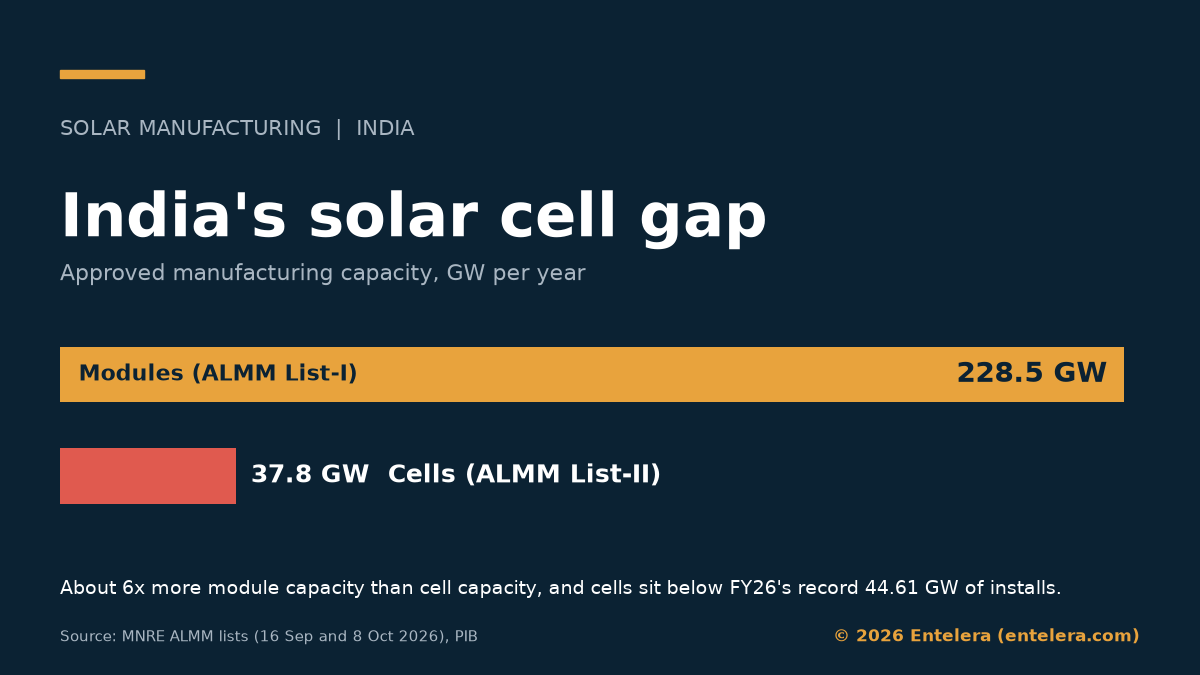
India can now build far more solar panels than it installs in a year. However, solar cell capacity in India tells a very different story. The government’s approved list shows 228.5 GW a year of module capacity. In contrast, the list for cells shows only about 37.8 GW. As a result, cells have become the narrowest point in India’s solar supply chain.
This article explains what the two lists cover and why cells matter so much. It also looks at the cost and timing effects for developers. Finally, it sets out what to watch next and what the gap means for India’s 2030 clean power goal.
Solar cell capacity in India at a glance
The figures come from the Ministry of New and Renewable Energy (MNRE). MNRE keeps the Approved List of Models and Manufacturers, known as ALMM. Its September update lifted List-I, the module list, to 228,524 MW a year. That update alone added 12,256 MW, including 5,599 MW from 12 new entrants.
Meanwhile, MNRE issued the 12th revision of List-II, the cell list, on 8 October 2026. It added a 402 MW Gopin Semicon plant near Surat in Gujarat. With that addition, solar cell capacity on India’s approved list reached about 37.8 GW a year. Three days earlier, the 11th revision had expanded a Premier Energies unit in Telangana.
For scale, India installed a record 44.61 GW of solar in FY 2025-26. That was almost double the 23.83 GW added the year before. It also beat the official target of 34 GW. So module capacity now equals about five record years of building. By contrast, solar cell capacity in India sits below a single record year.
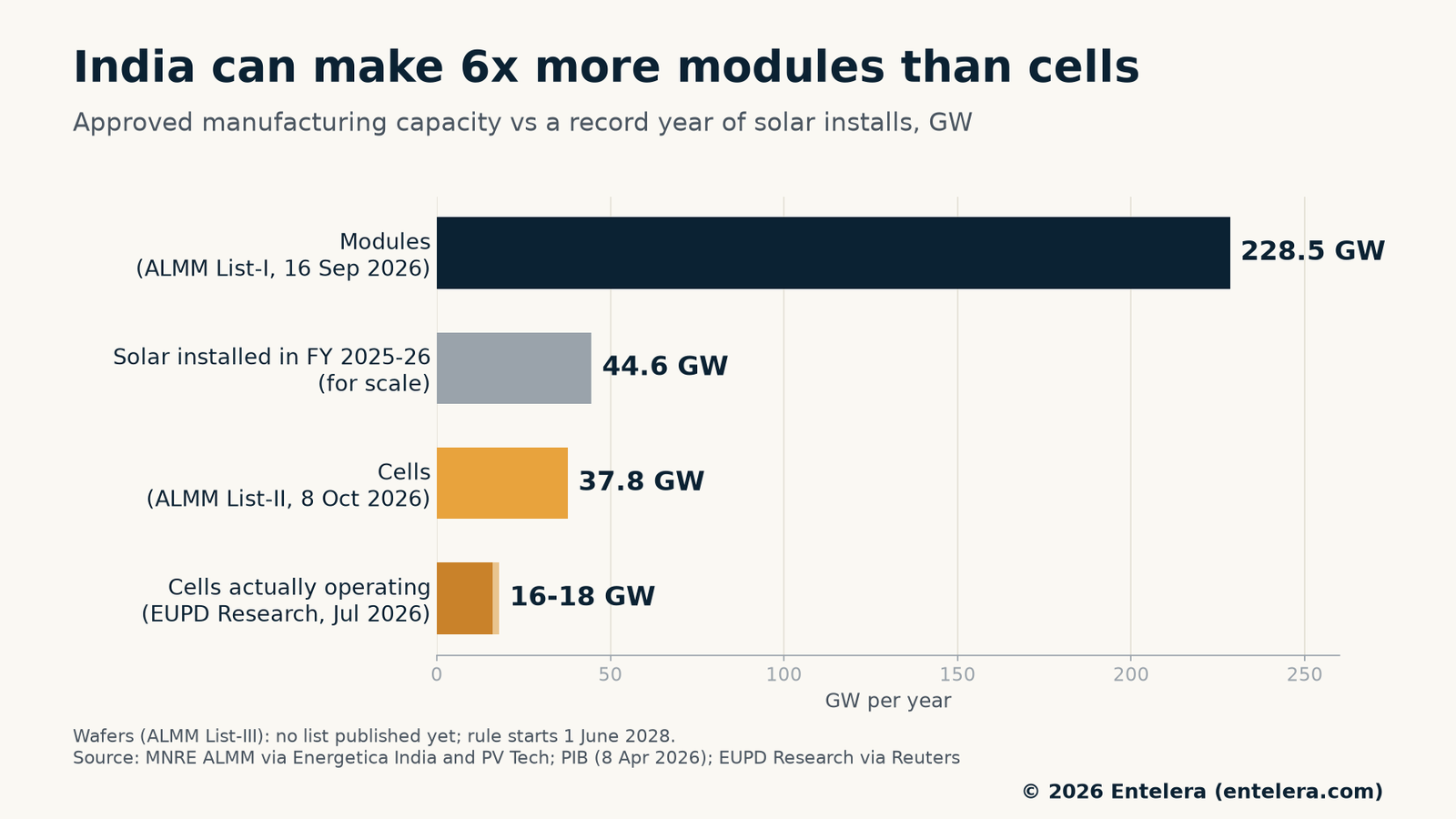
Put simply, the module figure is about six times the cell figure (228.5 ÷ 37.8 = 6.05). Moreover, the real gap in solar cell capacity in India is even wider, as the next sections show.
What ALMM List-I and List-II mean
ALMM works like a gatekeeper. Only listed makers and models qualify for government projects, subsidies and tenders. In addition, each list covers one step of the solar supply chain. In short, the lists decide which products developers can use on covered projects.
List-I: solar modules
MNRE introduced the module list in 2021 as a quality control measure. A module is the complete panel that developers mount in the field. Factories assemble it from solar cells and other parts. The list has grown fast. In fact, module capacity rose from about 172 GW at the end of March 2026 to 228.5 GW by September.
List-II: solar cells
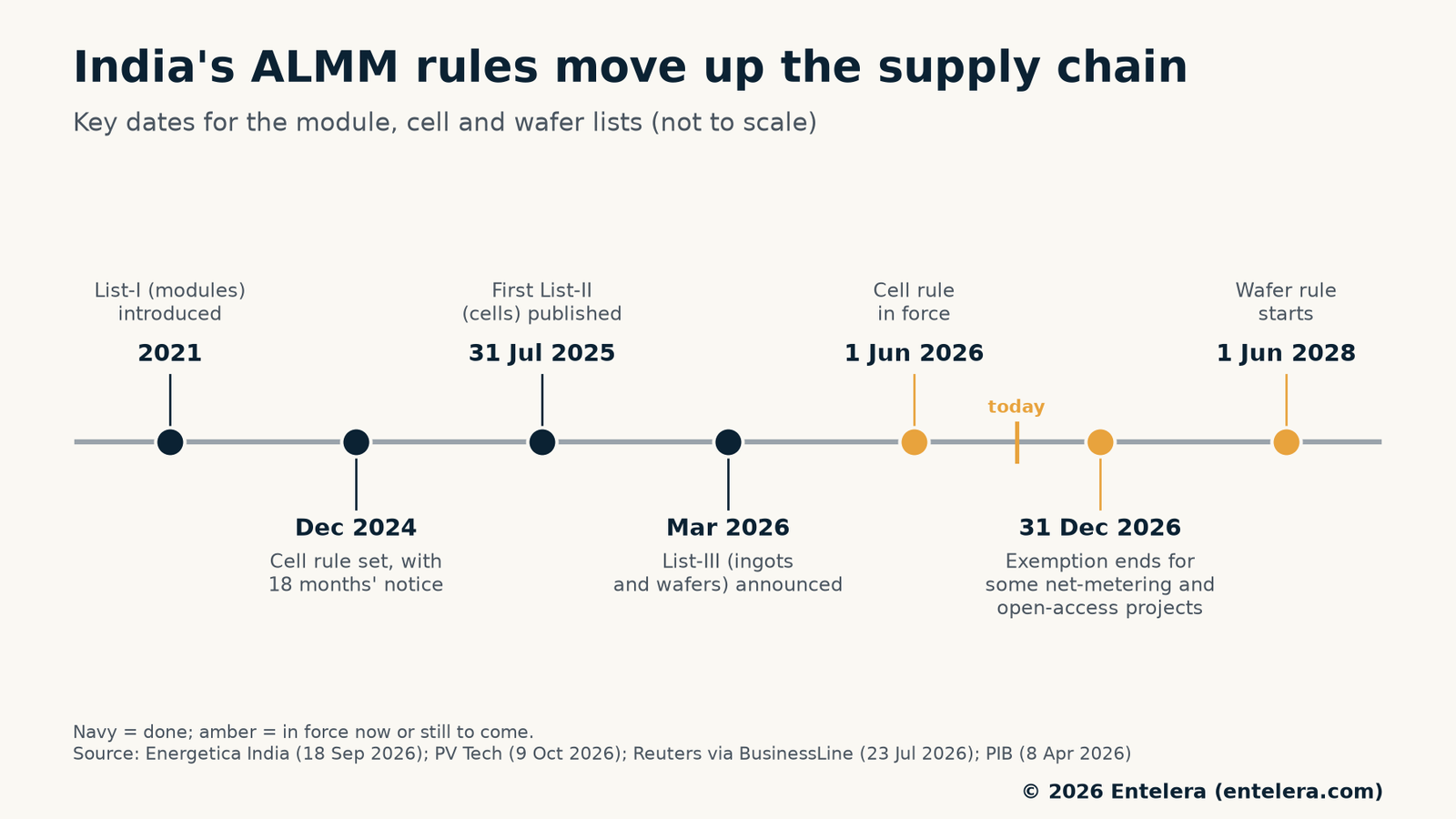
The cell is the part inside the panel that turns sunlight into electricity. The government set the cell rule in December 2024 and gave the industry 18 months to prepare. Then MNRE published the first cell list on 31 July 2025. Finally, the rule took effect on 1 June 2026.
Since then, covered projects must use cells from listed factories. This rule turned solar cell capacity in India into a pressing issue. These include government-backed schemes as well as net-metering and open-access projects. However, MNRE has extended a limited exemption for certain net-metering and open-access projects until 31 December 2026.
List-III: ingots and wafers
In March 2026, MNRE extended ALMM to silicon ingots and wafers under a new List-III. The wafer rule starts on 1 June 2028. Still, no wafer list exists yet. MNRE will publish the first one only after at least three independent wafer makers, with 15 GW of combined capacity, join it.
Why solar cell capacity in India is the real bottleneck
Cells are much harder to make than modules. According to industry sources cited by Reuters, cell factories are technology-intensive and take time to build. On top of that, China has curbed exports of solar manufacturing technology, equipment and technical support. Consequently, new Indian cell lines face long lead times.
Nameplate solar cell capacity in India vs real output
The 37.8 GW figure measures nameplate solar cell capacity in India. In other words, it shows what factories could make on paper. In practice, EUPD Research put effective operating cell capacity at only 16-18 GW in July. At that time, much of the listed capacity was not yet running, or ran well below its rating.
Actual output tells a similar story. The Indian Solar Manufacturers Association (ISMA) told Financial Express that cell production reached about 19.3 GW so far in 2026. It peaked at nearly 2.9 GW in August, according to the NISE DCR portal. Furthermore, Deloitte’s Anish Mandal noted that some Indian cell and module capacity serves buyers in western markets. So the supply open to Indian projects may be lower still.
Until local supply catches up, India keeps importing cells. About 95% of those imports come from China, according to industry estimates cited by Reuters. In addition, cell imports rose 37% in the last fiscal year to about $1.86 billion. As a result, Chinese export policy can feed straight into Indian project costs.
What weak solar cell capacity in India means for developers
In July, module makers without their own cell lines spoke to Reuters. They faced waits of up to six to eight months for domestic cells. Some had to stop production altogether. Indeed, the All India Solar Module Manufacturers’ Association said nearly a third of its 140 small and mid-sized members had halted output. Meanwhile, the rest had cut working cycles to three or four days.
Domestic cells also cost more. According to Reuters, they push the cost of Indian-made panels to almost double that of panels with Chinese cells. Similarly, the chief executive of AMPIN Energy Transition expected a short-term rise of about 35% in capital costs for power producers. That rise would last until domestic cell capacity scales up. For developers, higher costs can squeeze returns on bids that assumed cheaper equipment.
Value is therefore moving upstream. Firms that make their own cells can control supply and timing. In contrast, standalone module assemblers depend on rivals for a scarce input. These standalone makers employ about 75,000 people, including 45,000 in Gujarat, according to a state industry group.
What to watch next
The 31 December exemption deadline
First, watch whether MNRE extends the net-metering and open-access exemption beyond 31 December 2026. If it lapses, more projects will depend directly on domestic cells. In July, the ministry said it expected adequate cell capacity within six months. EUPD Research, however, thought that closing the gap would likely take three to five years.
The DCR price premium
Second, track the price gap between domestic content (DCR) modules and modules that use imported cells. A narrowing premium would signal that new cell lines are reaching the market. On the other hand, a wide premium would point to continued scarcity.
Delivery under the PLI scheme
Third, follow the Production Linked Incentive (PLI) scheme for high-efficiency solar modules. The scheme has an outlay of Rs 24,000 crore. Under it, the government has awarded 48,337 MW of fully or partially integrated manufacturing capacity. By 30 June 2026, makers had set up around 42 GW of module, 12 GW of cell and 2 GW of ingot-wafer capacity. They had also invested about Rs 73,400 crore.
Wafers and polysilicon
Finally, cells are only step one. Deloitte’s Mandal told Financial Express that Chinese makers dominate the chain above cells, from wafers to polysilicon and quartz. Meanwhile, ISMA expects solar cell capacity in India to reach 60 GW by December 2026 and pass 100 GW by mid-2027. These are industry projections, though, not listed capacity. Even if they arrive on time, wafers would remain the next gap before the 2028 rule.
Solar cell capacity in India and the 500 GW goal
India aims to reach 500 GW of non-fossil power capacity by 2030. By 31 March 2026, it had installed 283.46 GW, according to MNRE. That leaves about 216.5 GW still to add. For context, India added a record 55.29 GW of non-fossil capacity in FY 2025-26. Therefore, it needs to repeat that record pace almost every year until 2030.
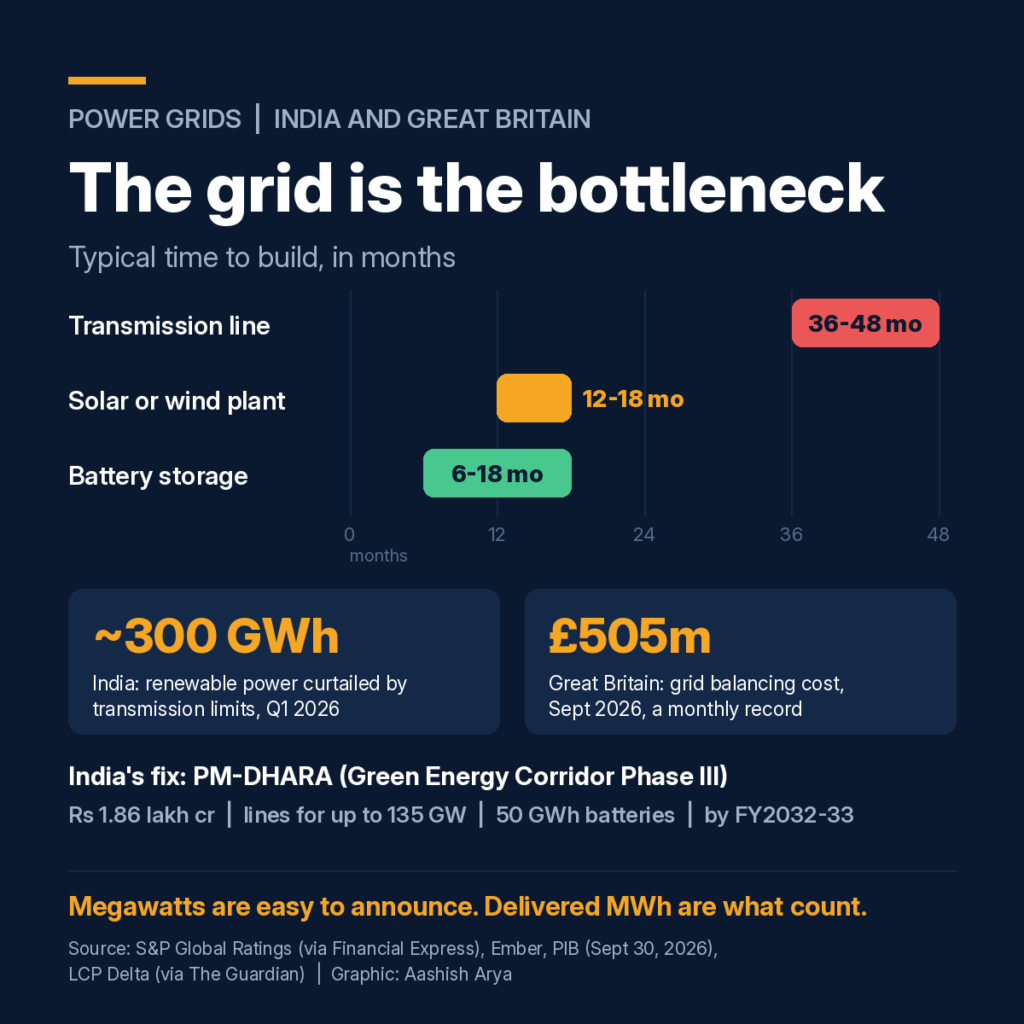
Solar has to carry most of that growth. So any slowdown in solar cell capacity in India could hurt the target directly. Reuters noted that more fossil power, mainly coal, would then have to fill the shortfall. My earlier analysis of India’s power mix and coal’s 83% share shows how much coal still matters. Moreover, cells are not the only constraint. Even with enough panels, new plants need grid lines, as my piece on India’s grid bottleneck and PM-DHARA explains.
The bottom line on solar cell capacity in India
India has solved module assembly. Its approved module capacity now exceeds five years of record installation. However, solar cell capacity in India still trails a single year’s demand, and real output trails further behind. Consequently, the next phase of India’s solar story depends on cells first, then wafers and polysilicon. In my view, the 31 December deadline and the DCR premium are the two signals to watch this winter.
Sources
- MNRE, PLI Scheme for High Efficiency Solar PV Modules (scheme page)
- Lok Sabha Unstarred Question No. 4016, MNRE answer, 12 August 2026
- PIB / MNRE, FY 2025-26 achievements, 8 April 2026
- PV Tech, 12th solar cell ALMM revision reaches 37.8GW, 9 October 2026
- SolarBytes, ALMM List-II revisions 11 and 12, 14 October 2026
- Energetica India, ALMM List-I passes 228 GW, 18 September 2026
- Reuters via The Hindu BusinessLine, solar push idles factories, 23 July 2026
- Financial Express, modules are ready, cells are not, 17 October 2026