India’s strategic petroleum reserves are back in the spotlight. Officials are still settling ADNOC’s role at Chandikhol in Odisha, the largest Phase 2 site, BusinessLine reported on 20 October. Meanwhile, the Indian crude basket has climbed from about $90 a barrel to over $110.
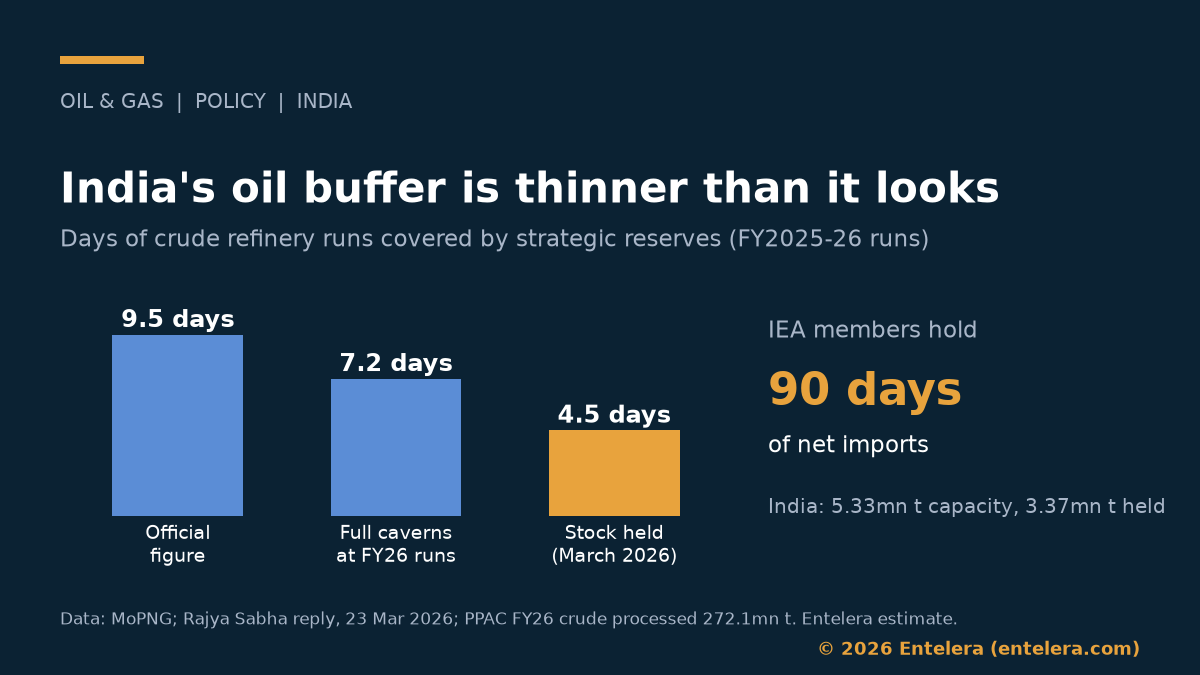
At first sight, the ministry’s headline number is reassuring. Full caverns, it says, meet about 9.5 days of national demand. However, our analysis suggests that the real buffer is much thinner. At today’s refinery runs and the latest reported stock, it is closer to 4.5 days. Unless stated otherwise, we convert rupees at INR94.91 to the dollar, the close on 20 October.
What India’s strategic petroleum reserves hold
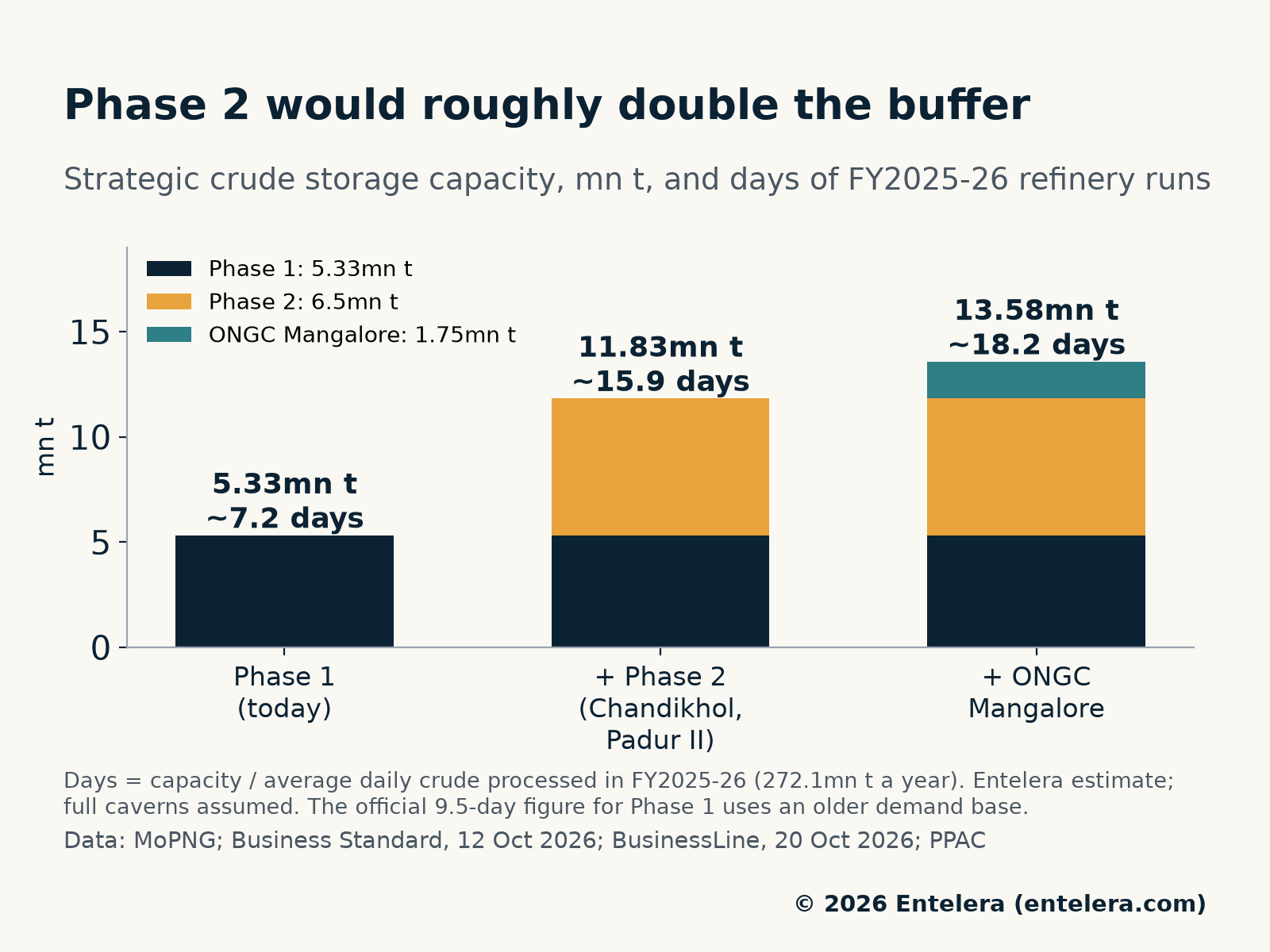
At present, Phase 1 has three underground rock caverns, according to the Ministry of Petroleum and Natural Gas (MoPNG). Visakhapatnam holds 1.33mn t, Mangaluru 1.5mn t and Padur 2.5mn t. Altogether, that is 5.33mn t, or roughly 39 mmbbl at a typical 7.33 barrels a tonne.
The caverns are not full, though. In a written reply to the Rajya Sabha on 23 March 2026, the government said they held about 3.372mn t. That is about 64% of capacity, The Indian Express reported. The ministry added that the actual reserve is “a dynamic number”. It is also the latest public stock figure.
In addition, oil marketing companies hold more. A Lok Sabha answer put their crude and product storage at 64.5 days. Adding the strategic reserves gives the official total of 74 days. By comparison, IEA members must hold stocks equal to 90 days of the previous year’s net imports. However, India is only an associate member, so that rule does not bind it.
Why 9.5 days is now closer to 7
The 9.5-day figure has stayed the same for years, yet demand has grown. In FY2025-26, Indian refiners processed 272.1mn t of crude, according to PPAC data reported by the Times of India. In other words, that is about 0.75mn t a day.
On that basis, full caverns would cover about 7.2 days of refinery runs. Against crude imports of 245.8mn t in FY2025-26, the figure is about 7.9 days. At the 3.372mn t stock last reported, cover falls to about 4.5 days of runs. These are Entelera estimates. In our view, though, they are a fairer guide to the buffer than the headline number.
In short, the 74-day total depends mostly on commercial stocks. In our view, refiners need much of that oil to keep running. So not all of it is a true emergency reserve. By contrast, India’s strategic petroleum reserves are the only stock the government fully controls.
Strategic petroleum reserves Phase 2 is moving slowly
First, some history. The government approved Phase 2 in July 2021. It adds 6.5mn t at two sites: 4mn t at Chandikhol and 2.5mn t more at Padur. Both also use a public-private partnership model.
Padur II is further ahead. Megha Engineering and Infrastructure won that contract about a year ago, Business Standard reported on 12 October. By contrast, the Chandikhol tender is still waiting. Its request for proposals was due in June. Now, officials say it depends on the terms of ADNOC’s participation.
Above all, the sticking point is commercial. For instance, ADNOC wants a prior deal to sell at least 50% of the stored crude to Indian refiners, an official told Business Standard. Officials have suggested a joint venture with Indian Oil, which runs the Paradip refinery about 95km away. Meanwhile, Odisha has leased about 400 acres of land for the site. Costs are rising, too. The 2021-22 estimate for Chandikhol was INR87.43bn ($921mn). Now, officials expect the cost to top INR100bn ($1.05bn).
In addition, ONGC is building a 1.75mn t reserve at Mangalore, BusinessLine reported. Bina in Madhya Pradesh and Bikaner in Rajasthan are under study for crude, LNG and LPG storage. Overall, PwC India puts Phase 2 capex at about INR150bn ($1.58bn), with government gap funding of close to 60%.
What Phase 2 adds to strategic petroleum reserves
On our numbers, Phase 2 would lift strategic capacity to 11.83mn t. That is about 15.9 days of FY2025-26 refinery runs. With ONGC’s Mangalore project, capacity would reach 13.58mn t, or about 18.2 days. Business Standard, without giving its method, puts the post-expansion buffer at around 11 days of consumption.
Either way, India’s strategic petroleum reserves would remain far below the IEA benchmark. However, the gain matters. A buffer of two to three weeks gives refiners time to reroute cargoes around a closed strait. By contrast, a buffer of four or five days leaves little room for error.
The ADNOC model and its trade-off
Still, ADNOC’s role cuts both ways. Under a May 2026 agreement, ADNOC can explore raising its crude storage in India to up to 30 mmbbl. That could include Mangalore, Visakhapatnam and Chandikhol, ADNOC said. It also explores storing crude in Fujairah as part of India’s reserve.
At 30 mmbbl, ADNOC’s oil would equal about 5.5 days of refinery runs, on our estimate. Even so, this crude belongs to the seller. As noted above, ADNOC also wants the right to sell much of it to Indian refiners. In our view, the model saves the government money but gives it less control.
The cost of filling strategic petroleum reserves
Meanwhile, timing matters as much as capacity. Topping up Phase 1 would need about 1.96mn t, or roughly 14 mmbbl. At $110 a barrel, that costs about $1.6bn. Filling all 6.5mn t of Phase 2 would take about 48 mmbbl, or roughly $5.2bn at today’s prices. These are Entelera estimates using 7.33 barrels a tonne.
That is why delay hurts. Stored crude bought at about $90 would have cost far less than barrels bought now, PwC India’s oil and gas leader told BusinessLine. So the lesson is to build capacity in calm years and fill it when prices are low. India’s import bill shows the cost of waiting; see our India crude import bill analysis.
What to watch next
- The Chandikhol request for proposals, and how it treats ADNOC’s sales rights.
- A fresh stock figure from ISPRL or Parliament, since the March number is the latest one public.
- Padur II construction progress under Megha Engineering.
- Overseas storage, including the Fujairah option and the talks with Japan.
- Brent and the Indian basket, which set the cost of any refill.
In our view, India’s strategic petroleum reserves are a policy promise that the caverns cannot yet keep. Phase 2 would help, but only once India builds and fills it. For the news behind this piece, see our report on the Phase 2 expansion.
Sources
- Ministry of Petroleum and Natural Gas, ISPRL and Phase 1 capacity: mopng.gov.in
- The Indian Express, Rajya Sabha reply on SPR stock, 23 March 2026: indianexpress.com
- Lok Sabha unstarred question 1056, SPR and national storage days: sansad.in (PDF)
- Business Standard, Chandikhol SPR delay, 12 October 2026: business-standard.com
- The Hindu BusinessLine, SPR Phase 2 progress, 20 October 2026: thehindubusinessline.com
- ADNOC, agreements with ISPRL and Indian Oil, 15 May 2026: adnoc.ae
- Times of India (PPAC data), FY2025-26 crude processing: timesofindia.indiatimes.com
- PPAC, Snapshot of India’s Oil and Gas Data, July 2026: ppac.gov.in (PDF)
- The Shillong Times (PTI), rupee close of 94.91 per dollar, 20 October 2026: theshillongtimes.com