Sinopec Q3 profit rose 57.2% year on year to CNY13.36bn ($2.01bn) for the July–September 2026 quarter, under Chinese accounting standards. The world’s biggest refiner by capacity said wider refining margins and higher crude prices more than offset weaker fuel demand. A year earlier, it earned CNY8.50bn.
Under international accounting standards (IFRS), profit attributable to shareholders reached CNY13.60bn ($2.05bn), up 63.6%. Meanwhile, quarterly revenue rose 9.3% to CNY769.7bn ($115.7bn), according to the company’s filing reported by TokenPost.
Refining margins lift Sinopec Q3 profit
Refining was the main driver. In the first nine months of 2026, the refining segment earned CNY30.10bn ($4.53bn) before interest and tax, Reuters reported. That compares with just CNY7bn ($1.05bn) a year earlier. Sinopec credited wider spreads for refined and chemical products, a better product mix and more output of higher-value fuels such as jet fuel and naphtha. In addition, higher crude prices brought inventory gains.
Nine-month net profit rose 30% to CNY38.99bn ($5.86bn). Under IFRS, it rose 25.3% to CNY40.17bn, while revenue grew 4.4% to CNY2.21tn ($332bn).
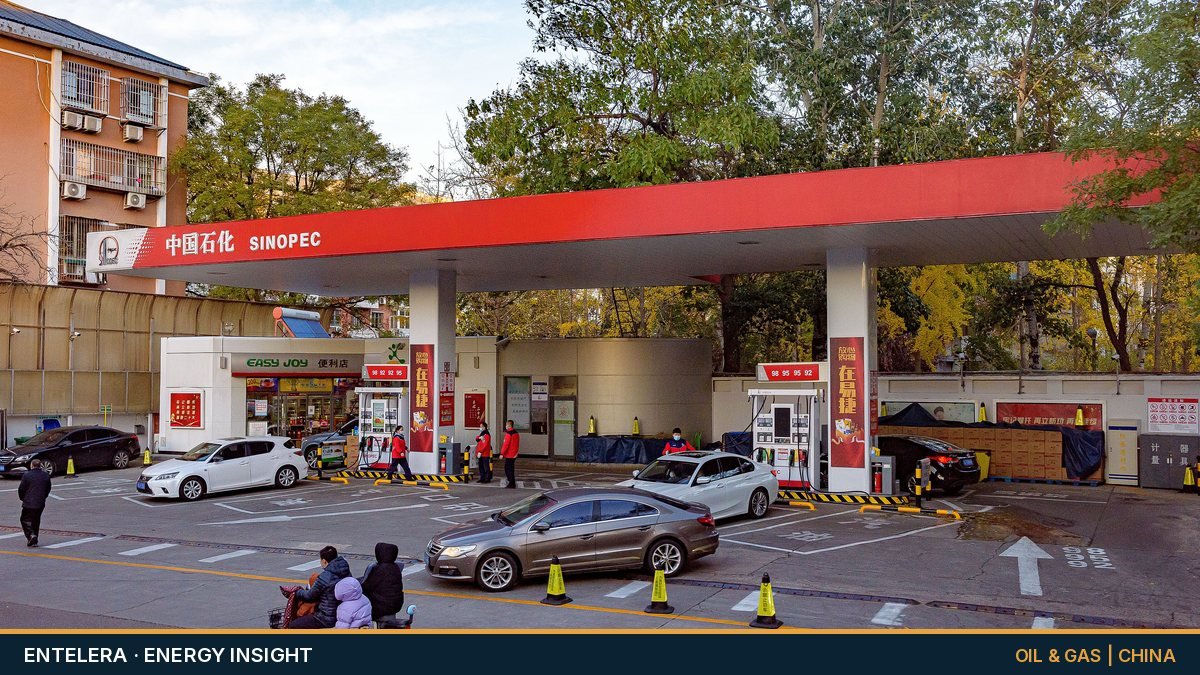
Falling fuel demand in China
Volumes, however, fell sharply. Sinopec processed 167.37mn tonnes of crude in nine months, or about 4.48 mmbbl/d, down 10.2%. Diesel output led the decline, down 9.2%. Likewise, gasoline fell 6.4% and jet fuel 5.9%.
Refined fuel sales dropped 11.4% to 151.91mn tonnes. Of that, domestic sales were 118.90mn tonnes, down 10.7%. According to Sinopec, China’s refined fuel consumption fell 8.6% in the first nine months. Soaring oil prices and a faster shift to alternative energy cut demand. By contrast, natural gas consumption edged up 0.1%.
Chemicals still loss-making
The chemicals business remains weak. Ethylene output dropped 19%, and the segment lost CNY1.69bn ($254mn) before interest and tax. Still, that loss narrowed from CNY8.22bn ($1.24bn) a year earlier. Moreover, China’s ethylene-equivalent consumption fell 9.4% as chemical demand stayed soft.
Upstream and spending
Sinopec’s crude production edged down 0.1% to 210.99mn barrels in the first nine months. Gas output, on the other hand, rose 1.4% to 1,115.21 bcf, or about 31.6 bcm. Capital spending increased to CNY74.5bn ($11.2bn), from CNY71.6bn ($10.8bn) a year earlier.
Why Sinopec Q3 profit matters
Sinopec’s results mirror a wider pattern in China. PetroChina also lifted its third-quarter 2026 profit on higher oil and gas prices this week. However, the two state giants face a shrinking domestic fuel market. Falling Chinese diesel and gasoline demand reduces China’s need for crude imports. As a result, that trend matters for exporters in the Middle East, Russia and Latin America.
At the same time, Sinopec’s margin gains show how tight global refined-product supply has become since the war in the Middle East began. Western majors such as Shell and TotalEnergies reported the same refining windfall on Thursday 29 October 2026.
What to watch
Investors will watch whether Chinese fuel demand keeps falling in the fourth quarter of 2026. They will also watch whether refining margins hold up as more Gulf crude returns to the market.
For a deeper analysis, read: China Fuel Demand Falls 8.6%: Why Sinopec Earns More While Refining Less