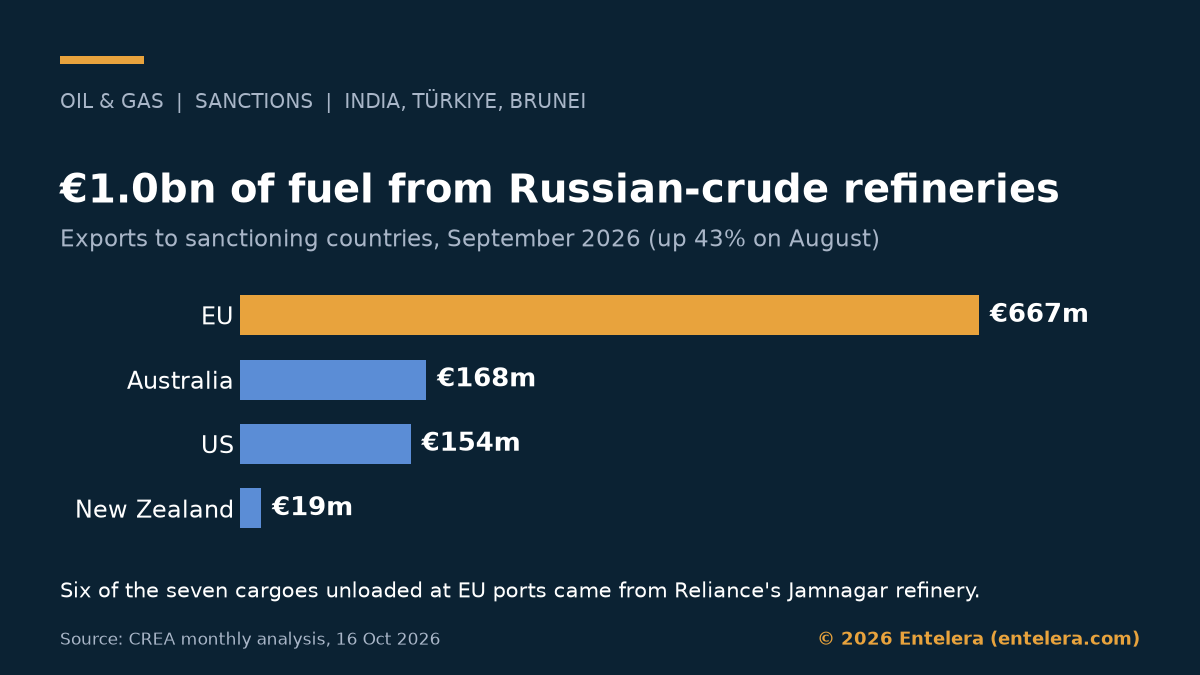
Refineries that run on Russian crude oil sold more fuel to the West in September, not less. Russian crude fuel exports from plants in India, Türkiye and Brunei to sanctioning countries reached €1.0bn, up 43% on August. That is the finding of the Centre for Research on Energy and Clean Air (CREA), an independent research organisation.
The surge came eight months after the EU banned fuel made from Russian crude. Moreover, one Indian site stands out. Reliance Industries’ Jamnagar refinery sent six of the seven flagged cargoes that unloaded at EU ports. This analysis explains how the ban works, why such cargoes still arrive, and what a tougher, refinery-level rule would mean for India.
Where Russian crude fuel exports went in September
CREA tracks oil products from refineries that process Russian crude and then ship to countries with sanctions on Russia. Its September report, published on 16 October, lists four buyers:
- European Union: €667m
- Australia: €168m
- United States: €154m
- New Zealand: €19m
Together, these come to €1,008m. However, not all of that fuel came from Russian oil. These plants blend crude from many sources. CREA estimates that about €295m of the products were refined from Russian crude itself.
Exports bound for the EU rose 80% in value on the month. That total includes a 104,000-tonne cargo of gasoil (diesel) from Jamnagar that was still sailing to Rotterdam at the end of September. By contrast, US-bound flows fell 16%, while Australian flows rose 12%.
One caveat matters here. CREA’s first estimate for August, published in September, was €510m. CREA updates earlier months as its data provider verifies shipments, and it treats its latest report as the most accurate. So monthly comparisons can shift as the data matures.
Jamnagar’s role in Russian crude fuel exports
Jamnagar is not an ordinary refinery. Reliance calls it the largest and most complex single-site refinery in the world. It can process 1.4 million barrels of crude a day and has a complexity index of 21.1. In addition, Reliance says the plant has run more than 216 grades of crude. That flexibility lets it switch between suppliers quickly. It also puts the plant at the heart of Russian crude fuel exports to Europe.
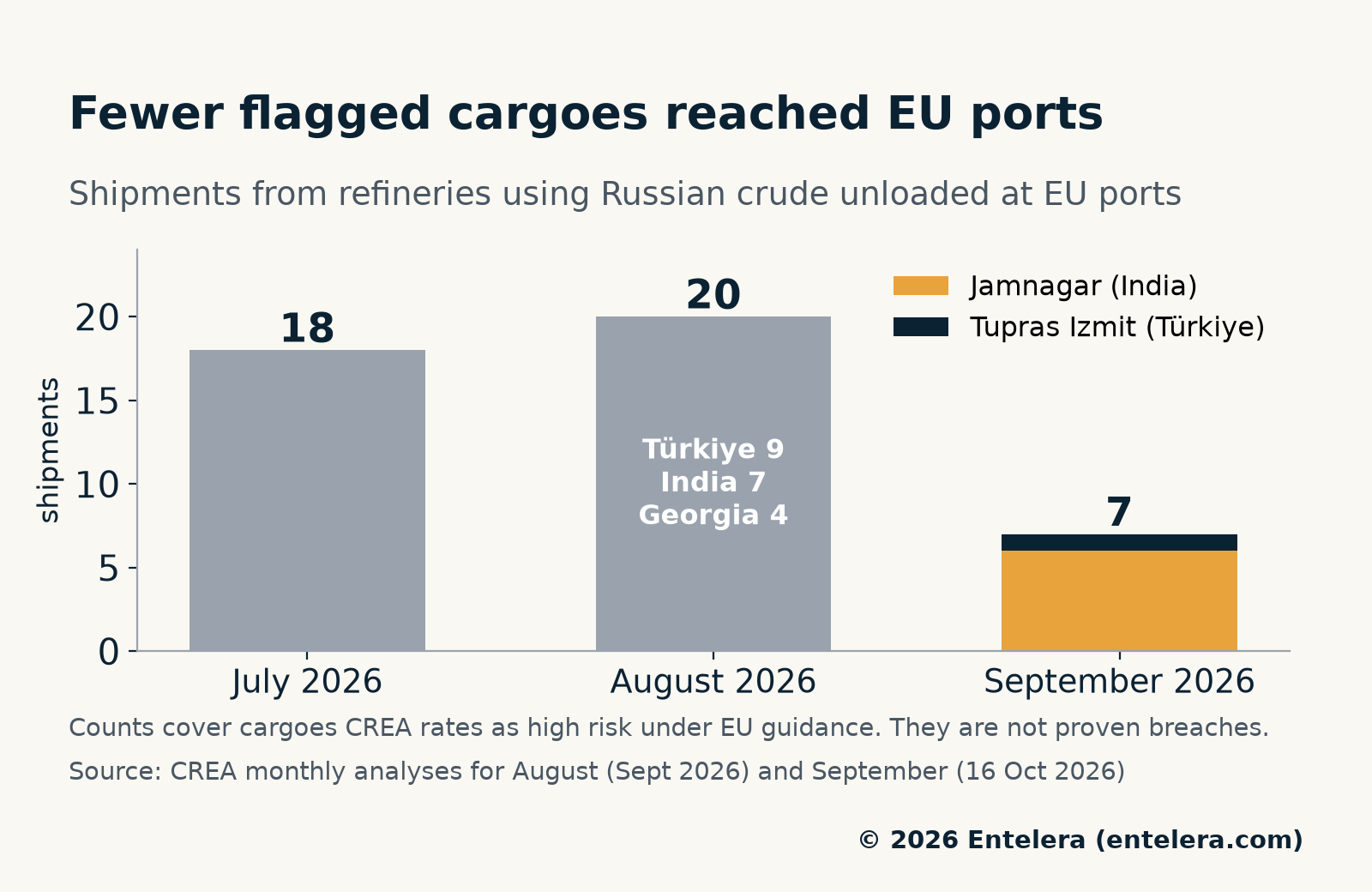
In September, CREA counted seven high-risk cargoes unloaded at EU ports. Six came from Jamnagar, and one came from Türkiye’s Tupras Izmit refinery. Italy took three, Romania two, and Spain and the Republic of Cyprus one each. A further three cargoes went to Kalecik in Northern Cyprus, where EU law does not apply, so CREA left them out of the count.
Fewer EU cargoes, but higher value
The count fell sharply, from 20 shipments in August to seven in September. Even so, the value heading to the EU rose. The two measures differ, though. The count covers cargoes that unloaded, while the value covers exports reported as bound for EU ports, including cargoes still at sea. Meanwhile, Jamnagar also led US-bound flows. It shipped €122m of the €154m that went to the US. Türkiye’s STAR refinery sent the other €33m.
Russian crude made up 32% of Jamnagar’s crude imports between July and September. That share is lower than before. CREA’s August report put it at 38% for the prior three months. Still, roughly one in three barrels arriving at the site came from Russia.
How the EU ban on fuel from Russian crude works
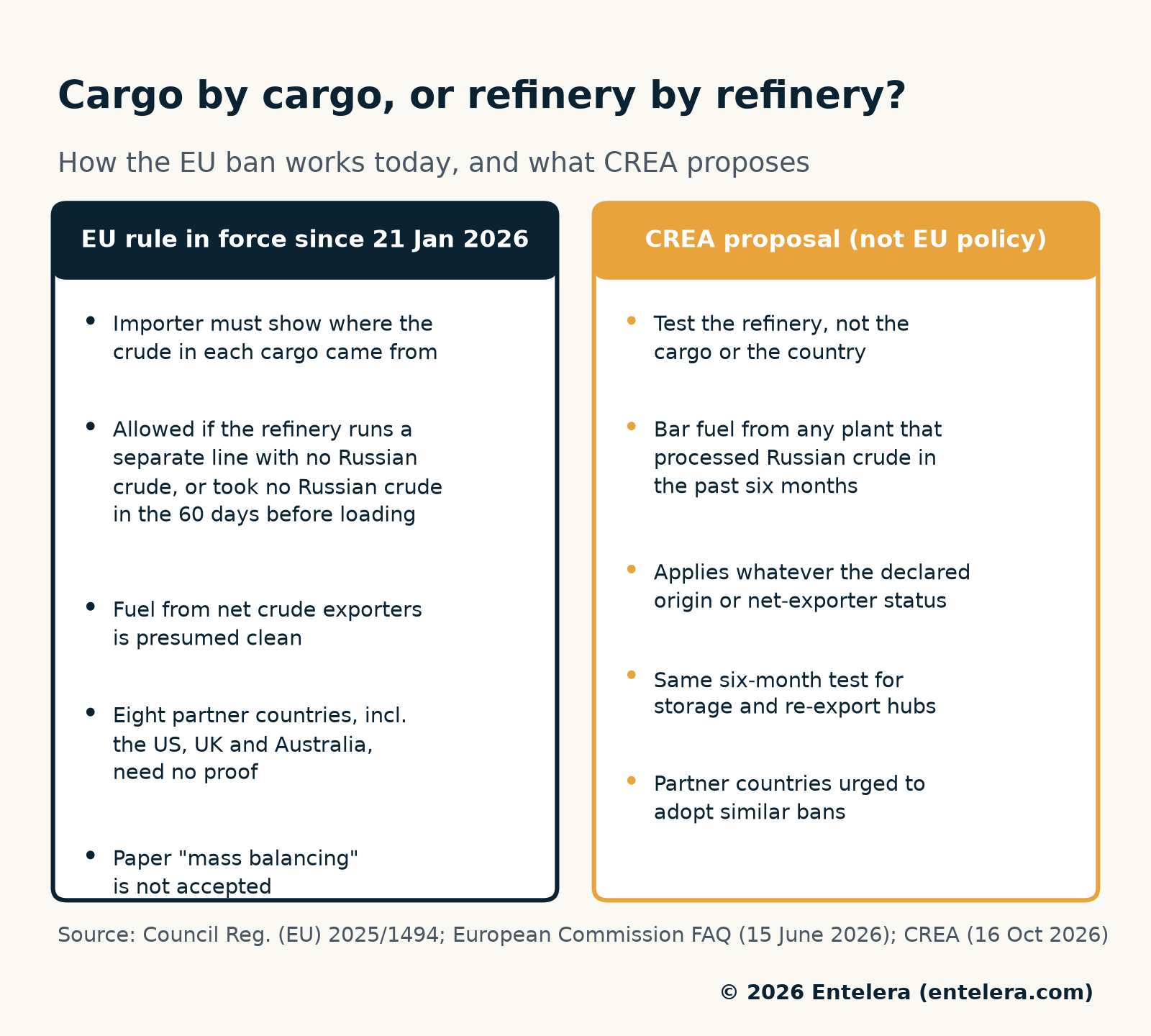
The EU adopted the ban in its 18th sanctions package on 18 July 2025. Council Regulation (EU) 2025/1494 added Article 3ma to the EU’s main Russia sanctions law. From 21 January 2026, it bars the purchase, import or transfer into the EU of petroleum products made abroad from Russian crude. In practice, it is the EU’s main legal check on Russian crude fuel exports.
The rule rests on proof of origin. At import, the importer must show where the crude behind the product came from. However, there are two big exceptions:
- Net crude exporters: fuel from countries that exported more crude than they imported in the previous year counts as made from domestic crude. Saudi Arabia, the UAE, Kuwait and Iraq are on the Commission’s list. India and Türkiye are not.
- Partner countries: imports from eight partners need no proof at all. They are Canada, Norway, the US, the UK, Switzerland, Australia, Japan and New Zealand.
What the Commission’s guidance asks of importers
The Commission’s guidance, last updated on 15 June 2026, tells importers to take extra care with cargoes from Türkiye, India and China. It also covers refineries that run Russian crude alongside other grades. In that case, a cargo may still enter the EU in two situations. Firstly, the refinery can process Russian crude on a separate, documented line. Secondly, the line that made the cargo may have received no Russian crude in the 60 days before loading. Otherwise, the cargo cannot enter.
The guidance also rules out paper accounting. A refinery cannot simply claim that its Russian barrels supply the home market while other crude feeds exports. The Commission says this “mass-balancing” approach is not accepted.
Why flagged cargoes still reach EU ports
The ban does not target refineries. Instead, it targets molecules, cargo by cargo. So a refinery that runs Russian crude can still sell to Europe, as long as it can prove the export cargo came from non-Russian oil. Checking that proof is the job of customs in each member state. That design shapes how Russian crude fuel exports reach Europe today.
That design explains the CREA numbers. CREA flags cargoes as high risk because of where they loaded, not because a court has found a breach. For that reason, a high-risk cargo is not automatically illegal. Yet CREA argues that member states must investigate these shipments. The Commission itself notes that oil is fungible, so no one can separate it once mixed.
The partner list creates a second route. CREA warns that the exemptions for the UK, the US, Canada, Norway and Switzerland let fuel refined from Russian crude reach the EU through re-export. That matters for this story, since the US and Australia were among the September buyers.
India’s Russian crude imports are falling
At the same time, India is buying less Russian oil. According to CREA, India’s Russian crude imports fell 13% in September. It was the second monthly fall in a row and the lowest level since April 2026. Imports dropped at Vadinar by 8%, at Jamnagar by 27% and at Paradip by 21%. As a result, Nayara Energy’s Vadinar refinery overtook Jamnagar as India’s largest importer of Russian crude. Over time, smaller intakes could also shrink fuel exports made from Russian crude.
Even so, India remained Russia’s second-largest fossil fuel customer after China. It bought €4.1bn of Russian hydrocarbons in September, and crude made up 88% of that. Since December 2022, India has taken 37% of Russia’s crude exports, against China’s 50%.
Ship-tracking firm Kpler, quoted by the Financial Express, put Russia’s share of India’s crude imports at 35.3% in September. That was down from 55.9% in July. Meanwhile, the price gap has stayed wide. Urals crude averaged $90.7 a barrel in September, still $23 below Brent, CREA says. Our Brent at $110 analysis covers the wider price picture.
Kpler analysts link the fall to tighter supply and stronger Chinese buying, not only US pressure. They expect India’s Russian crude imports to hold at 1.8-1.9 million barrels a day in October, PTI reported. Meanwhile, West Asian suppliers have regained ground. Their share of India’s crude imports rose to 39.5% in September from 26% in August, Kpler data show.
What refinery-level rules would mean for Russian crude fuel exports
CREA wants the EU to move from a country test to a refinery test. Under its proposal, the EU would bar products from any refinery that processed Russian crude in the past six months. That would apply whatever the product’s declared origin or the host country’s net-exporter status. CREA would apply the same six-month test to storage terminals and re-export hubs.
To be clear, this is a recommendation from an advocacy group. It is not EU policy. Still, the EU has already used a refinery-level tool once. Its 21st sanctions package placed a transaction ban on Georgia’s Kulevi refinery, due to apply from 25 January 2027. Before that, the Commission must report by 25 October 2026 on whether to keep the listing.
The trade-off for India’s refiners and for Europe
If Brussels adopted CREA’s six-month rule, the choice for India’s export refiners would be stark. A plant like Jamnagar, with about a third of its crude from Russia, would lose access to the EU until six months after its last Russian cargo. It would have to pick between discounted Russian barrels and European diesel buyers. In effect, Russian crude fuel exports to the EU would stop being a paperwork question and become a sourcing decision.
On the other hand, a blunt rule carries risks for Europe too. Kpler’s 16 October briefing called diesel the tightest part of the barrel. Our Strait of Hormuz analysis covers that squeeze. Fewer eligible refineries would mean fewer suppliers for EU diesel importers.
What to watch next on Russian crude fuel exports
- CREA’s October report, expected in November, for the next count of high-risk cargoes at EU ports.
- The Jamnagar gasoil cargo that was heading to Rotterdam at the end of September.
- The Commission’s Kulevi report, due by 25 October 2026, as a test of appetite for refinery-level listings.
- India’s October crude imports, which Kpler expects at 1.8-1.9 million barrels a day from Russia.
- Customs action in Italy, Romania, Spain and Cyprus, where September’s flagged cargoes unloaded.
In short, sanctions on Russian oil are moving from the country level towards the refinery level. India’s export refiners should plan for that shift now, rather than wait for Brussels to decide. Our news report on the CREA data has the key numbers at a glance.
Sources
- CREA, “September 2026: Monthly analysis of Russian fossil fuel exports and sanctions”, 16 October 2026: energyandcleanair.org
- CREA, “August 2026: Monthly analysis of Russian fossil fuel exports and sanctions”, 10 September 2026 (amended 16 October 2026): energyandcleanair.org
- The Hindu (PTI), “Indian refiners’ fuel exports to West surge 43% amid Russian crude imports”, 18 October 2026: thehindu.com
- Council Regulation (EU) 2025/1494 of 18 July 2025, Official Journal of the EU (Article 3ma): eur-lex.europa.eu
- European Commission, “Import ban on refined products obtained from Russian crude oil”, FAQs as of 15 June 2026: finance.ec.europa.eu
- European Commission, press release on the 18th sanctions package, 18 July 2025: ec.europa.eu
- Reliance Industries, “Petroleum Refining & Marketing” (Jamnagar refinery): ril.com
- Kpler, “Kpler Media Briefing: Middle East Energy and Maritime Disruptions”, 16 October 2026: kpler.com (PDF)
- Financial Express, “West Asia crude regains ground in India’s basket” (Kpler data), 1 October 2026: financialexpress.com