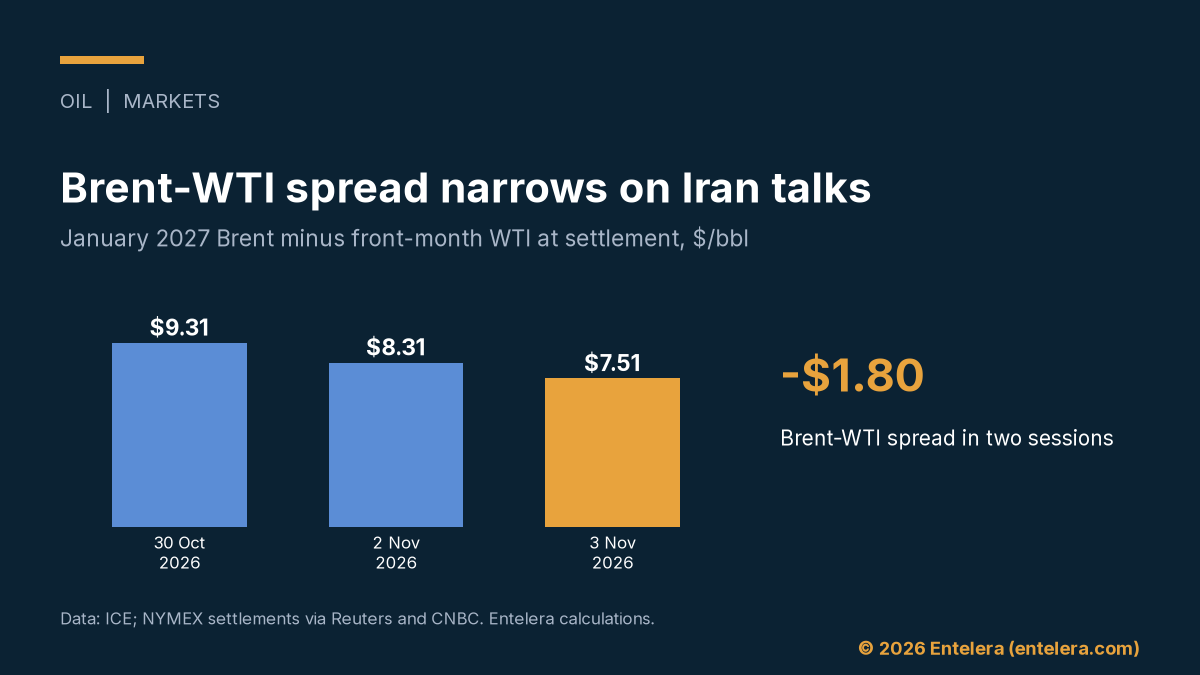
The Brent-WTI spread has narrowed by almost $2 a barrel in two sessions. On 2 November 2026, Brent crude fell 7.6% to $104.77 a barrel on hopes of US-Iran talks. WTI fell 7.4% to $96.46. Then, on 3 November 2026, Brent settled at $103.60, its lowest close since 7 October 2026.
This analysis looks at where the war risk premium sits, and what the curve still signals.
How far the Brent-WTI spread has moved
First, a word on the contract roll. December 2026 Brent expired on 30 October 2026 at $117.64. The more active January 2027 contract settled at $113.43, Reuters reported. So a fall measured from $117.64 overstates the move. On the January 2027 contract, Brent lost $9.83, or ~8.7%, in two sessions. By contrast, WTI fell $8.03, or ~7.7%, from $104.12.
As a result, the gap between January 2027 Brent and front-month WTI shrank from $9.31 on 30 October 2026 to $7.51 on 3 November 2026, on our calculation.
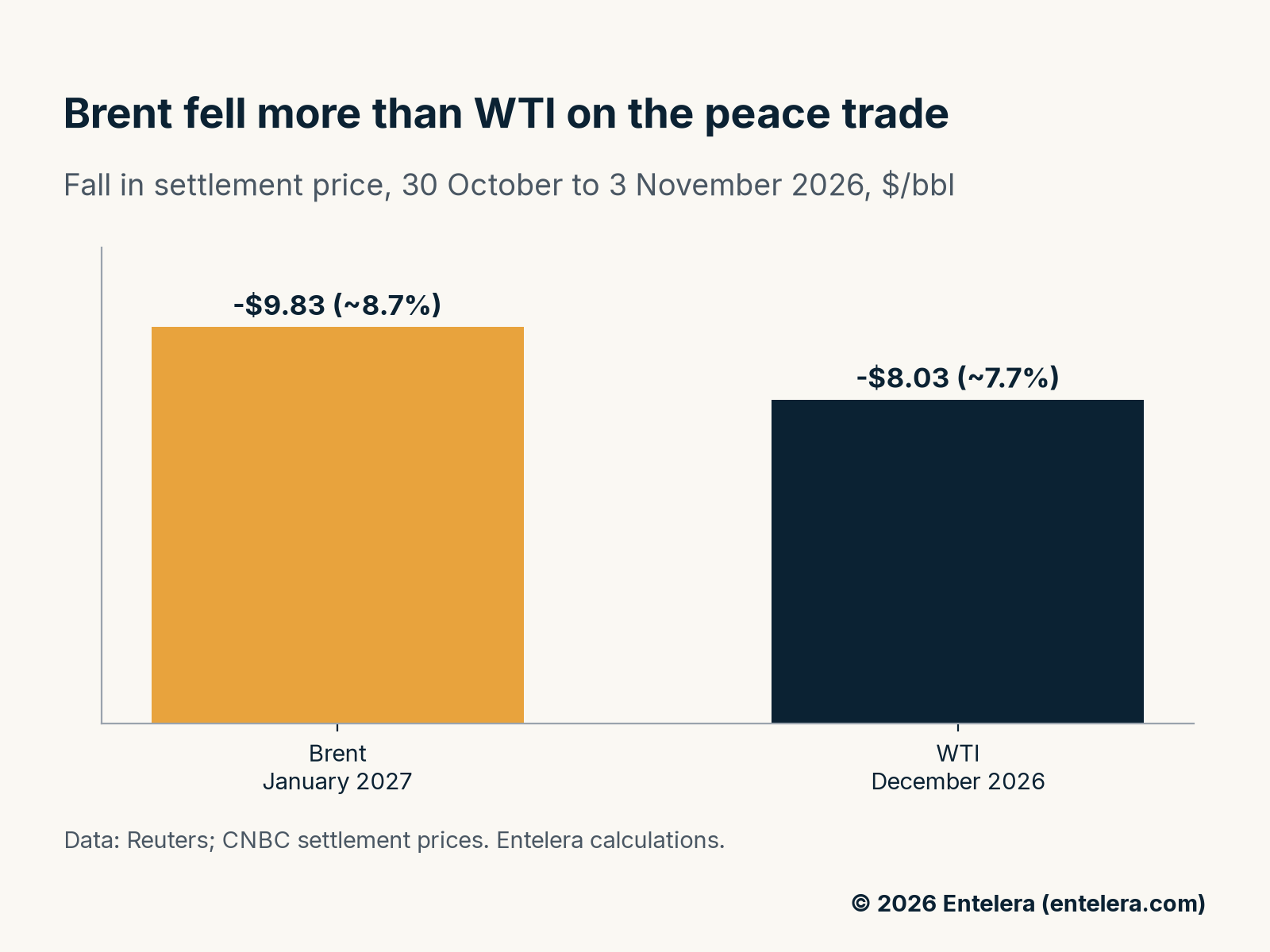
In our view, that shows where the premium sat. Brent prices seaborne crude, including barrels exposed to the Strait of Hormuz. WTI, by contrast, prices US crude delivered inland at Cushing. So when peace headlines hit, the seaborne benchmark gives back more.
The curve still shows a prompt squeeze
Even so, the curve has not relaxed. At expiry, December 2026 Brent stood $4.21 above January 2027, a steep one-month backwardation. Such a gap means buyers paid heavily for barrels now rather than later. Moreover, Brent at $103.60 still sits ~$30 above its ~$73 pre-war level of late February 2026.
Physical risks also remain. The strait, which used to carry 20% of global oil supplies, remains effectively shut. In addition, the US struck Iran’s Qeshm Island overnight on 2 November 2026, although officials called the strikes limited. For the freight side, read our analysis of Hormuz shipping costs after the limpet mine attack.
US stocks support WTI and a narrow Brent-WTI spread
US data point the same way. The American Petroleum Institute reported that crude stocks fell by 5.27mn barrels in the week to 30 October 2026. By contrast, analysts polled by Reuters had expected a rise of ~880,000 barrels. Distillate stocks also fell by 1.19mn barrels, and Haitong Futures said diesel inventories remain tight.
If official data confirm the draw, WTI should hold up better than Brent. That would keep the spread narrow.
What it means for traders and buyers
For refiners buying seaborne crude, the sell-off brings relief, but analysts doubt it will last on headlines alone. While tanker and Houthi attacks continue, TD Securities does not expect diplomacy headlines alone to erase “the risk premium”. Similarly, ING warned that escalation risks may not be over yet.
Earlier in the war, oil also fell on settlement rumours, only for the conflict to escalate again, CNBC noted. In our view, the spread and the backwardation are better gauges than flat price. If both keep narrowing, the market is pricing real supply returning, not just hope. For our earlier estimate of the premium, read Brent Forecast at $110: How Much of Today’s Price Is Risk Premium?
What to watch for the Brent-WTI spread
- US Energy Information Administration stock data at 21:00 IST on 4 November 2026, and whether they confirm the API draw.
- US midterm results and the Qatari-mediated talks, and any new attack on tankers.
- January 2027 Brent expiry on 30 November 2026, one day after the OPEC+ meeting on 29 November 2026.
Sources
- CNBC, Crude oil prices sell off more than 7% on Iran peace talk hopes ahead of U.S. midterms, 2 November 2026: cnbc.com
- Reuters via Yahoo Finance, Oil prices ease to settle near 4-week low on hopes peace talks will end wars, 3 November 2026: finance.yahoo.com
- Reuters via Euronext Live, Oil jumps 2%, settles at 6-month highs on fears of escalation in Iran, 30 October 2026: live.euronext.com
- ICE, Brent Crude Futures: expiry calendar: ice.com
- Reuters via CNA, Oil edges down as investors await US midterm election results, 4 November 2026: channelnewsasia.com
- CNBC, OPEC+ agrees to keep November oil output targets steady, 4 October 2026: cnbc.com