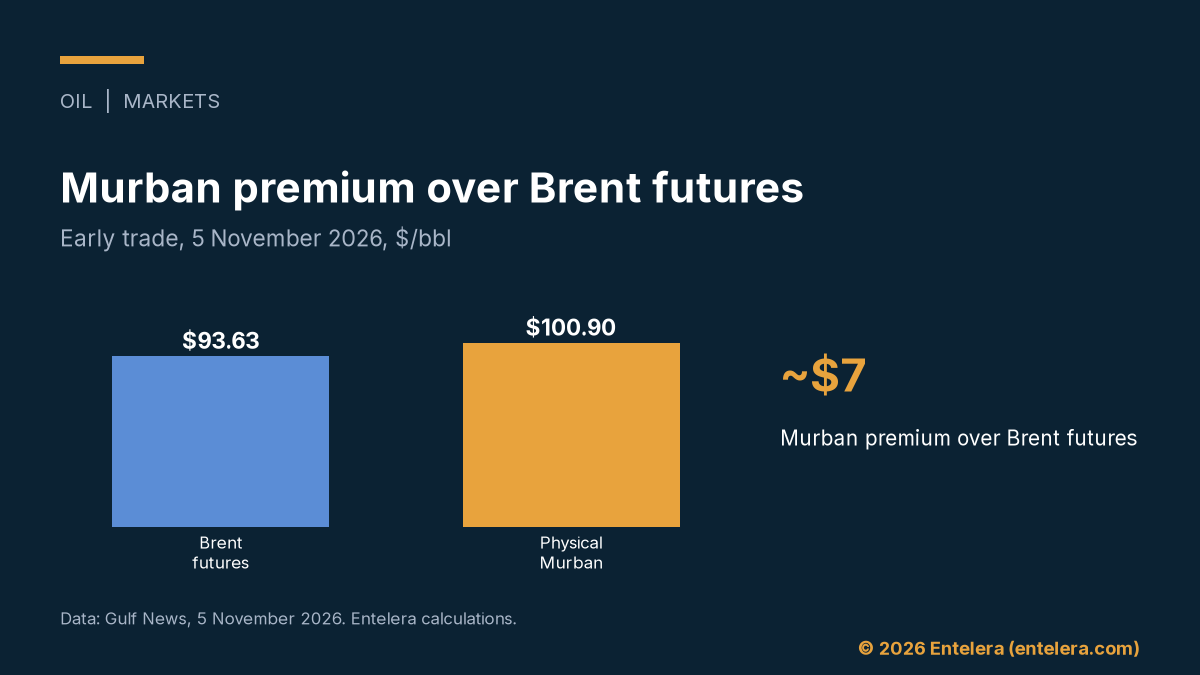
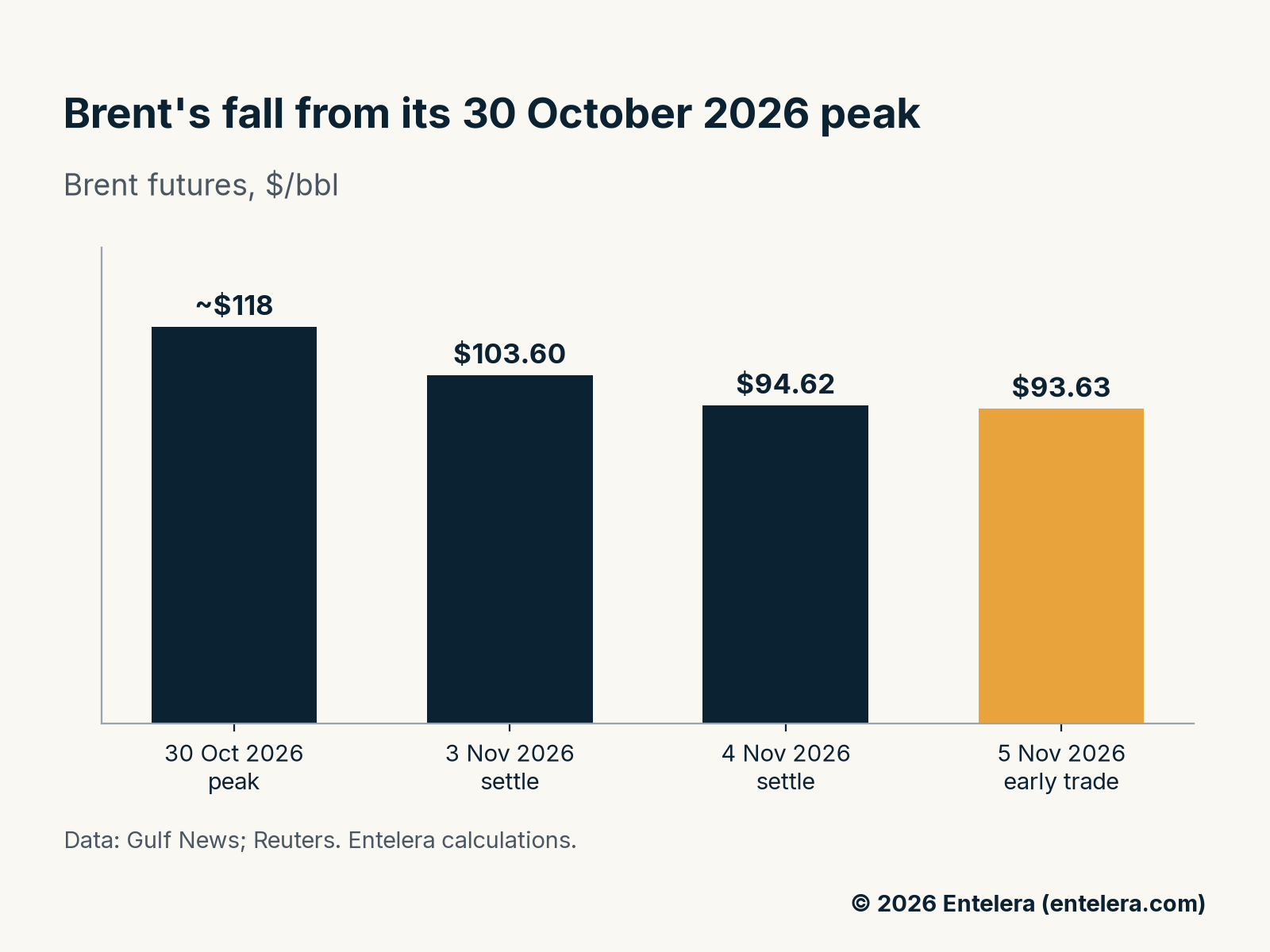
The Murban premium tells a different story from the futures screen. On 4 November 2026, Brent crude fell $8.98, or 8.7%, to settle at $94.62 a barrel, Reuters reported. It was the lowest close since 31 August 2026. Yet early on 5 November 2026, physical Murban traded at $100.90, against $93.63 for Brent futures, Gulf News said.
This analysis looks at why the paper market fell so fast, and why the physical barrel did not follow.
The paper market priced a deal
The trigger was political. Democrats won both houses of Congress on 3 November 2026, and traders bet that Washington would now seek a deal with Iran. In addition, President Donald Trump said the US had no immediate plans to strike Iran.
As a result, Brent has fallen from near $118 on 30 October 2026 to $93.63, Gulf News reported. On our calculation, that is a fall of ~$24, or ~21%, in four sessions.
WTI fell less. It lost $7.97, or 8.3%, to $88.12 on 4 November 2026. So the Brent-WTI spread narrowed again, to $6.50 from $7.51 a day earlier, on our calculation. In other words, the seaborne war premium is still leaving the paper market first.
Why the Murban premium held
Physical supply has not changed. Gulf exports of crude, condensate and products averaged 17.1 mmbbl/d in October 2026, Vortexa data show. That was down from 18.9 mmbbl/d in September 2026, or roughly three-quarters of pre-war levels.
Moreover, Murban has a rare advantage. Abu Dhabi can pump it to Fujairah, on the Gulf of Oman, and load it outside the Strait of Hormuz. That makes it one of the few Gulf grades still reaching buyers reliably. Asian refiners therefore pay up for prompt, deliverable barrels.
On our calculation, the gap stood at ~$7.27 a barrel early on 5 November 2026. In our view, that is the market’s real gauge of risk. Futures price the chance of peace; the physical premium prices the barrels still missing today.
US stocks add to the tightness
US data also point to a tight market. Crude stocks fell by 865,000 barrels to 409.8mn barrels in the week to 30 October 2026, the US Energy Information Administration said. By contrast, analysts had expected a rise of 877,000 barrels.
Distillates fell harder, by 3.6mn barrels to 99.3mn barrels, against an expected 100,000-barrel drop. Meanwhile, refinery use rose to 94.5%. Only Cushing, the WTI delivery hub, built stocks, by 280,000 barrels.
What it means for traders and refiners
For refiners, cheaper Brent does not mean cheaper Gulf crude yet. A buyer of Murban still pays ~$100 a barrel. So margins on Gulf-linked supply improve less than the headline suggests. Also, Vortexa said the October export data are more likely to be revised up than down.
Not everyone trusts the rally in peace bets. “I’m more concerned that we can see an escalation in Iran sooner than a resolution,” said Carl Larry of Enverus. For our earlier work on the spread, read Brent-WTI Spread: Why the Iran Peace Trade Hit Brent Harder Than WTI.
In our view, the Murban premium is the number to watch. If it narrows towards Brent, physical supply is returning. If Brent keeps falling while Murban holds, the paper market has run ahead of the barrels.
What to watch for the Murban premium
- Formal US-Iran talks and Qatar’s mediation, after the midterm result.
- Revised Gulf export data from Vortexa and Kpler for October and November 2026.
- January 2027 Brent expiry on 30 November 2026, one day after the OPEC+ meeting on 29 November 2026.
Sources
- Reuters via Cyprus Mail, Oil slumps after midterm election, raises bets on Iran war exit, 4 November 2026: cyprus-mail.com
- Gulf News, Crude slides toward $93, WTI drops to $87 as Trump rules out immediate Iran strikes, 5 November 2026: gulfnews.com
- Reuters via EnergyNow, US crude stocks, gasoline and distillate inventories fall – EIA, 4 November 2026: energynow.com
- Reuters via Investing.com, Gulf oil flows dip in October from post-Iran war high, data shows, 3 November 2026: investing.com
- Economy Middle East, Murban and the new geography of oil power: economymiddleeast.com