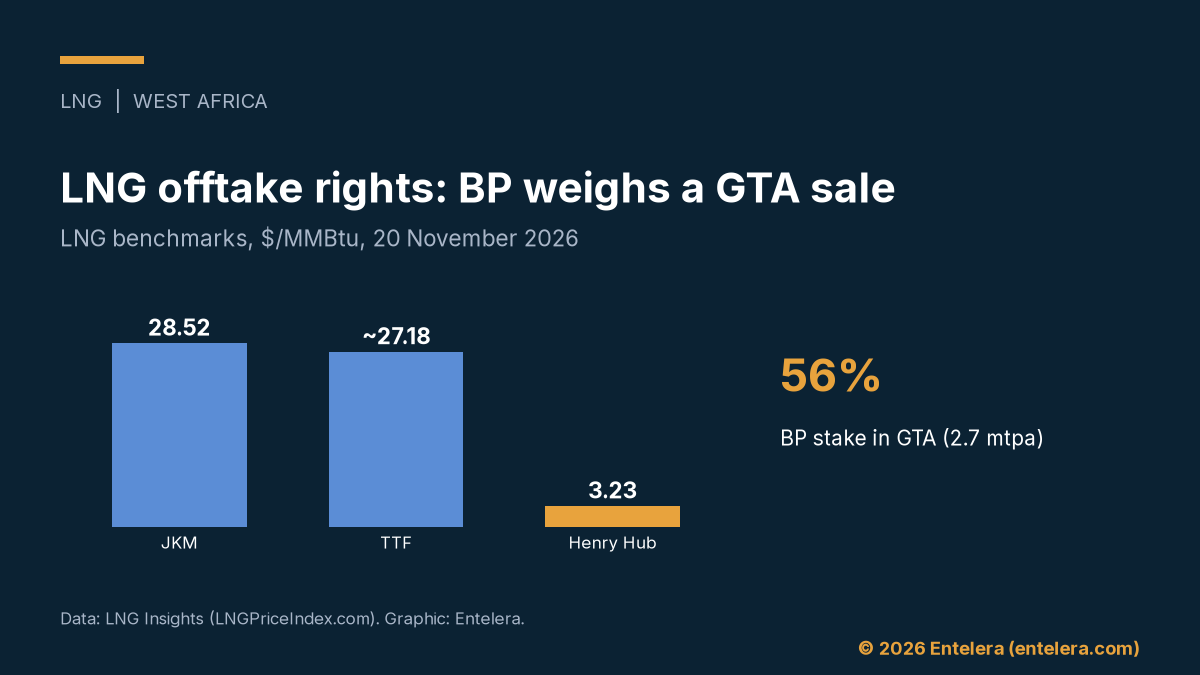
LNG offtake rights may matter more to BP than the plant itself. BP is weighing a sale of its 56% stake in Greater Tortue Ahmeyim (GTA) off Senegal and Mauritania, Bloomberg reported, as our news story on the BP GTA LNG stake sale reported. Yet BP would likely keep the right to lift and market all GTA cargoes. For traders, that split between equity and marketing is the real story.
What BP would sell, and what it would keep
GTA’s floating plant has a nameplate capacity of 2.7 mtpa, and Investing.com put its value at $4.8bn. BP’s share made up roughly 13% of the 12mn tonnes of LNG it produced worldwide in that period. Partners are Kosmos Energy (27%), Senegal’s Petrosen (10%) and Mauritania’s SMHPM (7%).
Crucially, people familiar with the matter told Bloomberg that BP would likely keep LNG offtake rights for all GTA cargoes. In effect, BP would swap an operating asset for a marketing contract. The plant fed BP’s trading arm during the Iran war, when Qatari shipments faltered.
However, an expansion phase needs more capital. Phase 2 could add up to 3 mtpa through a gravity-based structure, lifting the project above 5 mtpa. So a sale would let BP avoid those costs while chief executive Meg O’Neill cuts debt ahead of her strategy update next month.
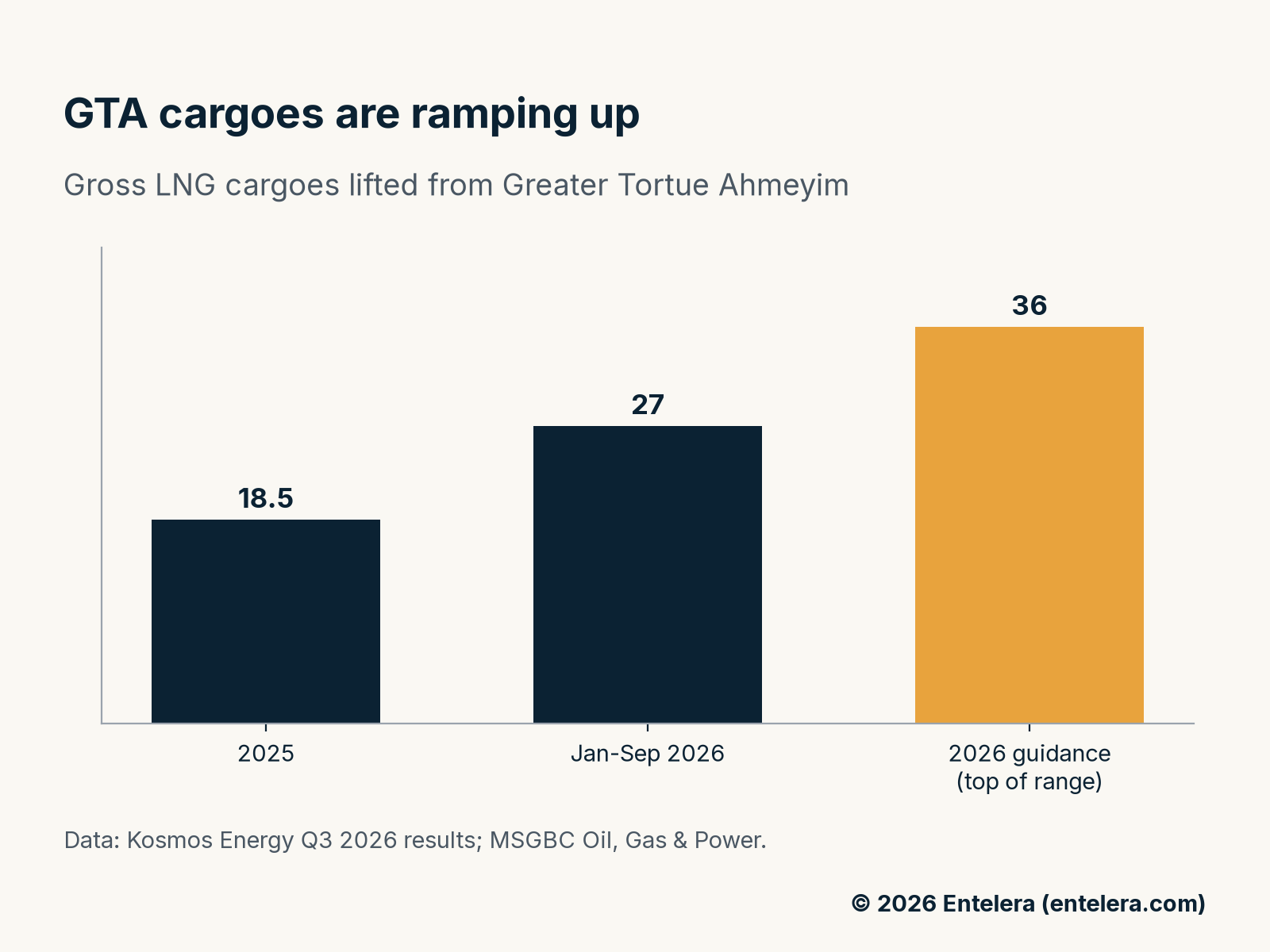
GTA cargoes are ramping up
Operationally, GTA has turned a corner. The partners lifted 8.5 cargoes in Q3 2026 and 27 in the first nine months, Kosmos said. As a result, full-year liftings should reach the upper end of the 32-36 guidance, against 18.5 cargoes in 2025.
Meanwhile, output averaged ~2.44 mtpa in Q3 2026, below nameplate because of warmer seasonal temperatures. Kosmos expects 8-9 cargoes in Q4 2026, at an average of ~170,000 cubic metres each.
Why LNG offtake rights carry the value
Now look at prices. On 20 November 2026, JKM stood at $28.52/MMBtu and TTF at ~$27.18, LNG Insights data show. Henry Hub was just $3.23. Indeed, a standard 3.4 TBtu cargo was worth ~$97mn at JKM.
At that value, 36 cargoes a year would gross ~$3.5bn at spot prices, on our sums. Of course, much of that margin goes to whoever markets the gas, not to whoever owns the plant. Therefore, BP can sell the equity, bank cash and still keep the trading upside that helped BP during the Iran war.
Equally, the JKM-TTF spread was only +$1.34/MMBtu. GTA sits in the Atlantic, so its cargoes can swing between Europe and Asia as that spread moves. That flexibility is exactly what a portfolio trader wants to keep, and LNG offtake rights deliver it without the capital bill.
What LNG offtake rights mean for traders, portfolio players and buyers
Traders: if BP keeps marketing rights, GTA volumes stay in its portfolio. Watch the JKM-TTF spread for where those Atlantic cargoes land.
Portfolio players: a buyer would own infrastructure and gas-in-place but hand the trading margin to BP. That suits a national oil company or an infrastructure fund more than a trader.
Buyers: for European utilities, GTA is a short-haul Atlantic source. Since Qatari cargoes are absent, the same logic as Orlen’s move away from oil-indexed LNG applies: flexible supply now earns a premium.
Investors: our BP Q3 2026 results summary sets out the earnings base. A sale with retained offtake would keep the trading stream while freeing capital.
What to watch next
BP’s strategy update next month, and whether it confirms a GTA sale.
The structure of any deal, especially how long BP keeps LNG offtake rights.
A final investment decision on GTA Phase 2, and who funds it.
The JKM-TTF spread through winter 2026-27.
Sources
Investing.com (Bloomberg), BP weighs divesting West Africa LNG stake to streamline portfolio, 19 November 2026: investing.com
Kosmos Energy, Third quarter 2026 results, November 2026: kosmosenergy.com
MSGBC Oil, Gas & Power, bp backs MSGBC 2026 amid 3 mtpa GTA Phase 2 LNG push, 2026: msgbcoilgasandpower.com
LNG Insights, LNG benchmark pricing, 20 November 2026: lnginsights.com
Free account
Sign up free to read the full analysis
Create a free Entelera account to read every analysis in full. It takes less than a minute; no payment details needed.
Entelera Research is the editorial team behind Entelera. We cover crude, LNG, power, renewables, policy and geopolitics, looking at energy the way companies have to: supply, demand, margins, policy and risk, with every number linked to its source and a close eye on India and its place in global markets.
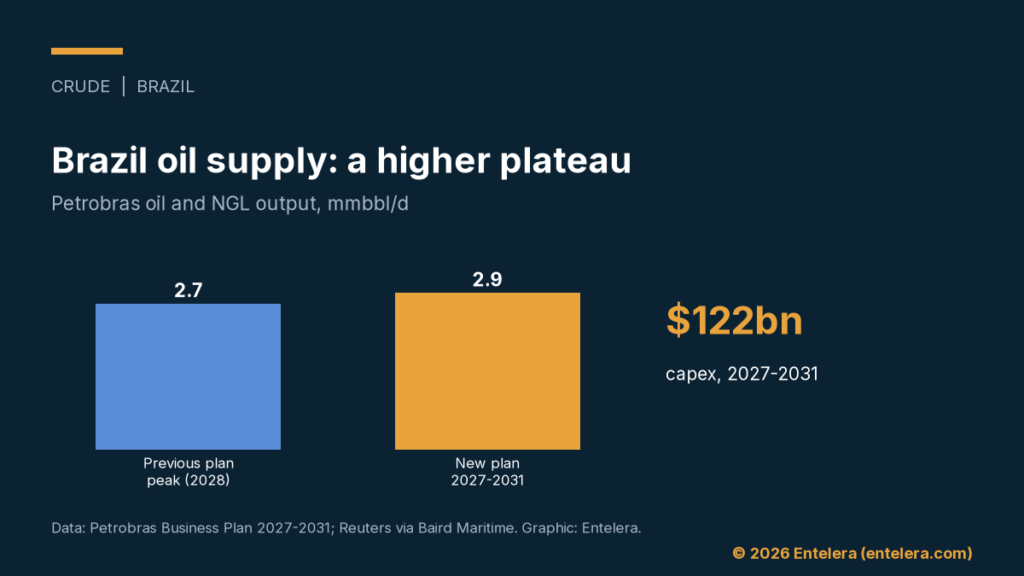
Brazil oil supply climbs to a 2.9 mmbbl/d Petrobras plateau to 2031. What the $122bn plan means for crude differentials, diesel imports and 2027 balances.