Saudi Arabia will store crude at Singapore’s Jurong Rock Caverns from the second half of 2027, the two countries said on 26 October. The aim is to bring oil closer to Asian buyers after the war disrupted Hormuz shipments.
It is a sensible move. But how much difference can one storage site make? This analysis puts it in scale.
How big are the Jurong Rock Caverns?
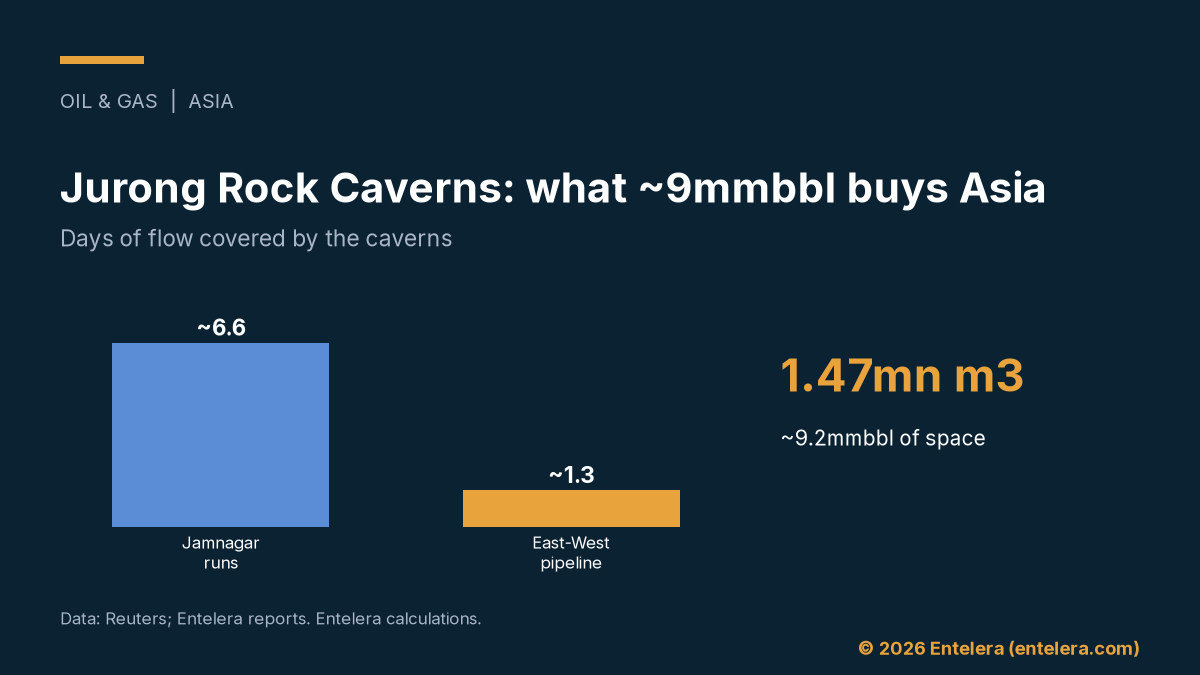
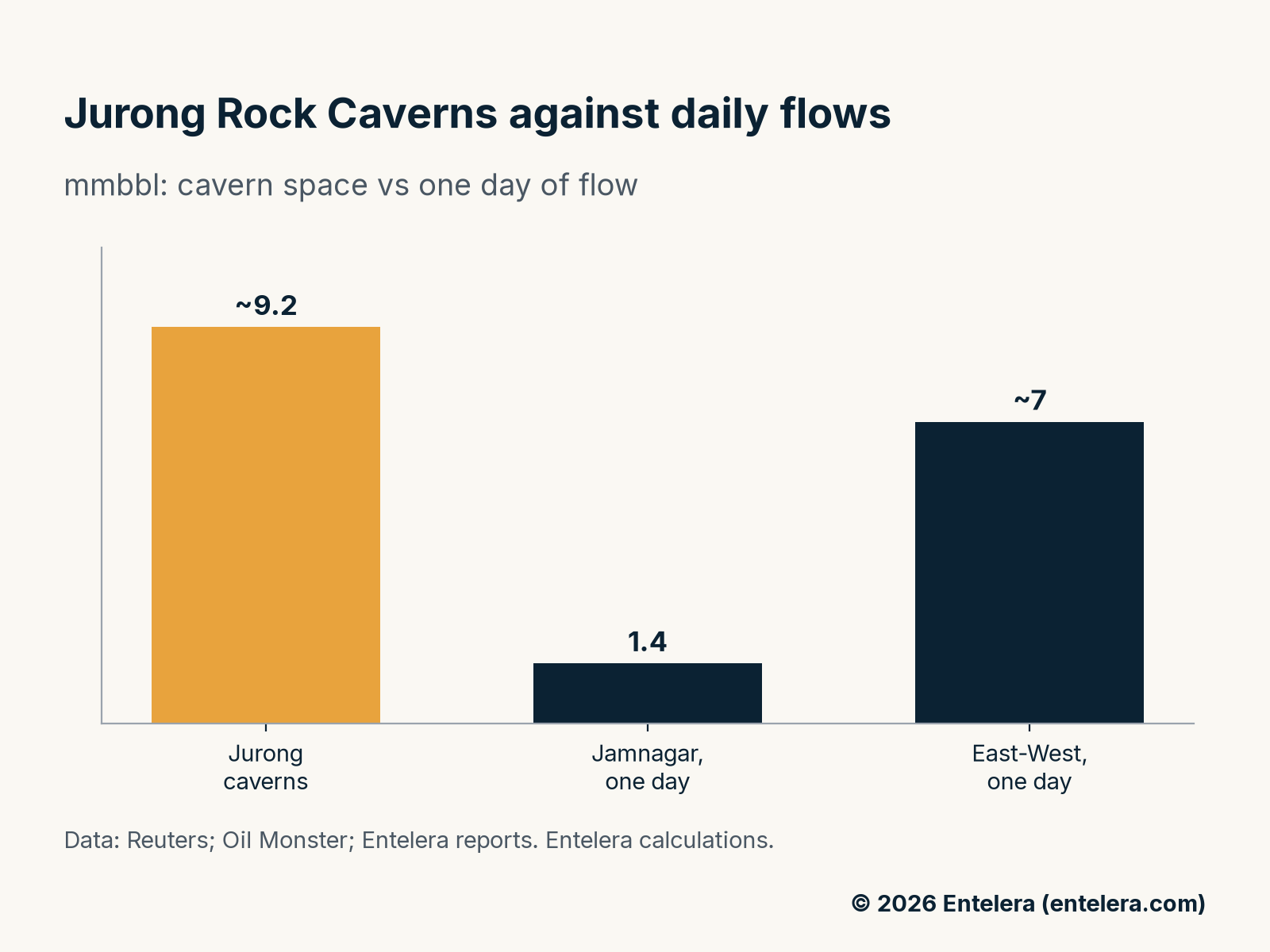
The caverns sit 150 metres under Jurong Island. They can hold up to 1.47mn cubic metres of liquids such as crude and condensate. At 6.29 barrels per cubic metre, that is ~9.2mmbbl, on our estimate. However, neither side said how much Aramco will store, or on what terms.
For comparison, Reliance’s Jamnagar complex can process about 1.4 mmbbl/d. So a full cavern equals ~6.6 days of its runs. Similarly, it is ~1.3 days of the East-West pipeline at its maximum of about 7 mmbbl/d.
A buffer, not a reserve
In other words, the caverns cannot replace lost Gulf supply for long. Instead, they can bridge a gap of days while tankers reroute. That still matters. Before the war, Asia bought two-thirds of its crude from the Middle East, Reuters reported.
For Aramco, the benefit is speed. Oil already in Singapore can reach Asian refiners in days, rather than weeks from Yanbu. In addition, it gives Aramco a stronger hand in its row with Asian buyers over 2027 contract terms.
What the Jurong Rock Caverns deal signals
In our view, the deal points to a wider shift: producers are moving stock closer to customers. India, for example, has held talks with ADNOC on its strategic reserve expansion. For that model, see our analysis of India’s strategic reserves.
Meanwhile, the timing tells its own story. A start in the second half of 2027 suggests both sides expect supply risk to last. Indeed, the IEA does not expect markets to return to pre-war levels next year.
What to watch next
- The volume and terms Aramco commits.
- Similar deals with Japan, South Korea or India.
- Aramco’s 2027 term talks with Asian refiners.
For the news, read our report on the Singapore storage plan.
Sources
- Reuters via Moneycontrol, Saudi Arabia to store crude oil in Singapore to bolster Asia supply security, 26 October 2026: moneycontrol.com
- Arab News, Saudi Arabia plans Singapore crude storage to strengthen Southeast Asia supply chain, 26 October 2026: arabnews.com
- Oil Monster, Houthis claim fresh attack on Saudi East-West pipeline (pipeline capacity), 27 October 2026: oilmonster.com
- Entelera, Rubio presses Reliance to refine more Venezuelan crude (Jamnagar capacity), 21 October 2026: entelera.com