An Infineum sale is back on the table. Shell and ExxonMobil, which own the fuel and lubricant additives maker 50:50, have hired Bank of America to explore a deal, the Financial Times reported on 22 October. They are aiming for a valuation of ~$8bn, and private equity could be interested. However, the process is at an early stage and may not lead to a sale.
For two of the world’s largest oil companies, the price is modest. Still, the move says a lot about how both now rank their businesses. This analysis looks at what Infineum is, what the money means and who could buy it.
What the Infineum sale would put on the market
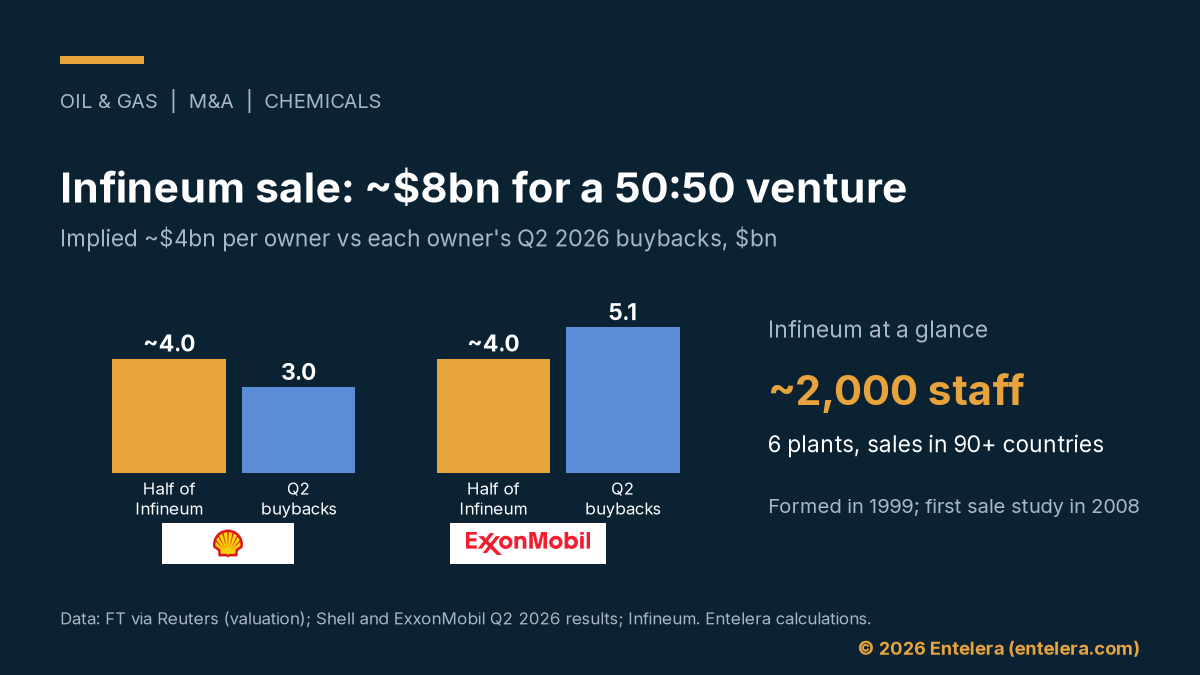
Infineum was formed in January 1999, when ExxonMobil and Shell combined their additive divisions. It makes the chemicals that help engine oils and fuels work, from detergents to cold-flow improvers. It has ~2,000 staff and six plants, in the US, Brazil, Germany, Italy, Singapore and China. Its products sell in more than 90 countries, its 2024 sustainability report says.
Moreover, it is one of only four major suppliers of lubricant additives. The others are Lubrizol, owned by Berkshire Hathaway, Chevron’s Oronite and Afton Chemical, part of NewMarket. Neither owner reports Infineum’s earnings separately, so outsiders cannot test the ~$8bn figure against profit.
Why the owners are trying an Infineum sale again
This is not the first attempt. In March 2008, the two companies hired JP Morgan to test market interest in Infineum, Lubes’N’Greases reported at the time. No sale followed. One consultant warned then that regulators would look closely at a purchase by any of the other three big suppliers.
That point still matters. In our view, competition rules make a deal with a rival hard, which is why private equity is the natural bidder. A buyer would also need long supply deals. Infineum sells to its owners as well as to third parties, and site partners run two of its French plants.
Timing helps too. High oil prices have left the majors with strong cash flow, and they are pruning assets that do not fit. Chevron, for instance, is marketing older US Gulf fields, as our analysis of Chevron asset sales explains.
What an Infineum sale is worth to each owner
On the reported valuation, each owner’s half is worth ~$4bn before tax, debt and fees. That is small next to their cash flow. In the second quarter, Shell generated $21.4bn of operating cash flow and bought back $3.0bn of shares. Over the same period, ExxonMobil generated $23.6bn and bought back $5.1bn.

On our estimate, ~$4bn equals ~19% of Shell’s second-quarter operating cash flow and ~17% of ExxonMobil’s. For Shell, it would also equal ~10% of its $41.8bn of net debt at the end of June. Clearly, the money helps, but it does not change either balance sheet.
For comparison, Berkshire Hathaway paid ~$9.7bn for all of Lubrizol in 2011, including ~$0.7bn of net debt. Lubrizol was a broader business, with 2010 revenue of $5.4bn, of which additives made $3.9bn. Without Infineum’s own figures, however, we cannot say whether ~$8bn is a full price.
Shell’s wider exit from chemicals
For Shell, the Infineum sale fits a bigger plan. Chief executive Wael Sawan has said Shell wants either a sale or a capital-market deal for its US chemicals business. In August, the FT reported that ExxonMobil, LyondellBasell, Apollo and Kuwait Petroleum’s chemicals arm had made early offers for those assets. The whole US portfolio could fetch up to $8bn, the FT said, although Shell invested $14bn in its Monaca plant alone.
Meanwhile, chemicals results have swung widely. The unit lost $117mn on an adjusted basis in the first quarter. Then it earned $0.4bn in the second, its best result since the third quarter of 2021, as margins rose. Shell has also sold Jiffy Lube in the US and agreed other non-core sales this year.
ExxonMobil: seller here, buyer there
ExxonMobil’s position looks mixed. It would sell its half of Infineum, yet it is reportedly among the bidders for Shell’s US chemicals plants. In our view, the two fit together. ExxonMobil wants large chemical plants tied to its own refineries and feedstock, not a half share in a business it does not control alone.
By contrast, Chevron keeps Oronite, its own additives arm. So if a fund buys Infineum, Oronite would be the only one of the four big additive makers still owned by an oil major.
What to watch next
- First-round bids, and whether private equity or a trade buyer leads.
- Any figures for Infineum’s earnings, which would show whether ~$8bn is a full price.
- Shell’s third-quarter results on 29 October, for updates on chemicals sales and buybacks.
- ExxonMobil’s third-quarter results, for any comment on Infineum or Shell’s US chemicals.
- Competition reviews, if a rival additive maker bids.
In short, an Infineum sale would raise little cash for either owner. Its value lies in the signal: both majors are narrowing what they own, and a niche additives business no longer makes the cut. For the deal report itself, see our news story on the Infineum sale.
Sources
- Reuters via BOE Report, Shell- and Exxon-backed UK chemicals group weighs $8 billion sale, FT reports, 22 October 2026: boereport.com
- Reuters via Euronext, Shell- and Exxon-backed UK chemicals group weighs $8 billion sale, FT reports, 22 October 2026: live.euronext.com
- Infineum, Sustainability Report 2024: infineum.com
- Infineum, Sustainability Report 2020 (sites and site partners): infineum.com
- Lubes’N’Greases, Who Is Eyeing Infineum?, 19 March 2008: lubesngreases.com
- The Lubrizol Corporation, 2010 annual report on Form 10-K (competitors, additives revenue): sec.gov
- Berkshire Hathaway, completion of the Lubrizol acquisition, 16 September 2011: berkshirehathaway.com
- Shell, second-quarter 2026 press release: shell.com
- ExxonMobil, second-quarter 2026 earnings release (Form 8-K), 31 July 2026: investor.exxonmobil.com
- Bloomberg via Energy Connects, Exxon among suitors for Shell US chemicals unit, FT says, 24 August 2026: energyconnects.com
- Clash Report, Shell draws Exxon, Lyondell interest in $8bn US chemicals sale (citing the FT), 24 August 2026: clashreport.com
- Industrylinqs, Shell CEO: better market conditions needed to sell chemicals business, May 2026: industrylinqs.com