Shell and TotalEnergies have just posted their highest quarterly profits since 2022. On 29 October 2026, Shell reported adjusted earnings of $10.8bn for the third quarter of 2026 and TotalEnergies $9.1bn. Repsol’s adjusted net income rose to €2.71bn ($3.11bn). For all three European oil majors, refining did most of the work.
This analysis looks at how much of the profit came from refining, where the cash went, and why the buybacks grew more slowly than the windfall.
How much refining carried the European oil majors
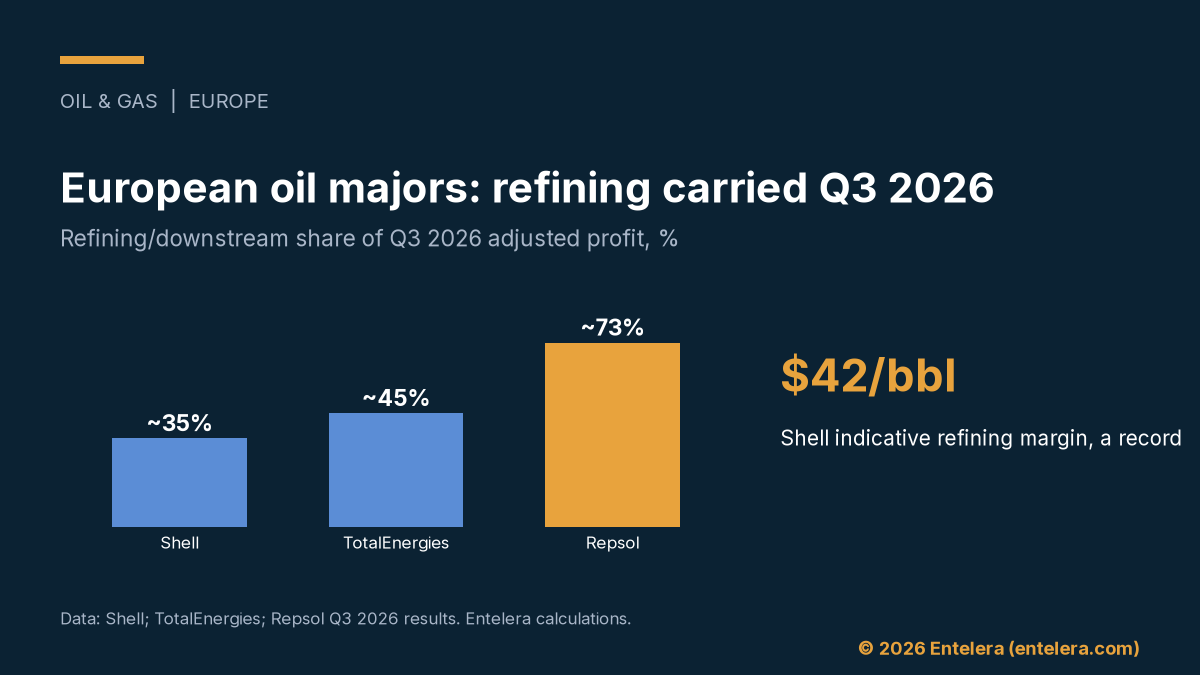
Refining margins hit records. Shell’s indicative refining margin reached $42/bbl, against $24/bbl in the second quarter of 2026. Repsol’s Spanish margin indicator was $36.2/bbl, from $8.8/bbl a year earlier. Meanwhile, TotalEnergies earned $33.2/bbl, Reuters reported.
As a result, downstream became the biggest profit centre. Shell’s Products unit earned $3.8bn, about 35% of group adjusted earnings, on our estimate. TotalEnergies’ Downstream made a record $4.1bn, roughly 45% of its adjusted net income. At Repsol, the Industrial division made €1.99bn ($2.28bn), or about 73% of the total. In other words, the smaller and more refining-heavy the company, the bigger the windfall.
Where the cash went
Cash flow from operations was huge. Shell generated $21.0bn, TotalEnergies $12.3bn and Repsol €3.53bn ($4.05bn). However, the buybacks rose only modestly. Shell lifted its quarterly buyback to $5bn, from $3bn. TotalEnergies set $2.5bn a quarter for the fourth quarter of 2026 and the first quarter of 2027. Repsol launched a third 2026 buyback of €950mn ($1.09bn).
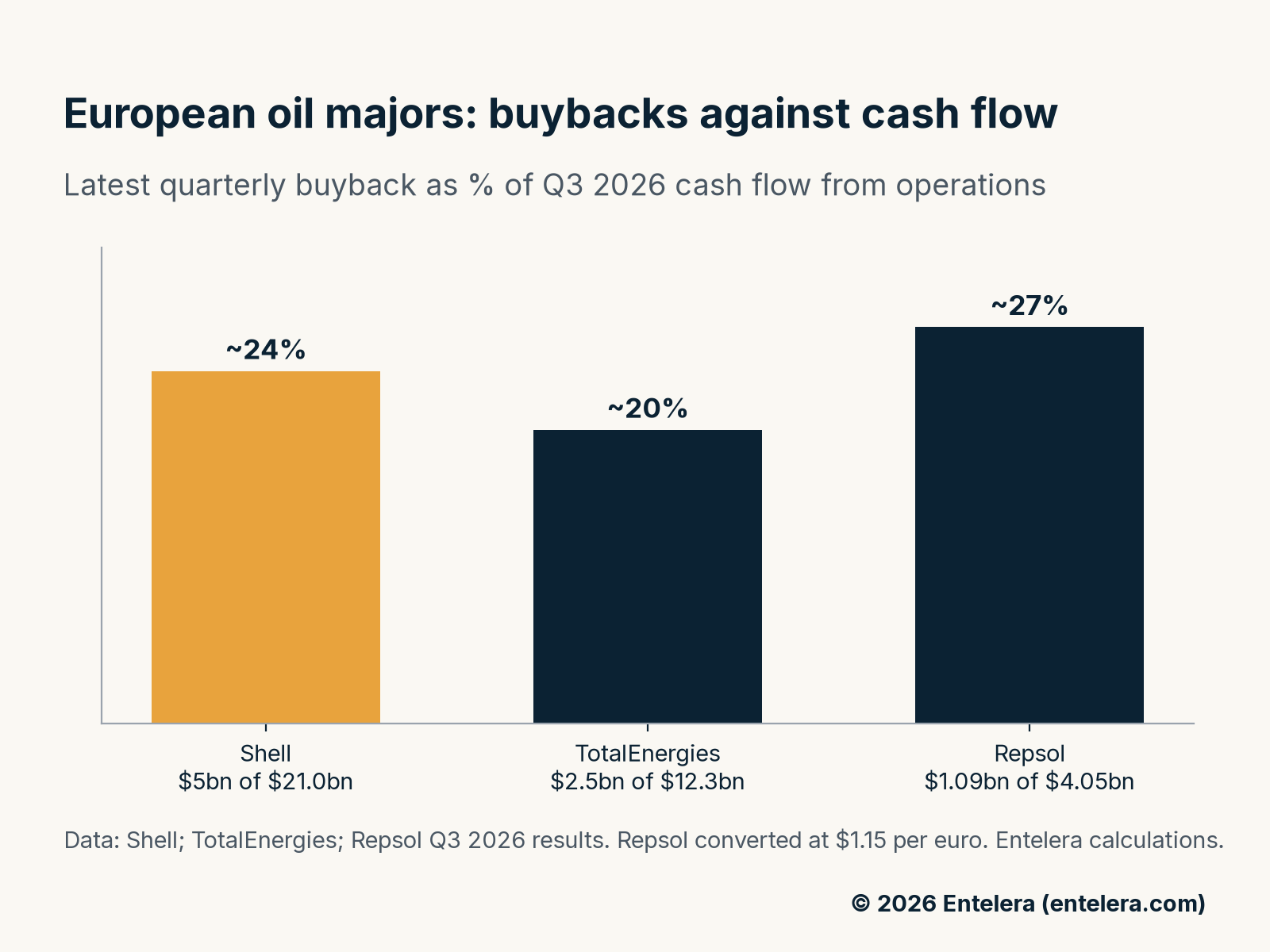
Measured against one quarter’s cash flow, the European oil majors are handing back a quarter or less through buybacks, before dividends. Instead, much of the rest went into balance sheets. Shell’s net debt fell to $39.7bn, even after its $16.4bn purchase of ARC Resources. TotalEnergies cut gearing to 9.1%, from 13.1%, and Repsol to 6.2%, from 11.3%.
Why the European oil majors are holding back
In our view, the boards are treating the refining windfall as temporary. First, the margin comes from the fuel squeeze after the Strait of Hormuz closed. If Gulf product exports return, it could fall quickly, as our analysis of US refining margins showed. Second, buybacks are hard to cut once raised, so a step-by-step increase is safer.
Moreover, each company has its own claims on the cash. Shell’s net debt includes about $8bn of non-cash lease debt linked to shipping rates. It also expects a non-cash loss of about $6.4bn on a Dutch pension plan in the fourth quarter of 2026. TotalEnergies took a $1.9bn impairment, mainly on offshore wind. Still, RBC expects Shell to miss its payout guidance of 40-50% of cash flow for 2026.
What to watch next
- BP, ExxonMobil and Chevron results on 30 October 2026, for a direct comparison of refining earnings and buybacks.
- Shell’s Capital Markets Update on 4 February 2027, where payout policy may change.
- Refining margins into winter 2026-27, which decide whether the European oil majors raise buybacks again.
For the news, read our report on the Shell Q3 2026 results. Also see our reports on TotalEnergies and Repsol.
Sources
- Shell, Shell plc 3rd quarter 2026 and nine months unaudited results, 29 October 2026: shell.com
- Shell via GlobeNewswire, Shell plc publishes third quarter 2026 press release (segment table, net debt, outlook), 29 October 2026: globenewswire.com
- Reuters via Euronext Live, Shell and Total post highest quarterly profit since 2022, 29 October 2026: live.euronext.com
- TotalEnergies, Third quarter 2026 results, 29 October 2026: totalenergies.com
- TotalEnergies via Business Wire, TotalEnergies SE: Third Quarter 2026 Results, 29 October 2026: businesswire.com
- Repsol via MarketScreener, Information on the third quarter 2026 results, 29 October 2026: marketscreener.com
- Investing.com, Repsol beats estimates as buyback and dividend boost lifts shares, 29 October 2026: investing.com