Chevron and Egypt took another step on Aphrodite gas on 20 October. They initialled financial and commercial terms for linking the Cyprus field to Egypt’s gas grid, the petroleum ministry said. The project is now in front-end engineering and design (FEED), ahead of a possible final investment decision (FID).
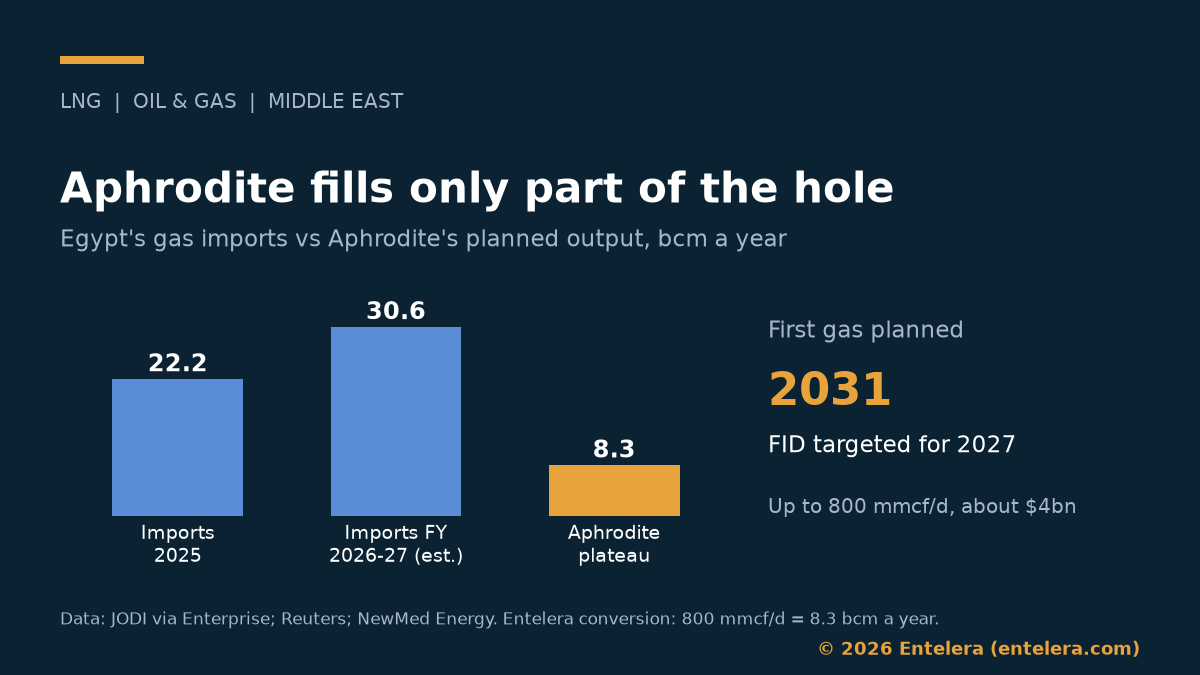
Clearly, this is good news for Egypt, which badly needs gas. However, the numbers show its limits. At its planned peak, Aphrodite would supply about 8.3 bcm a year, on our estimate. That is roughly a quarter of the imports Egypt expects this fiscal year. Moreover, first gas is not due until 2031.
What Aphrodite gas brings
To begin with, Aphrodite lies offshore Cyprus. Its best-estimate contingent resources are 3.7 tcf, after a 4% upgrade in March, MEES reported. Chevron operates the field with 35%. Shell holds another 35% and NewMed Energy 30%. Shell agreed in July to sell its Cyprus unit to Hungary’s MOL, subject to approvals, Reuters reported.
In addition, the development plan is straightforward. A floating production unit with four initial wells would produce up to about 800 mmcf/d, NewMed Energy said. Then, a subsea pipeline of about 280km would carry the gas to Egypt’s network. The partners put the cost at about $4bn. They aim to take FID in 2027 and start production in 2031.
Meanwhile, Egypt has already secured the sales. In April, the partners signed a 15-year binding term sheet with state-owned EGAS for all the gas the field can produce. Egypt can use it at home or liquefy it for export, the ministry said.
Why Egypt needs Aphrodite gas
Above all, Egypt’s gas output is in steep decline. Production fell from nearly 59 bcm in 2023 to about 42 bcm in 2025, according to JODI data analysed by Enterprise. That is a loss of almost 17 bcm a year in just two years. Over the same period, imports rose from about 8.5 bcm to 22.2 bcm.
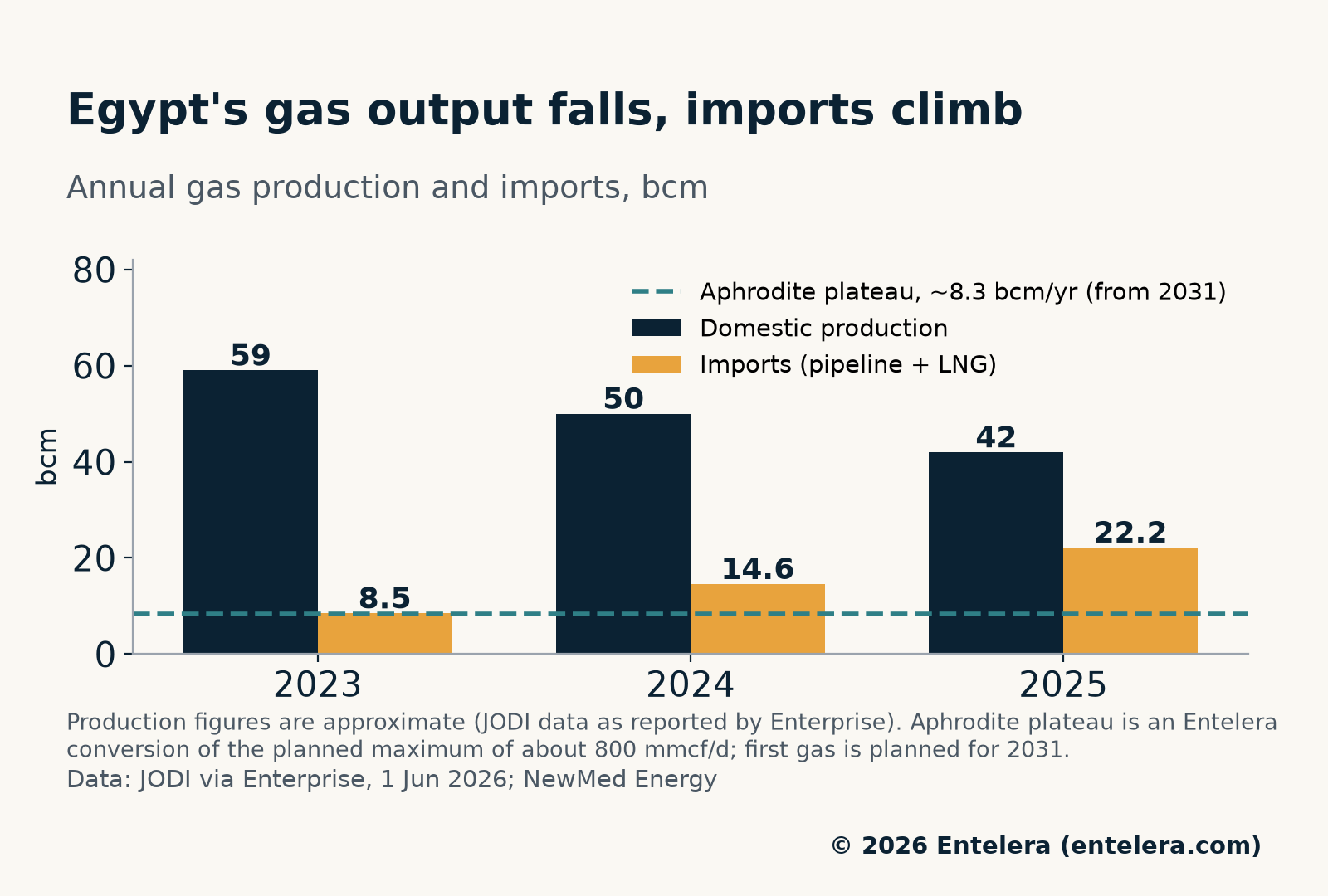
Moreover, the decline has not stopped. Kpler now expects Egypt to produce 37.3 bcm in 2026. As a result, it raised its forecast for Egyptian LNG demand to 12.2mn t this year and 13.2mn t in 2027. Similarly, official documents seen by Reuters put imports at 1,081 bcf in fiscal year 2026-27, up from 985 bcf. That is about 30.6 bcm, against 27.9 bcm, on our conversion.
As a result, LNG now does most of the balancing. Egypt bought around 7.94mn t of LNG in the first seven months of 2026, against 3.4mn t a year earlier, Enterprise reported. In July, imports of 1.67mn t used almost all of its 19.7 mtpa of regasification capacity, Kpler said. Meanwhile, pipeline imports fell 34% year-on-year in the first quarter, to 1.7 bcm, as regional tensions rose.
How much of the gap Aphrodite gas covers
On our estimate, 800 mmcf/d equals about 8.3 bcm a year. That would cover about 27% of Egypt’s expected imports for 2026-27. It would also replace about 63% of the 13.1 bcm of LNG that Egypt imported in 2025. Still, it is just under half of the output Egypt lost between 2023 and 2025.
In fact, Aphrodite gas has real value, too. In energy terms, 8.3 bcm is roughly 300mn MMBtu a year. At $10/MMBtu, that is worth about $3bn. At about $30/MMBtu, close to where Asian spot LNG traded in mid-October according to EnergyReader, it is nearer $9bn. These are Entelera estimates. Even so, they show why Cairo is keen to lock in pipeline gas.
The gap before Aphrodite gas arrives
The bigger problem is timing. Aphrodite will not help this winter, nor for several winters after. So Egypt is in talks with Shell, TotalEnergies, BP and Hartree Partners, Reuters reported. It wants 15 to 18 LNG cargoes a month for at least three years. Those deals could cost $8bn to $11bn a year, Reuters calculated, based on recent deals priced at about $1.5 above TTF. Egypt’s gas import bill for the same volumes had already risen from about $560mn before the conflict to about $1.65bn in March.
Chevron’s East Med position
For Chevron, Aphrodite adds to a strong hand in Egypt. After all, Chevron also operates Israel’s Leviathan field. In August 2025, Leviathan’s partners signed a deal to sell about 130 bcm of gas to Egypt, worth about $35bn, Reuters reported. Israel approved the deal in December 2025.
Then, in January 2026, Chevron and its partners approved a $2.36bn Leviathan expansion, NewMed said. It is designed to lift output to about 21 bcm a year, with first gas from the expansion expected in 2029. In our view, Chevron is becoming Egypt’s main pipeline gas supplier. That gives it more leverage, but it also concentrates risk. Indeed, the first-quarter data show that pipeline flows into Egypt fell during regional tensions.
Similarly, Cyprus has a wider plan. Its energy minister said the Cronos field should export to Europe through facilities linked to Zohr and the Damietta LNG plant. By contrast, Egypt plans to use Aphrodite gas mainly at home. For Europe, any extra East Med LNG would arrive long after this winter; see our report on European gas prices.
What to watch next
- Binding agreements to replace the initialled terms, and the FID planned for 2027.
- FEED results, which should firm up the $4bn cost and the 800 mmcf/d design.
- MOL’s purchase of Shell’s stake, which needs approvals.
- Egypt’s multi-year LNG deals, which would shape its import bill for at least three years.
- Leviathan expansion progress, due to add supply in 2029.
In short, Aphrodite gas is a useful step for Egypt and a strategic one for Chevron. Yet it is not a fix. Until 2031, Egypt’s gas balance runs on LNG. For the deal itself, see our news report on the Aphrodite agreement.
Sources
- Egypt Ministry of Petroleum and Mineral Resources, Aphrodite financial framework, 20 October 2026: petroleum.gov.eg
- Reuters via Baird Maritime, Chevron and Egypt Aphrodite deal, 20 October 2026: bairdmaritime.com
- NewMed Energy, Aphrodite updated development plan, 15 February 2025: newmedenergy.com (PDF)
- NewMed Energy, news and updates (FEED, Leviathan export permit and expansion): newmedenergy.com
- MEES, Aphrodite resources revised up, 13 March 2026: mees.com
- Egypt Today, Aphrodite pipeline of about 280km: egypttoday.com
- Enterprise (JODI data), Egypt gas balance, 1 June 2026: enterpriseam.com
- Enterprise, Egypt LNG imports in 2026, 30 September 2026: enterpriseam.com
- Kpler, Egypt production and LNG demand forecast, 2026: kpler.com
- Reuters via Zawya, Egypt in talks for multi-year LNG supply: zawya.com
- Israel approval of Leviathan export deal (Reuters), 17 December 2025: reuters.com
- EnergyReader, daily briefing (Platts JKM), October 2026: energyreader.io
- Reuters, Leviathan signs $35bn gas supply deal with Egypt, 7 August 2025: reuters.com
- Reuters, Chevron approves Leviathan expansion, 16 January 2026: reuters.com