Australian LNG exports now come with a home-market condition. Parliament passed the Domestic Gas Reservation Scheme on 27 November 2026. From 1 January 2028, exporters must offer up to 20% of their annual exports to local buyers, while Western Australia is exempt. Our news story on the gas reservation scheme covered the law. Here we look at what it means for Australian LNG exports, spot cargoes and JKM.
How big the call on Australian LNG exports really is
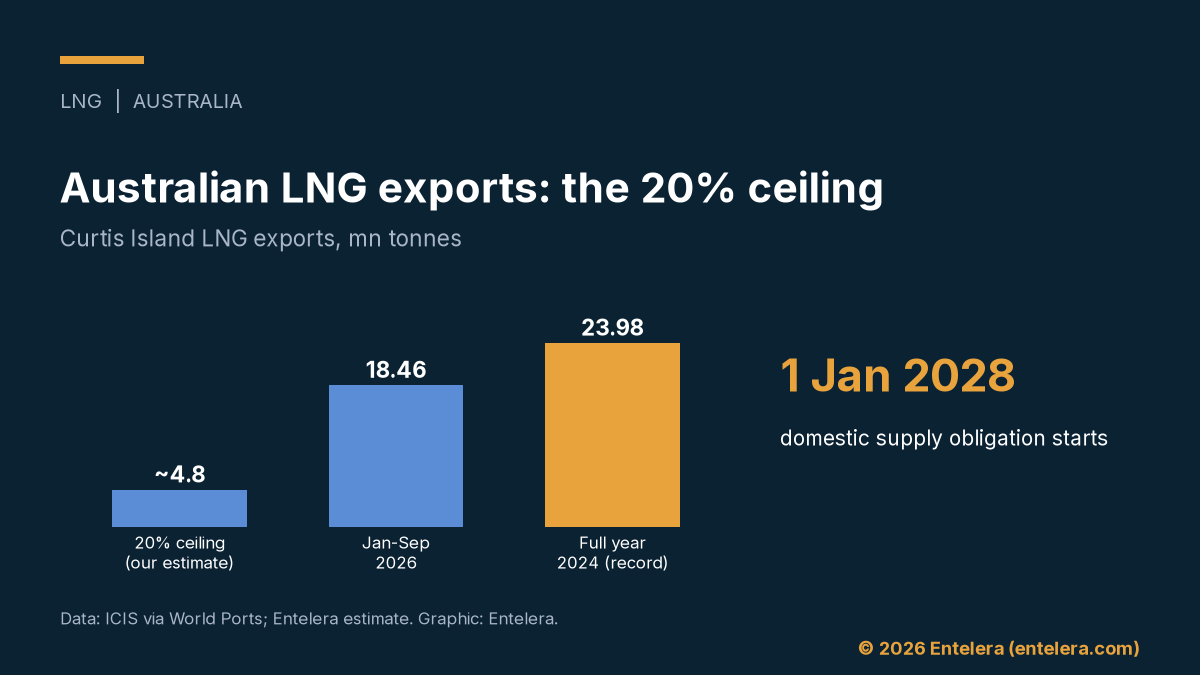
The burden falls on Curtis Island in Queensland. Shell, Origin Energy and Santos run its three plants, which shipped a record 23.98mn tonnes in 2024, ICIS data cited by World Ports show. They loaded 18.46mn tonnes in January-September 2026, up 5.4% on a year earlier. In 2025, Curtis Island made up about 31% of Australia’s 76.02mn tonnes of LNG exports.
So a full 20% obligation on ~24mn tonnes would be close to 4.8mn tonnes a year, by our estimate. However, that is a ceiling, not a target. The regulator will set each obligation to cover forecast demand plus a 10% oversupply. It can also cut it when the full 20% is not needed. Also, the law respects LNG contracts signed on or before 22 December 2025, the energy department says.
The spot cargoes are what traders lose
The real exposure is the spot book. AEMO expects about 1,253 PJ a year of east coast gas to go to long-term LNG contracts through 2035, plus 85 PJ a year for spot cargoes. By our estimate, 85 PJ is roughly 1.5mn tonnes of LNG, or about 20 standard cargoes of ~70,000 tonnes.
Meanwhile, the near-term domestic gap is small. In June 2025, the ACCC said an east coast supply gap of 55 PJ was possible in 2028, rising to 543 PJ by 2034. On our conversion, 55 PJ is about 1mn tonnes of LNG. In other words, the first-year call could absorb much of the spot book but leave term contracts intact. After that, the call grows as southern fields decline. For example, AEMO sees Victoria’s shortfall reaching 115 PJ in 2035, about 2.1mn tonnes of LNG.
Netback versus home price
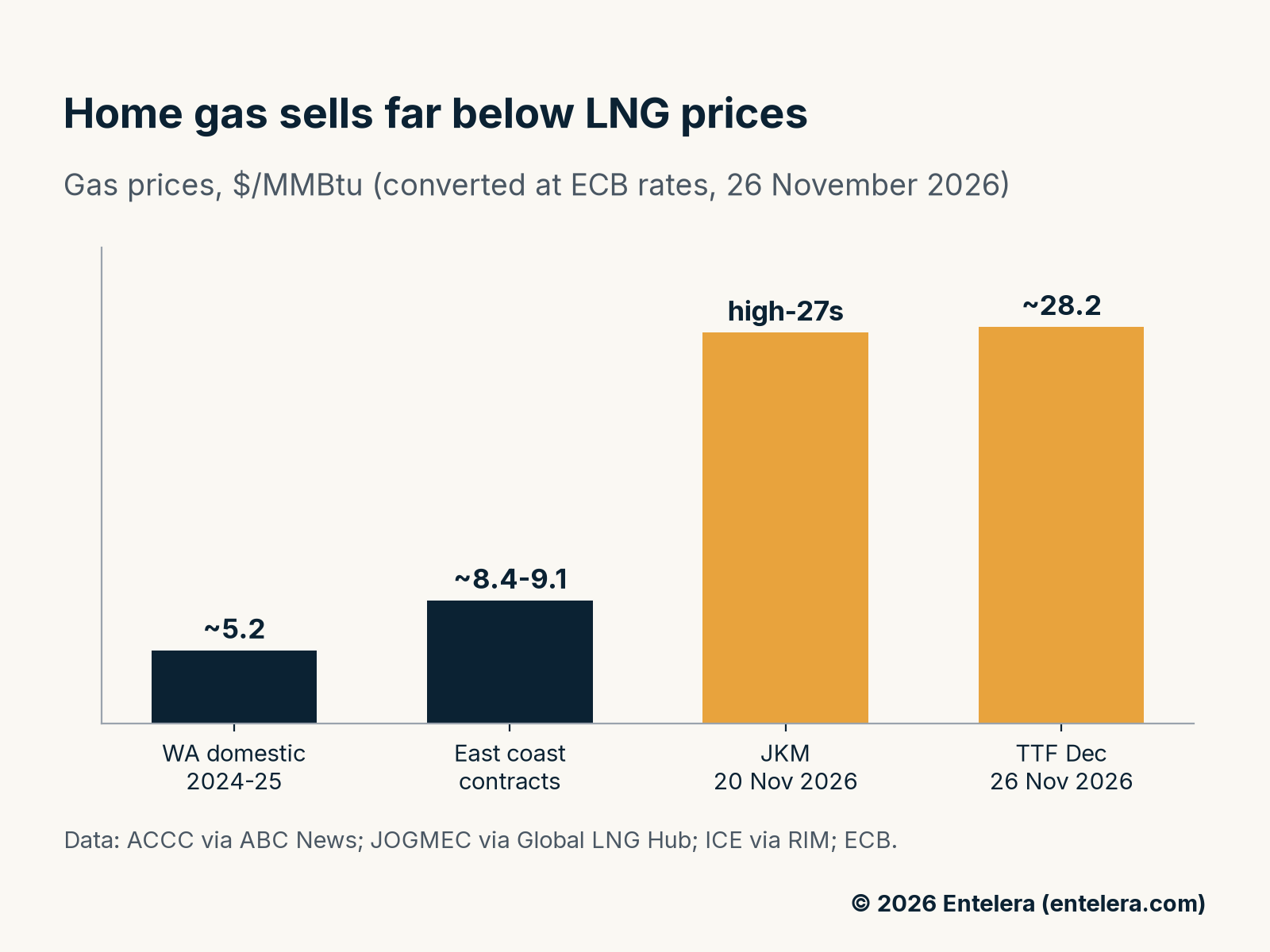
The price gap explains why exporters resist. East coast long-term contracts cost about AUD12-13 a gigajoule, ACCC figures cited by ABC News show. That is ~$8.40-9.10/MMBtu at the ECB rate of 26 November 2026. Western Australia averaged AUD7.45 a gigajoule in 2024-25, or ~$5.20/MMBtu. By contrast, JKM traded in the high-$27s/MMBtu on 20 November 2026, JOGMEC data show. Then on 26 November, ICE TTF for December settled at €87.83/MWh (~$28.20/MMBtu).
So at today’s prices, every cargo of Australian LNG exports sold at home gives up a wide margin. Still, the law bites from 2028, not this winter. Moreover, the IEA expects about 300 bcm a year of new LNG export capacity by 2030, which should narrow that netback. Therefore, the scheme costs exporters most if Asian prices stay high into 2028. Our JKM analysis tracks the current market.
What Australian LNG exports mean for traders, portfolio players and buyers
LNG traders: fewer uncommitted Queensland cargoes from 2028 remove a Pacific balancing tool. That supports JKM in winter at the margin and thins Pacific spot liquidity.
Spread traders: the scheme adds to the case for JKM over TTF in northern winters from 2028, since Queensland is one of the closest flexible sources to north Asia.
Portfolio players: Shell, Origin, Santos and the GLNG partners, including Petronas, TotalEnergies and KOGAS, lose spot optionality. By contrast, WA exporters such as Woodside keep theirs, as in its Trafigura supply deal.
Buyers: Japanese, Korean and Chinese term buyers keep their pre-2026 contracts. However, spot and mid-term tenders for Queensland gas should get thinner.
What to watch next
The regulator’s rules on how it measures demand and the 10% oversupply.
Export licence applications during 2027.
The ACCC’s next gas inquiry report and its 2028 supply forecast.
Finally, Curtis Island spot tenders for 2028 delivery.
Sources
Australian Government (Ministers King, Bowen and Ayres), Joint media release: Australian gas reserved for Australians, 27 November 2026: minister.dcceew.gov.au
Department of Industry, Science and Resources, New national framework for energy security and affordable gas, 27 November 2026: industry.gov.au
DCCEEW, Gas Market Review and reforms: Domestic Gas Reservation Scheme: dcceew.gov.au
ABC News, Australia’s domestic gas reservation scheme passes parliament with Coalition backing, 26 November 2026: abc.net.au
World Ports, Queensland LNG holds key to Australia’s East Coast gas gap, 18 October 2026: worldports.org
ACCC, Gas inquiry 2017-2030 interim report, June 2025: accc.gov.au
Global LNG Hub (JOGMEC), Natural gas prices weekly update: JKM, TTF and Henry Hub, 24 November 2026: globallnghub.com
Entelera Research is the editorial team behind Entelera. We cover crude, LNG, power, renewables, policy and geopolitics, looking at energy the way companies have to: supply, demand, margins, policy and risk, with every number linked to its source and a close eye on India and its place in global markets.