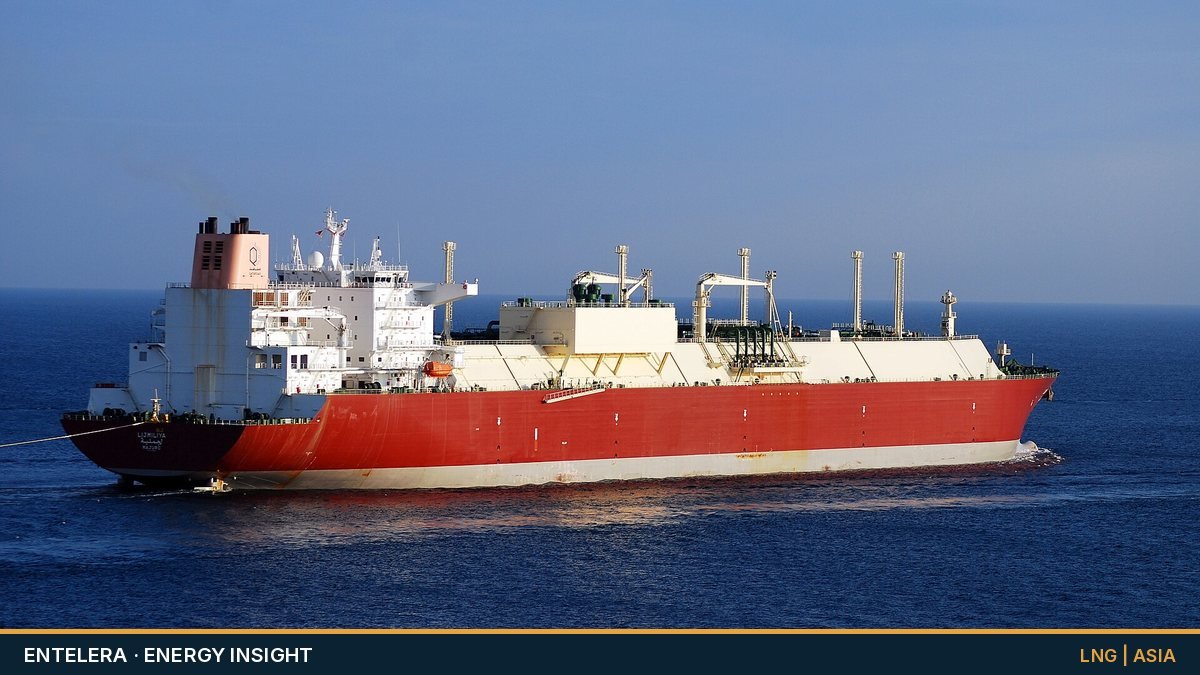
The Asian spot LNG price eased last week but stayed close to a four-year high. The average price for December 2026 delivery into north-east Asia was estimated at $31.40/MMBtu in the week to 6 November 2026, Pipeline & Gas Journal reported. That was down from $32.50/MMBtu a week earlier, which was the highest since mid-December 2022.
How the Asian spot LNG price moved
The week was volatile. According to JOGMEC data published by Global LNG Hub, JKM started near the low-$34s on 30 October 2026. It then fell to the mid-$33s on 3 November 2026 as US-Iran talks showed progress. Next, it slid to the mid-$31s on 4 November 2026 after the US midterm results. By 5 November 2026, it had dropped to the mid-$29s.
However, the market did not stay there. On 6 November 2026, traders grew more cautious about a quick supply recovery. As a result, JKM rebounded to the high-$31s by the end of the week. Even so, Asian end-user buying stayed weak, and cargoes still looked expensive.
“The whole market remains structurally tight heading into winter, with disrupted Middle Eastern supply and weaker European storage increasing competition for flexible cargoes,” said Toby Copson of Davenport Energy.
Europe falls faster
European prices dropped more sharply. JOGMEC data showed the TTF December contract at $28.0/MMBtu on 6 November 2026, down from $34.0/MMBtu on 30 October 2026. That is a fall of around 18%. In euro terms, Argus put TTF at about €86/MWh, down almost 17% from €104/MWh. Moreover, European gas fell another 3.95% to €82.21 ($92.10) per MWh on 9 November 2026, Anadolu Agency reported.
Supply expectations drove the slide. “Prices have fallen over the past week, partly because of an apparent shift in tone towards de-escalation from Trump and of increased Qatari supply expectations,” said Martin Senior of Argus. He added that Qatari loadings were well above half of capacity.
Still, storage is a concern. EU underground storage stood at 73.0% on 6 November 2026, according to AGSI+ data. That is 12.6% lower than a year earlier and 18.6% below the five-year average.
Spreads, freight and arbitrage
On our calculation, JKM held a premium of more than $3/MMBtu over TTF at the end of the week. Meanwhile, S&P Global Energy assessed its Northwest Europe LNG benchmark for December 2026 at $29.065/MMBtu on 5 November 2026. That was a $0.560 discount to front-month TTF.
Freight also firmed. Spark Commodities put Atlantic rates at $55,250 a day and Pacific rates at $32,750 a day. Nevertheless, US and Nigerian arbitrage to north-east Asia via the Cape of Good Hope still pointed firmly to Europe, Spark said. We explained this trade in our analysis of the US LNG arbitrage and the TTF-JKM spread.
In the US, Henry Hub rose to $3.0/MMBtu from $2.9/MMBtu, helped by strong LNG feedgas demand.
Outlook for the Asian spot LNG price
Kpler’s Ronald Pinto expects prices to rise slightly this week. He cited stronger Indian gas-for-power demand, falling Japanese utility stocks, coal outages and winter restocking. Indeed, Japan’s LNG inventories for power fell 0.23mn tonnes to 1.92mn tonnes as of 1 November 2026, METI data showed. On the other hand, stable Chinese coastal inventories and limited Pakistani spot demand could cap gains. Above all, geopolitics will remain the main driver, Pinto said.
For a deeper analysis, read: TTF Gas Price: Why Europe’s 18% Fall Still Leaves Storage Tight
Sources
- Pipeline & Gas Journal: Asian spot LNG prices ease but remain near four-year high as Europe competes for winter supply
- Global LNG Hub (JOGMEC data): Natural gas prices weekly update – JKM, TTF and Henry Hub (9 November 2026)
- Anadolu Agency: Global energy prices extend losses as Brent crude drops nearly 5% on hopes of US-Iran deal
- Entelera: US LNG arbitrage: the Europe TTF-JKM spread