The Hormuz bypass race in the Gulf has a new entrant, at least on paper. The UAE is considering a third crude pipeline from its western coast to Fujairah, Bloomberg reported on 4 November 2026. However, ADNOC called the report “not accurate and purely speculative”.
This analysis looks at how much UAE crude can already avoid the strait, and what more capacity would mean for flows and prices.
How much Hormuz bypass capacity the UAE has
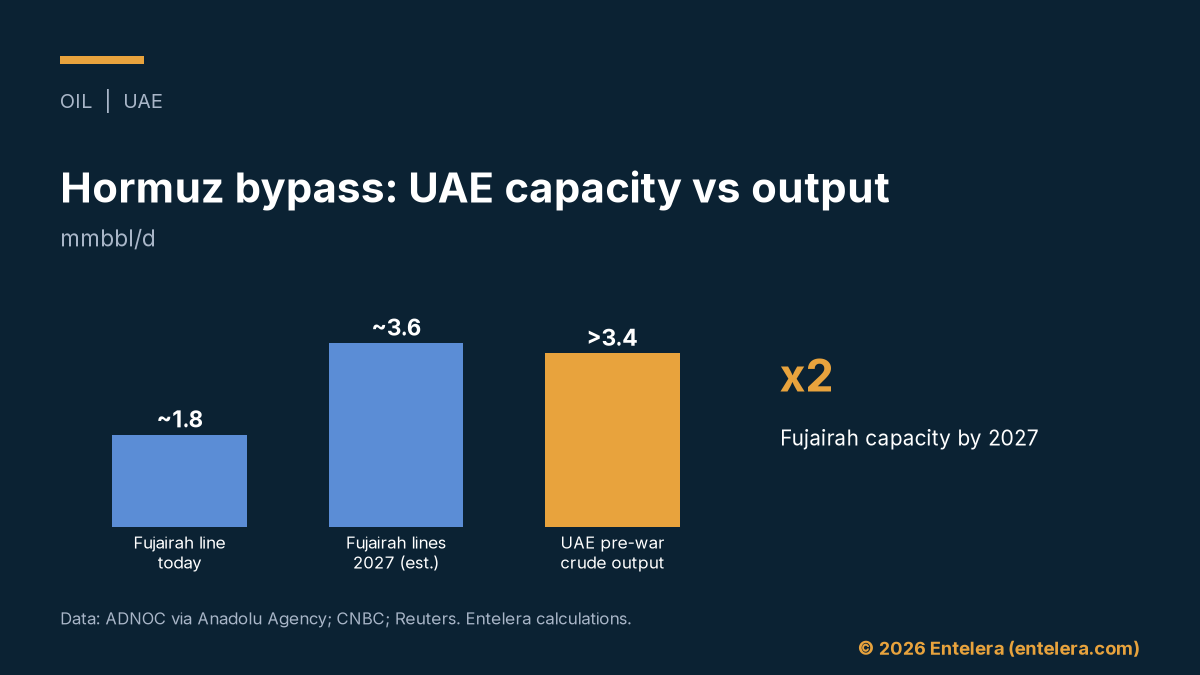
Today, one line does the work. The Habshan-Fujairah pipeline has carried Murban crude to the Gulf of Oman since 2012. Its design capacity is 1.5 mmbbl/d, and ADNOC can raise it to ~1.8 mmbbl/d, CNBC reported. Bloomberg puts it at about 2 mmbbl/d.
Next, a second line is coming. ADNOC said in May 2026 that its West-East Pipeline would start in 2027 and double export capacity through Fujairah. At the time, construction was 50% complete. On our calculation, that would lift capacity to ~3.6 mmbbl/d.
By comparison, the UAE produced more than 3.4 mmbbl/d of crude before the war, Reuters reported. In other words, by 2027 nearly all UAE crude could, in theory, leave without passing Hormuz.
Why the third line matters for traders
According to Bloomberg, the third line could be open to other companies. ADNOC has discussed it with some Asian customers, although the route is not final. That would turn Fujairah into a regional export hub, not just an ADNOC terminal.
In addition, Kuwait relies entirely on Hormuz for its crude exports. Its state oil company has held talks with the UAE and Saudi Arabia on alternative routes, Bloomberg reported. A shared line could, therefore, carry other Gulf grades too.
For now, the squeeze is real. Gulf exports fell to 17.1 mmbbl/d in October 2026 from 18.9 mmbbl/d in September 2026, Vortexa data show. Notably, the UAE recorded the largest decline of any country.
What it means for Murban and the curve
Bypass capacity is why physical Murban held ~$7 above Brent futures on 5 November 2026, Gulf News reported. It is one of the few Gulf grades that can still reach buyers reliably. As Fujairah capacity grows, more UAE barrels gain that access. In turn, the scarcity premium on Hormuz-free crude should shrink over time.
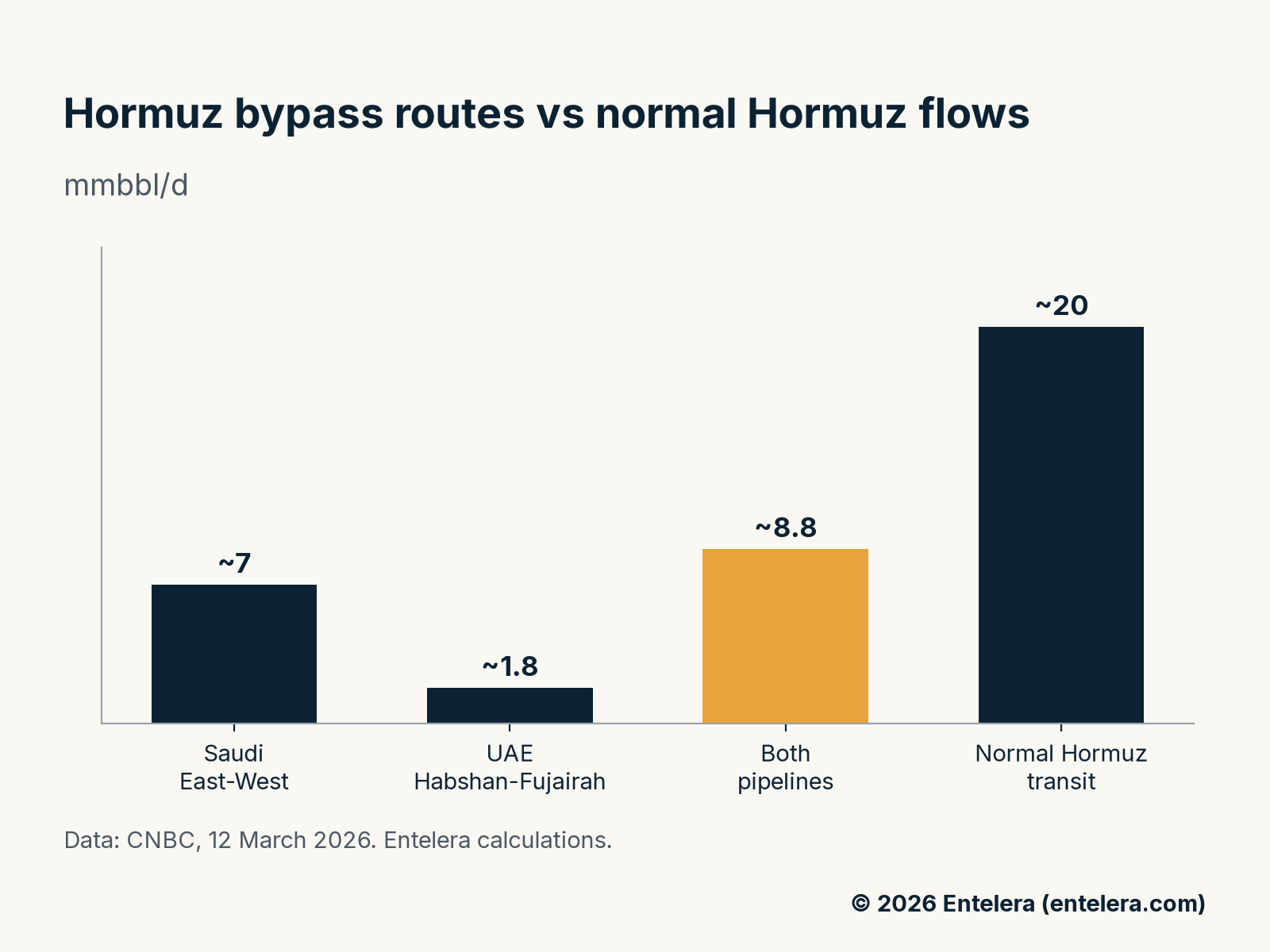
Even so, pipelines do not solve everything. Together, Saudi Arabia’s East-West line (~7 mmbbl/d) and the UAE line can carry under half of the nearly 20 mmbbl/d that normally transits Hormuz. For the Saudi side, read The East-West Pipeline: Why Saudi Arabia’s Hormuz Bypass Is Now the Market’s Weak Point.
Moreover, Fujairah itself is exposed. Drone attacks disrupted loadings there in March 2026, Reuters reported. So a bigger Hormuz bypass reduces the risk but also concentrates it in one port.
What to watch for the Hormuz bypass
- West-East Pipeline progress and the first Asian liftings at Fujairah, which ADNOC has pencilled in for early 2027.
- Any formal ADNOC decision on a third line, its route and third-party access.
- UAE export data for November 2026 from Vortexa and Kpler.
Sources
- Anadolu Agency, UAE mulls 3rd oil pipeline to bypass Strait of Hormuz: Report, 4 November 2026: aa.com.tr
- OilPrice.com, UAE Weighs Plans for Third Strait of Hormuz Bypass Pipeline, 4 November 2026: oilprice.com
- CNBC, Two pipelines helping Saudi Arabia, UAE bypass the Strait of Hormuz, 12 March 2026: cnbc.com
- Reuters, Why does the port of Fujairah matter to the oil market?, 14 March 2026: reuters.com
- Reuters via Investing.com, Gulf oil flows dip in October from post-Iran war high, data shows, 3 November 2026: investing.com
- Gulf News, Crude slides toward $93, WTI drops to $87 as Trump rules out immediate Iran strikes, 5 November 2026: gulfnews.com
- Economy Middle East, Murban and the new geography of oil power: economymiddleeast.com