On 21 October, the US Department of Energy said it will lend up to 315,000 barrels from its heating oil reserve. Companies must return the fuel with a premium before the 2027-28 winter. Bids are due on 27 October, and deliveries end by 13 November.
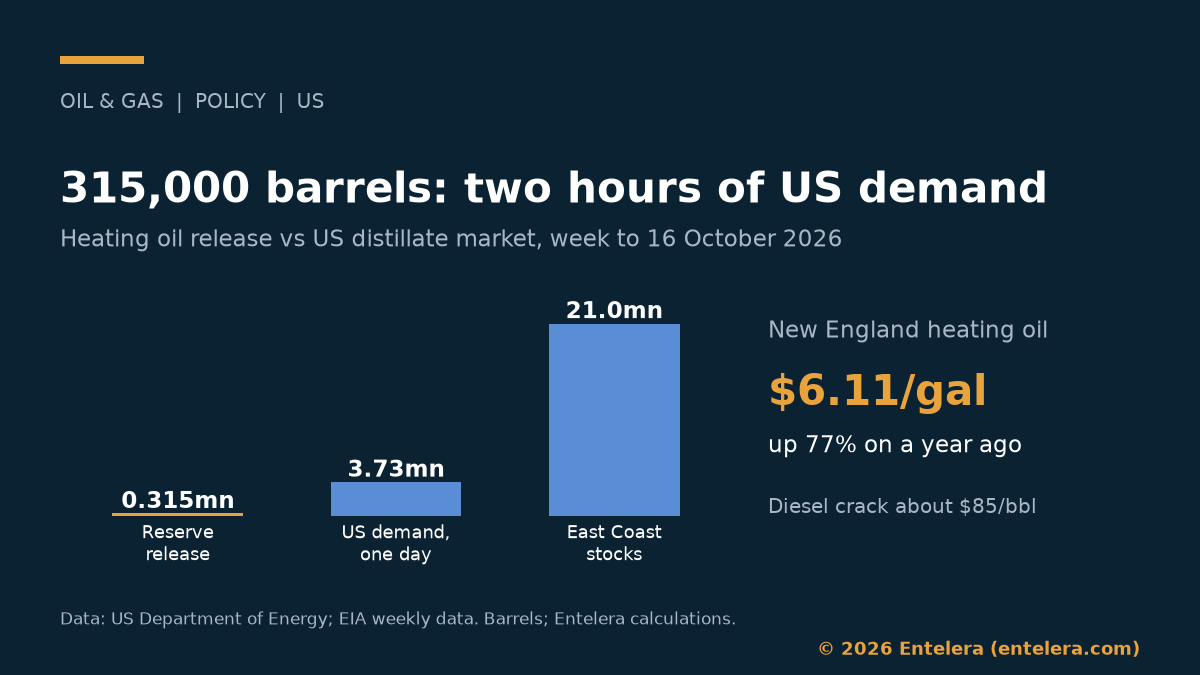
The move answers a real problem. New England homes paid $6.11 a gallon for heating oil on 19 October, up 77% on a year earlier, EIA data show. However, the numbers suggest the heating oil reserve can do little for prices. This analysis sets the release against the size of the market.
How big the heating oil reserve release is
The Northeast Home Heating Oil Reserve holds about 1mn barrels, with sites in Maine, Massachusetts, Connecticut and New Jersey, Reuters reported. So the loan is nearly a third of it. In addition, the US has tapped the reserve only once since Hurricane Sandy in 2012.
Against national demand, though, the volume is tiny. The US used 3.73 mmbbl/d of distillate in the week to 16 October, according to EIA. On our calculation, 315,000 barrels equal about two hours of that demand. They also equal about 1.5% of East Coast distillate stocks. Similarly, they match roughly 1.2 days of East Coast refinery output of distillate.
Senator Susan Collins said the release equals a 13% supply increase for New England. We could not check that figure against public data, and she gave no period. By contrast, Tom Kloza of Gulf Oil called the move “puzzling and probably inconsequential”, Reuters reported.
The real squeeze: East Coast stocks
The bigger story is the stock level. East Coast distillate stocks stood at 21.0mn barrels on 16 October, EIA data show. That is the lowest mid-October level in EIA’s weekly series, which starts in 1990. It is also about 30% below the 2021-2025 average for the same week, on our calculation.
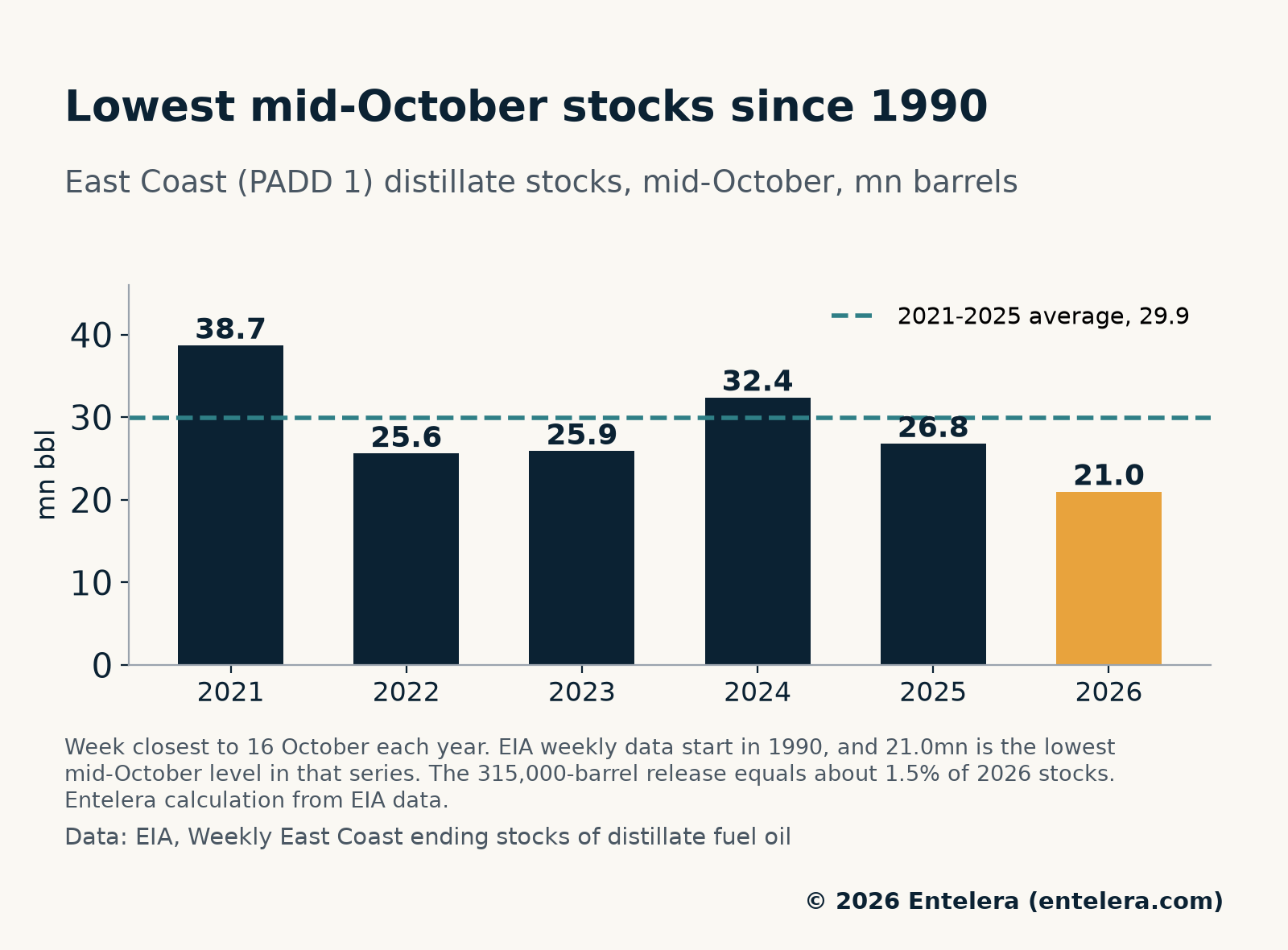
Nationally, the picture is tight but less extreme. US distillate stocks were 104.3mn barrels, about 9% below the 2021-2025 average for the week. That equals about 28 days of current demand.
Why diesel and heating oil cost so much
Crude is part of the story. Brent averaged $125.59 a barrel in the week to 16 October, EIA data show. That is about double the level of a year earlier. Even so, product prices have risen faster. New York Harbor ultra-low sulphur diesel averaged $5.03 a gallon that week, or about $211 a barrel.
On our calculation, that implies a diesel crack of about $85 a barrel over Brent. A year earlier, the same measure was about $31. In other words, the shortage is in refined products, not just crude. Retail diesel averaged $6.28 a gallon nationally on 19 October, up 73% on a year earlier. It peaked at $6.53 in September, according to EIA.
The heating oil reserve and the wider US toolbox
The heating oil reserve is one of several levers. Washington has already agreed to lend 172mn barrels of crude from the Strategic Petroleum Reserve (SPR), Reuters reported. As a result, the SPR held 282.7mn barrels on 16 October, down from 408.6mn a year earlier, EIA data show. The administration also wants refiners to run harder.
Politics matters too. About a third of New England homes use heating oil, including about half in Maine, Reuters noted. Midterm elections take place on 3 November. Meanwhile, Energy Secretary Chris Wright called the loan “a temporary measure”. He urged north-eastern states to back the Constitution gas pipeline instead, which New York has blocked on environmental grounds.
For a comparison with India’s own buffer, see our analysis of India’s strategic petroleum reserves.
What to watch next
- Bids on 27 October, and how much of the 315,000 barrels companies take.
- Weekly East Coast stocks, with the next EIA data due on 28 October.
- Further releases: the department will judge whether more are needed, a source told Reuters.
- The diesel crack, the clearest sign of whether the product squeeze is easing.
- Winter weather in the North-East, which drives heating oil demand.
In short, the heating oil reserve release is a political signal more than a supply fix. The real test is whether refiners and imports can rebuild East Coast stocks before the cold arrives. For the announcement itself, see our news report on the reserve exchange.
Sources
- US Department of Energy, exchange from the Northeast Home Heating Oil Reserve, 21 October 2026: energy.gov
- Reuters via Investing.com, US aims to loan about a third of heating oil reserve, 21 October 2026: investing.com
- East Coast (PADD 1) distillate fuel oil stocks, weekly (EIA): eia.gov
- US distillate fuel oil stocks, weekly (EIA): eia.gov
- Product supplied of distillate fuel oil in the US, weekly (EIA): eia.gov
- Refiner and blender output of distillate on the East Coast, weekly (EIA): eia.gov
- New England residential heating oil price, weekly (EIA): eia.gov
- Retail No 2 diesel prices in the US, weekly (EIA): eia.gov
- New York Harbor ultra-low sulphur diesel spot price, weekly (EIA): eia.gov
- Brent spot price FOB, weekly (EIA): eia.gov
- Strategic Petroleum Reserve crude stocks, weekly (EIA): eia.gov