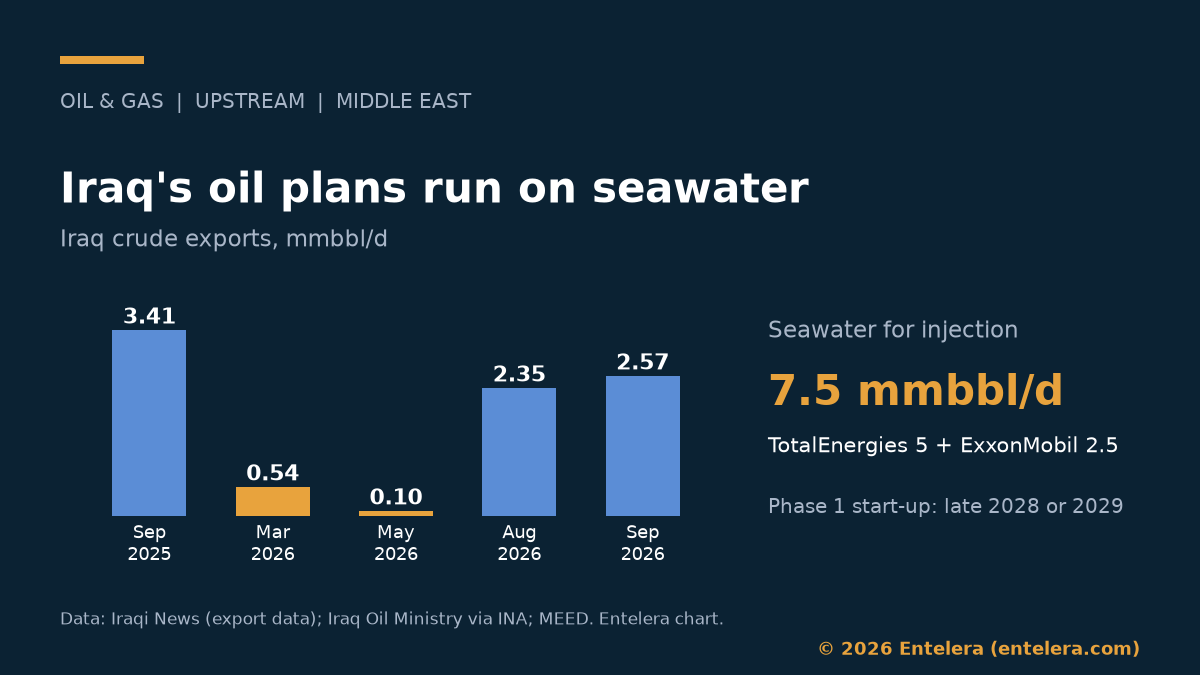
ExxonMobil signed a memorandum of understanding (MoU) with Basra Oil Company on 21 October, Iraq’s oil ministry said. It covers the second phase of Iraq seawater injection for southern oilfields, with up to 2.5 mmbbl/d of capacity. This phase adds to a 5 mmbbl/d scheme that TotalEnergies is building.
Water sounds dull next to oil. Yet Iraq seawater injection is the hidden limit on how much crude the country can produce. This analysis explains why, what the new phase could support and what stands in the way.
Why Iraq seawater injection matters
As oilfields age, reservoir pressure falls. So operators inject water to hold it up. As a rule of thumb, 1.3-1.5 barrels of water keep pressure for each barrel of oil. That is the estimate of a 2018 Iraq Energy Institute study. However, Iraq cannot spare river water, because of drought and lower flows from upstream dams. Therefore, the plan is to treat water from the Gulf and pipe it inland.
The idea is old. In fact, ExxonMobil first won the Common Seawater Supply Project (CSSP) in 2010. Then the government removed it in 2012, citing poor economics and weak coordination, the same study notes. After that, the scheme shrank and stalled for years.
Where the first phase stands
Today, the first phase sits inside TotalEnergies’ Gas Growth Integrated Project (GGIP). This $27bn programme also includes Basra Oil Company with 30% and QatarEnergy with 25%, while TotalEnergies holds 45%, MEED reports. China Petroleum Pipeline Engineering has a $2.5bn contract for about 949km of pipelines. Meanwhile, Hyundai E&C won the treatment plant, worth KRW4.39tn ($3.16bn).
The water will go to Rumaila, Zubair, West Qurna 1, West Qurna 2 and Majnoon, plus fields in Maysan and Dhi Qar. Early groundworks have begun. Even so, start-up is now due in late 2028 or early 2029, according to MEED. The war has also slowed equipment shipments through the Strait of Hormuz.
How much oil Iraq seawater injection could support
On our estimate, the 5 mmbbl/d first phase could sustain about 3.3-3.8 mmbbl/d of oil at the 1.3-1.5 ratio. ExxonMobil’s 2.5 mmbbl/d phase would add about 1.7-1.9 mmbbl/d. Together, 7.5 mmbbl/d of Iraq seawater injection could support about 5.0-5.8 mmbbl/d of oil.
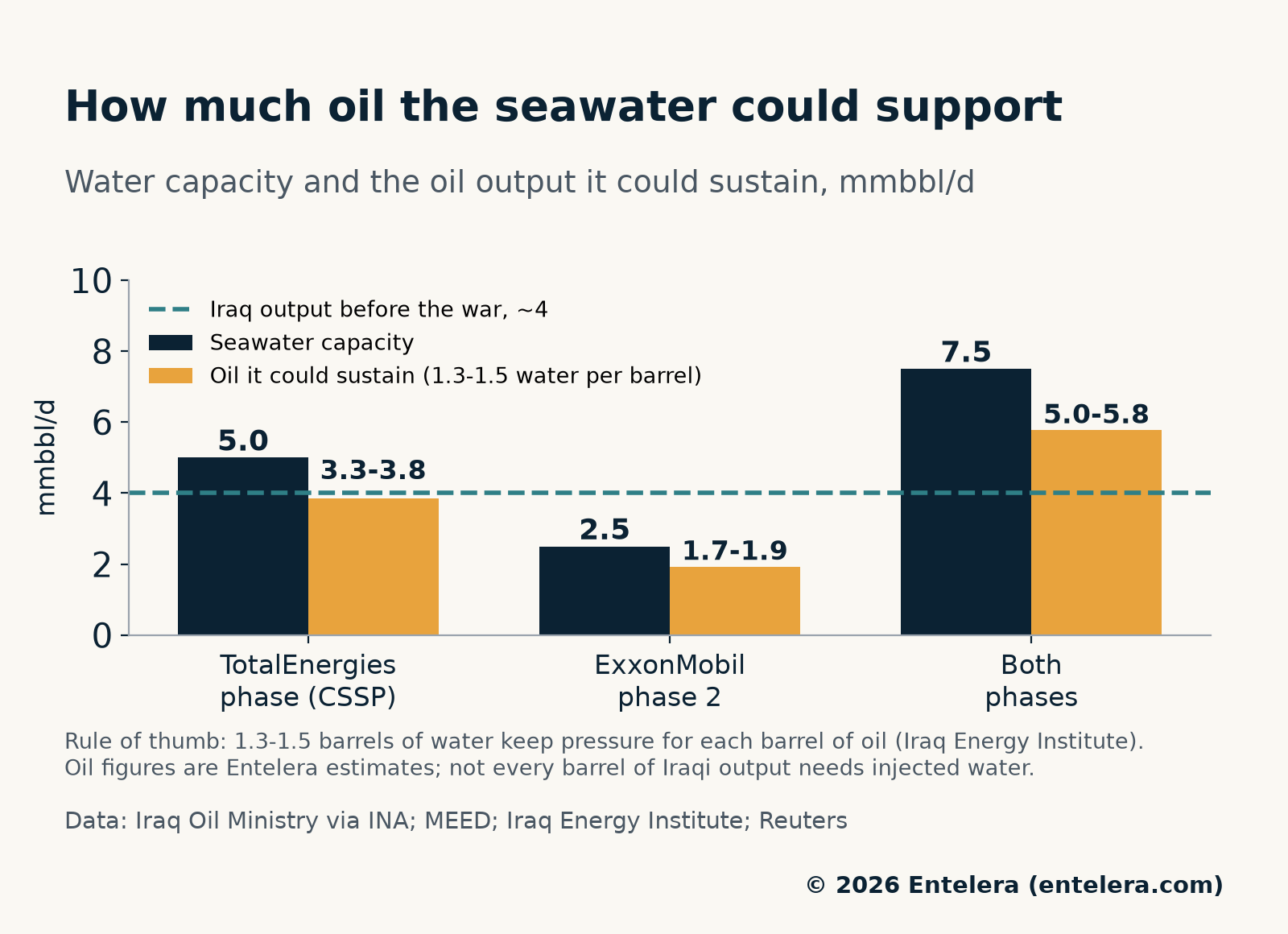
For context, Iraq produced around 4 mmbbl/d before the Iran war, Reuters reported. In August, Prime Minister Ali al-Zaidi set a goal of 8-10 mmbbl/d within six years. Of course, not every barrel needs injected water. Still, the arithmetic shows that Iraq needs both phases just to grow output from its southern giants. Back in 2018, the Iraq Energy Institute put the need at 9-11 mmbbl/d of water to reach the targets of that time.
ExxonMobil’s road back to Iraq
For ExxonMobil, this is a return. In November 2023, it agreed to hand its 22.7% stake in West Qurna 1 to Basra Oil Company, Iraq Oil Report said. It had left the field by early 2024. Then, in October 2025, it signed heads of agreement covering Majnoon, export infrastructure and marketing, Bloomberg reported via World Oil. Majnoon is one of Iraq’s biggest fields, and Shell left it in 2017 over profit-sharing.
The water deal fits that plan. Majnoon is on the CSSP delivery list, so a water role gives ExxonMobil a say over a key input for its own target field. Meanwhile, Chevron is in talks on West Qurna 2 after Lukoil’s exit, and on four Nasiriyah blocks, the minister told INA. In addition, Iraq is moving its service contracts towards profit-sharing terms, which he said US and European firms prefer.
The Hormuz problem for Iraq seawater injection
However, more water only helps if the oil can leave. Most Iraqi crude sails from Basra through the Strait of Hormuz. As a result, exports fell to 0.54 mmbbl/d in March and about 0.1 mmbbl/d in May, Iraqi News reported. By September they had recovered to 2.57 mmbbl/d. That was still 25% below the 3.41 mmbbl/d of September 2025.
Alternatives are limited. The only working export pipeline, to Ceyhan in Turkey, carries about 0.17 mmbbl/d, according to Reuters. A pipeline to Syria’s Baniyas could cost at least $15bn and take four years to build, sources told Reuters. In other words, Iraq’s upstream plans and its export routes have to grow together.
What to watch next
- A binding contract for the second phase, with a cost and a timetable. The MoU gives neither.
- First-phase progress towards a start-up in late 2028 or early 2029.
- Field terms for ExxonMobil at Majnoon and for Chevron at West Qurna 2.
- OPEC+ baselines for 2027, where Iraq is pushing for a higher quota.
- Hormuz traffic and monthly Iraqi export data.
In short, the MoU is a small step on paper but a central one in practice. Without seawater, Iraq’s 8-10 mmbbl/d goal stays out of reach. For Chevron’s own portfolio moves, see our analysis of its Gulf asset sale. For the deal itself, see our news report on the ExxonMobil MoU.
Sources
- Iraqi News Agency, Basra Oil Company and ExxonMobil MoU, 21 October 2026: ina.iq
- Kurdistan24, Iraq signs MoU with ExxonMobil for 2.5 million-barrel seawater project, 21 October 2026: kurdistan24.net
- MEED, Groundworks under way for major Iraqi water project, 10 September 2026: meed.com
- IPLOCA, CPP’s Iraq Common Seawater Supply Project enters commencement phase, 2026: iploca.com
- Iraq Energy Institute, Muddy Waters: Iraq’s Water Injection Needs, 19 January 2018: qamarenergy.com (PDF)
- Reuters via TradingView (Zawya), Iraq in talks with Chevron, ExxonMobil, 20 October 2026: tradingview.com
- Reuters via EnergyNow, Iraq aims to boost oil output to 8-10 million bpd, 21 August 2026: energynow.com
- Iraqi News, Iraq’s seaborne oil exports in September, 6 October 2026: iraqinews.com
- Iraq Oil Report, ExxonMobil finalises deal to exit West Qurna 1, 10 November 2023: iraqoilreport.com
- Bloomberg via World Oil, ExxonMobil signs Majnoon oil field deal, 8 October 2025: worldoil.com