Chevron asset sales have reached the US Gulf. The company has started marketing some of its oldest fields there, it confirmed to Reuters on 21 October. The package includes Petronius, Tubular Bells and Llano, plus stakes in several other fields. Two people aware of the process told Reuters it could raise about $1bn.
In cash terms, that is small. However, these Chevron asset sales say a lot about how the company now ranks its barrels after buying Hess. This analysis looks at what is for sale, what the money means and who might buy.
What is in the Chevron asset sales package
First, the named fields are mature. Petronius started producing in 2000, Llano in 2004 and Tubular Bells in 2014, according to Reuters. Chevron operates Petronius with Talos Energy as its partner. Shell operates Llano, where Chevron holds 50%.
Moreover, two of the three came with Hess. Before the takeover, Hess held 57% of Tubular Bells and 50% of Llano, its 2024 annual report shows. Chevron completed the Hess deal in July 2025. At that point, the Hess Gulf assets produced 31,000 boe/d net, Chevron said.
Still, Chevron has not said how much the package produces, and it gave no price. The $1bn figure comes from sources. In addition, a spokesperson said the process will take months and that a sale is not certain.
Why Chevron asset sales make sense now
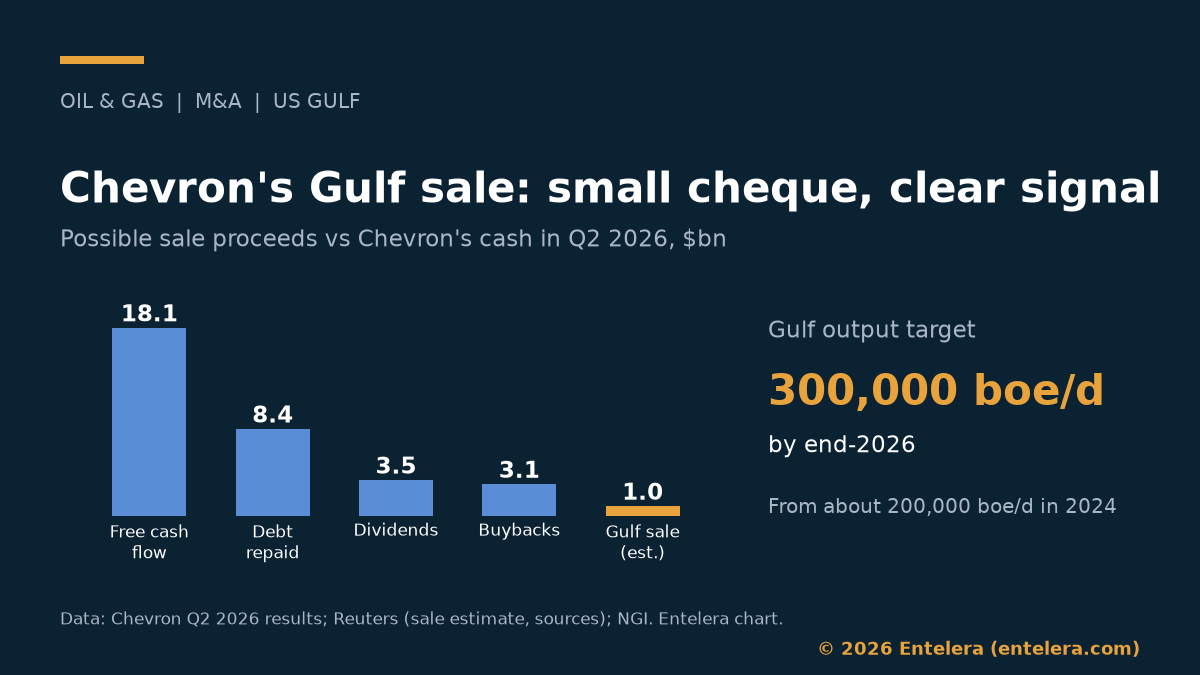
Above all, Chevron wants to focus on its newest platforms. It aims to lift Gulf output to 300,000 boe/d by the end of this year. That compares with about 200,000 boe/d in 2024, NGI reported. Anchor, its first project working at 20,000 psi, started in 2024. Then Ballymore followed in April 2025 as a tieback to the Blind Faith platform. It can produce up to 75,000 barrels a day gross.
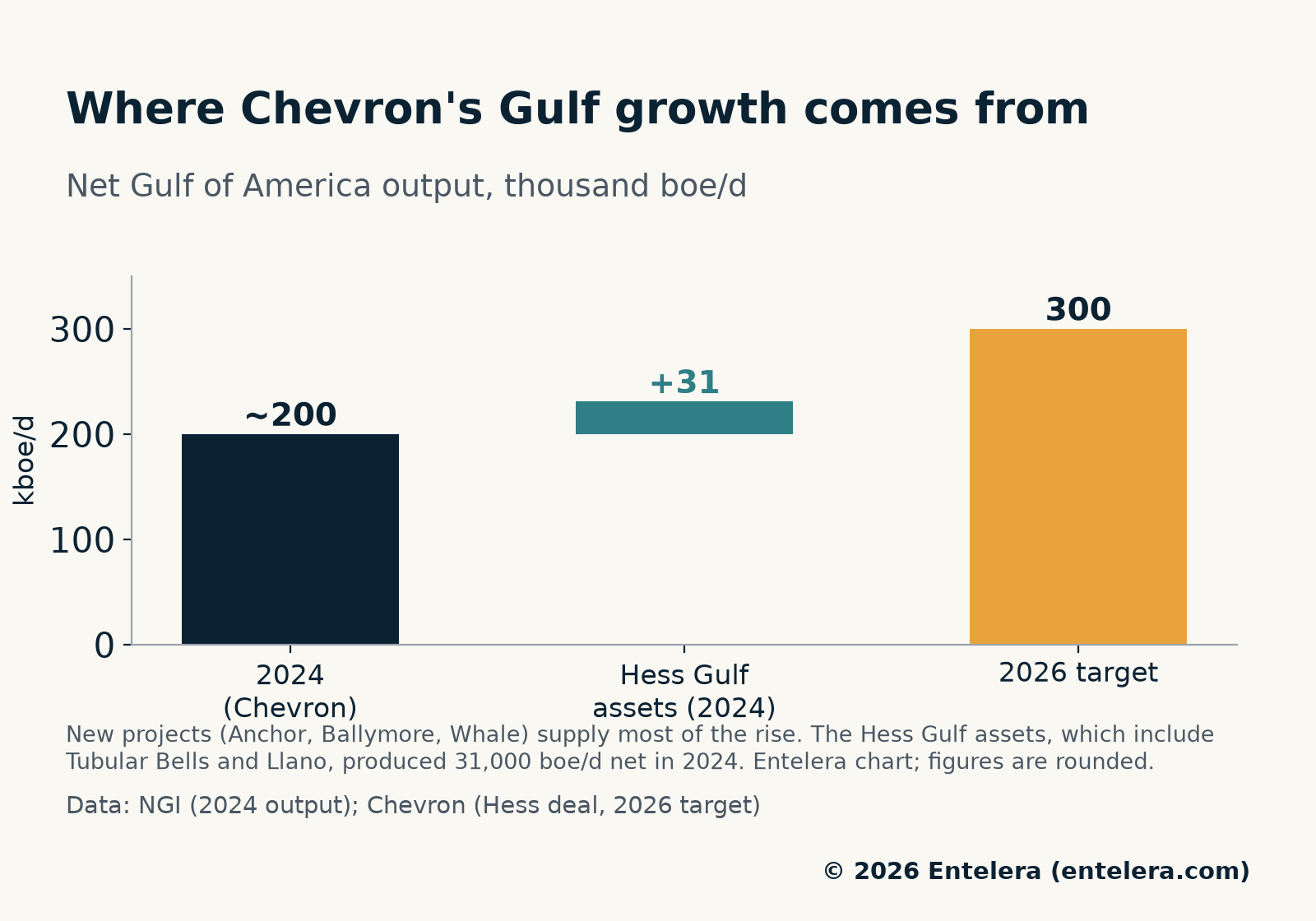
In our view, the logic is simple. Old platforms need steady spending on upkeep, and their output keeps falling. By contrast, tiebacks such as Ballymore use existing hubs and add barrels cheaply. So selling the older assets frees money and staff for the hubs Chevron wants to grow.
Timing helps too. US crude touched a six-month high on 20 October, Reuters noted, and high prices support valuations. Furthermore, buyers remain keen on US production, the sources said.
How much Chevron asset sales add
For Chevron, $1bn is small this year. In the second quarter alone, it generated $18.1bn of free cash flow, its results show. It also repaid a record $8.4bn of debt, paid $3.5bn in dividends and spent $3.1bn on buybacks. Brent averaged $104 a barrel in the quarter.
On our estimate, $1bn equals about 5.5% of that quarter’s free cash flow. Equally, it would fund about a third of one quarter’s buybacks. Clearly, the sale is about focus, not funding.
The Gulf package also adds to a wider programme. Chevron plans $10bn-15bn of asset sales by 2028, a goal it repeated in March 2025. It was already more than halfway there by April 2025, analysts at Tudor, Pickering, Holt & Co. told NGI. Since then, it has sold its Hong Kong fuels business. It has also agreed to sell its Singapore refining stake and other Asian downstream assets, with closing due in 2027.
Who might buy
According to the sources, interest should come from three groups: international offshore specialists that want a bigger US Gulf position, US firms focused on the basin, and other majors. In our view, existing partners such as Talos at Petronius and Shell at Llano know the assets best.
For mid-size buyers, mature fields with working platforms can make sense. They often produce cash for years with modest spending. However, they also carry the cost of removing platforms and plugging wells at the end of their lives. That liability will shape any price.
What this says about Chevron’s strategy
Overall, Chevron is high-grading. It keeps fewer, larger hubs and sells the tail. Its capex rose to $4.5bn in the second quarter from $3.7bn a year earlier. Spending on legacy Hess assets drove most of the rise. Meanwhile, total output reached 4.07mn boe/d, up 20% on a year earlier.
At the same time, Chevron is looking for new growth abroad. In the second quarter, it signed heads of agreement with Iraq on West Qurna 2, Nasiriyah and an export pipeline. For the wider picture in Iraq, see our analysis of ExxonMobil’s seawater deal.
What to watch next
- Bids and buyers over the coming months, and whether the package sells as one deal or in parts.
- The price per flowing barrel, once Chevron or a buyer discloses output for the fields.
- Gulf output at year-end, against the 300,000 boe/d target.
- Chevron’s third-quarter results, for updates on asset sales, buybacks and debt.
- Iraq talks, where Chevron could add large new barrels.
In short, the Chevron asset sales are a small cheque with a clear message. Chevron wants its Gulf capital in a few new, high-pressure hubs rather than in ageing platforms. For the deal itself, see our news report on the Gulf sale.
Sources
- Reuters via EnergyNow, Chevron to sharpen US Gulf focus with sale of older assets, 21 October 2026: energynow.com
- Chevron, second-quarter 2026 results (SEC filing), 31 July 2026: sec.gov
- Chevron, completion of the Hess acquisition, 18 July 2025: chevron.com
- Hess Corporation, 2024 annual report on Form 10-K: sec.gov
- Chevron, Ballymore start-up, 21 April 2025: chevron.com
- Chevron, Gulf of America assets: chevron.com
- NGI, Chevron pares portfolio (Gulf output, asset sale progress), 2 April 2025: naturalgasintel.com
- Chevron, sale of East Texas gas assets and $10-15bn divestment plan, 31 March 2025: chevroncorp.gcs-web.com