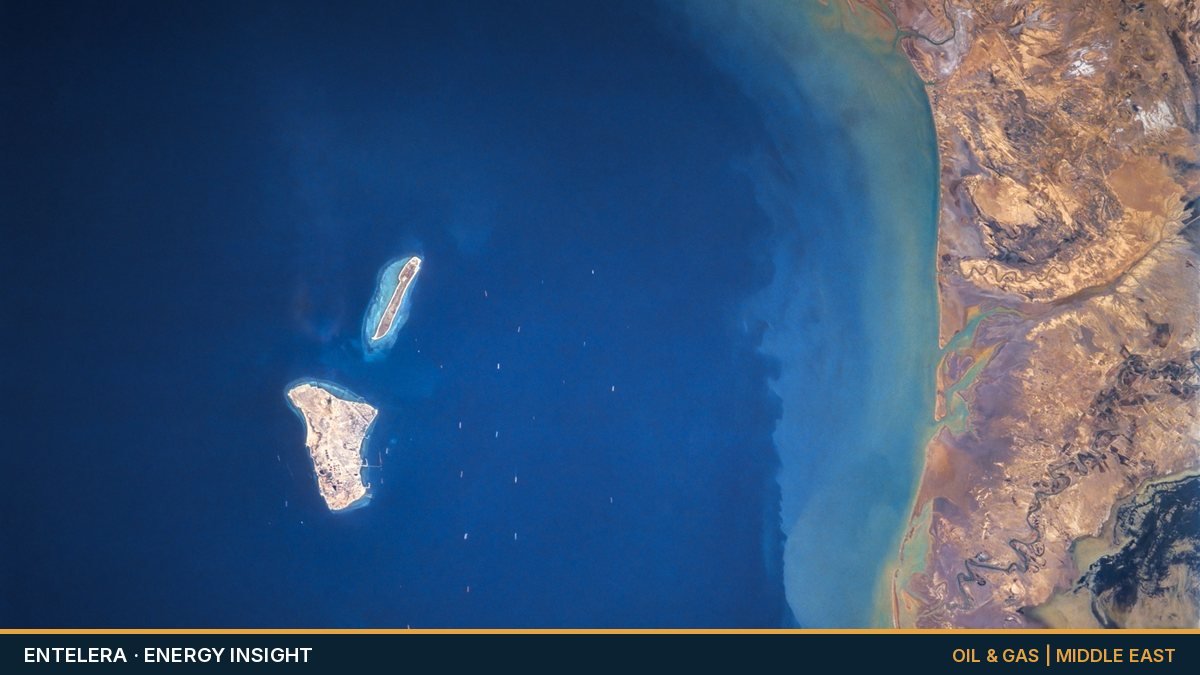
Iran has lined up loaded crude tankers at Kharg Island to test the US naval blockade. Satellite imagery and ship-tracking data show more than 14 tankers there with crews and Iranian flags, Euronews reported on 20 November 2026. Those reports say Tehran plans to send the Iran oil tanker convoy towards the Gulf of Oman in the coming days, with China as the likely buyer.
However, no Iranian official body has announced a convoy. The idea started with a Fars News Agency column on 19 November 2026. It then spread to lawmakers and Friday prayer leaders. Meanwhile, Foreign Minister Abbas Araghchi told ILNA that Iran must break the blockade, Iran International reported.
What the Iran oil tanker convoy data shows
Kpler counts about 20 tankers near Kharg, and most hold cargo already. Still, they sit idle, and Kpler has seen only one tanker move. Its analyst Homayoun Falakshahi said it was too early to call this a serious push, RFE/RL reported.
In addition, TankerTrackers saw a tanker take Iranian crude in a ship-to-ship transfer on 19 November 2026. If it clears the blockade, it would make the first seaborne Iranian crude export since mid-July 2026. In response, CENTCOM warned it may stop, board or capture ships that receive such cargoes, Al Jazeera reported.
Kharg matters because it handles about 85-90% of Iran’s crude exports. The terminal can also store about 30 mmbbl.
Why the blockade now bites
The numbers explain the pressure on Tehran. Iran loaded about 2 mmbbl/d of crude and condensate in March 2026. That fell to about 740,000 b/d in July 2026 and to 220,000-255,000 b/d in August 2026. Then, in September 2026, Kpler recorded no loadings at all.
At the same time, the floating buffer has gone. Iranian oil on the water outside the blockade peaked at 88.8 mmbbl on 14 July 2026. By mid-October 2026 it had fallen to zero, as the last cargoes reached China. As a result, Kpler expects Iran’s crude and condensate revenue to hit zero by mid-December 2026. Another 43 mmbbl sits stranded inside the blockade zone.
Only small cargoes have slipped through so far. For example, about 12 small LPG tankers have crossed the blockade line since it resumed, UANI said.
What the Iran oil tanker convoy means for flows and freight
For traders, the Iran oil tanker convoy poses a binary risk. If tankers get through, sanctioned sour barrels could return to Chinese independent refiners. Those plants have run without new Iranian supply for months. Before the war, Iran shipped roughly 1.5-2 mmbbl/d, mostly to China.
On the other hand, a US move against the convoy could escalate fast. Fars warned that any attack would bring strikes on Gulf oil sites. It named the UAE, Saudi Arabia, Qatar, Kuwait, Oman and Bahrain. That threat hits Gulf freight and war-risk insurance, not only flat price. For now, US-escorted Hormuz traffic keeps moving, at an average of 26.5 vessels a day over 15-18 November 2026.
For context, see our analysis of how the Iran risk premium now sits in Brent’s spreads.
What to watch
Next, watch whether the ship-to-ship cargo leaves the Gulf of Oman. Also watch for more tankers moving from Kharg, and for any formal Iranian announcement. Finally, watch how Washington answers the first test of the Iran oil tanker convoy.
Sources
- Euronews: Iran readies tanker convoy at Kharg Island to test US oil blockade
- RFE/RL: With Oil Revenue Running Out, Iran Teases Breaking US Blockade
- Iran International: Iran readies tankers to run US blockade, threatens Persian Gulf oil if fired on
- Al Jazeera: US targets Iran’s ship-to-ship transfers: Can Tehran break the blockade?
- Iran International: Tanker loads Iranian crude in Persian Gulf as Tehran weighs resuming exports
- UANI: Iran Shipping Update – November 19, 2026