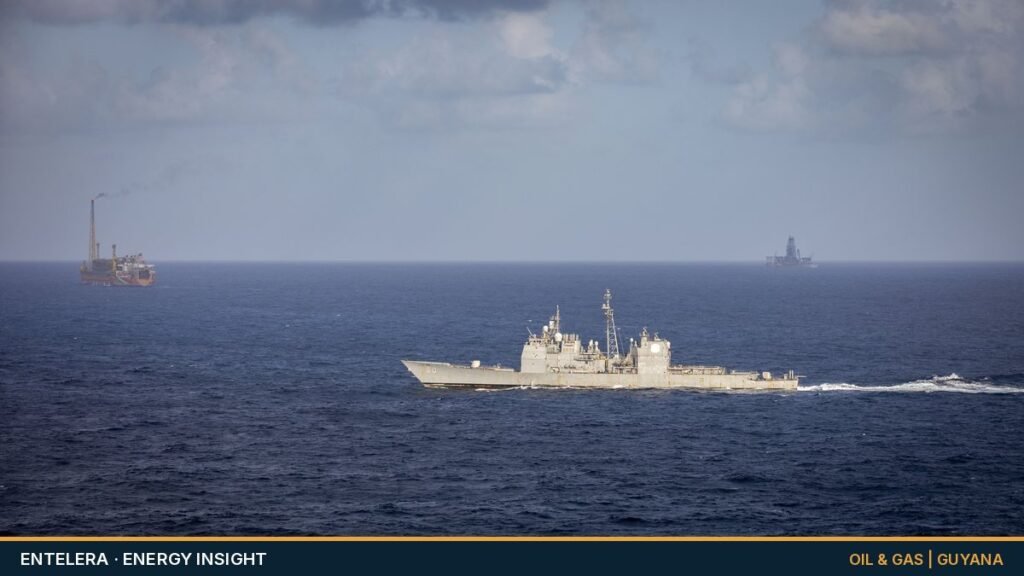
ExxonMobil has taken a final investment decision (FID) on Longtail, committing $12.5bn to Guyana’s first gas and condensate development. The ExxonMobil Longtail FID came on 12 November 2026. It followed government approval of the field development plan and the production licence. Longtail is the eighth project on the Stabroek block, and first production is due in 2030.
What the ExxonMobil Longtail FID covers
Longtail opens a new phase for Stabroek. Until now, every project on the block has produced oil, with gas as a by-product. By contrast, Longtail targets non-associated gas and condensate-rich reservoirs in the south-east of the block. It will tap nine reservoirs as a multi-field development.
The project will use a new-build floating production, storage and offloading (FPSO) vessel. The vessel can handle about 1.2bn cubic feet of gas a day. It can also produce up to 250,000 barrels a day (b/d) of condensate. In total, 27 production wells and 18 gas injection wells will feed it. Over 30 years, Guyana’s Ministry of Natural Resources expects Longtail to produce about 776mn barrels of condensate.
Dan Ammann, president of ExxonMobil Upstream Company, called Guyana “one of the world’s most prolific energy developments”. He added that Longtail marks the next phase in developing its resources.
Longtail gas and Guyana’s industrial plans
For now, the FPSO will reinject the gas it does not use. However, the licence requires a gas utilisation and export study. The vessel’s base design must also include gas export facilities. ExxonMobil said a pipeline could carry Longtail gas to shore. Still, that depends on future investment decisions, market demand and infrastructure.
Meanwhile, the government has bigger plans for that gas. It wants a second offshore gas-to-energy pipeline to feed power plants and a gas industrial site in Berbice. In particular, it names fertiliser production, alumina and mineral processing and data centres as possible users.
ExxonMobil Longtail FID: partners Chevron’s Hess and CNOOC
ExxonMobil Guyana operates the block with a 45% interest. Hess Guyana Exploration, now part of Chevron, holds 30%. CNOOC Petroleum Guyana holds the remaining 25%. As a result, the deal also gives two other large oil companies a long-life gas and condensate project.
Where Longtail fits in Guyana’s growth
ExxonMobil already produces about 900,000 b/d of oil from four Stabroek projects. Moreover, it expects output to pass 1mn b/d once Uaru starts up in the fourth quarter of 2026. Whiptail should follow in 2027 and Hammerhead in 2029. Then Longtail adds condensate from 2030, along with a first route to gas sales.
Guyana growth has steadily supported ExxonMobil’s earnings. Our story on ExxonMobil Q3 2026 results showed this. Even so, Longtail marks the company’s first bet on Stabroek gas rather than oil.
What to watch after the ExxonMobil Longtail FID
First, watch the Uaru start-up in the fourth quarter of 2026. It should lift Guyana output above 1mn b/d. Next, look for the gas utilisation and export study that the licence requires. Finally, a decision on a second gas pipeline would show how much Longtail gas Guyana can use at home.
For a deeper analysis, read: Guyana Crude Exports: What Longtail Means for Atlantic Sweet Differentials
Sources
- ExxonMobil (Business Wire): ExxonMobil Advances Next Phase of Guyana Development with Longtail
- Department of Public Information Guyana: GoG approves eight Petroleum Production Licence: Longtail Petroleum Production Licence
- World Oil: ExxonMobil takes $12.5-billion FID on Longtail development offshore Guyana
- Demerara Waves: ExxonMobil to invest US$12.5 billion in approved Longtail natural-gas project
- Entelera: ExxonMobil Q3 2026 results: adjusted profit of $17.5bn as refining beats upstream