Brent backwardation tells a calmer story than the headlines. Brent rose 0.8% to $92.69 a barrel early on 19 November 2026 after a New York Times report that President Donald Trump is weighing new strikes on Iran, as our news story on the Brent crude price reported. Yet for traders, the more useful signal sits in the spreads.
Why the flat price bounced and then stalled
The bounce followed a bearish US print. US crude stocks rose by 3.4mn barrels to 417.8mn barrels in the week to 13 November 2026, against a forecast build of just 58,000 barrels, EIA data showed. As a result, Brent settled $1.19 lower at $91.95 on 18 November 2026. Meanwhile, WTI fell 3.2% to $83.26, its lowest close since 26 August 2026.
Moreover, Brent is on course for a fall of about 20% in November 2026, and the IEA sees a surplus of about 2mn b/d this quarter. So the strike headline met a market where speculators had cut their WTI net long for seven weeks in a row, ING noted.
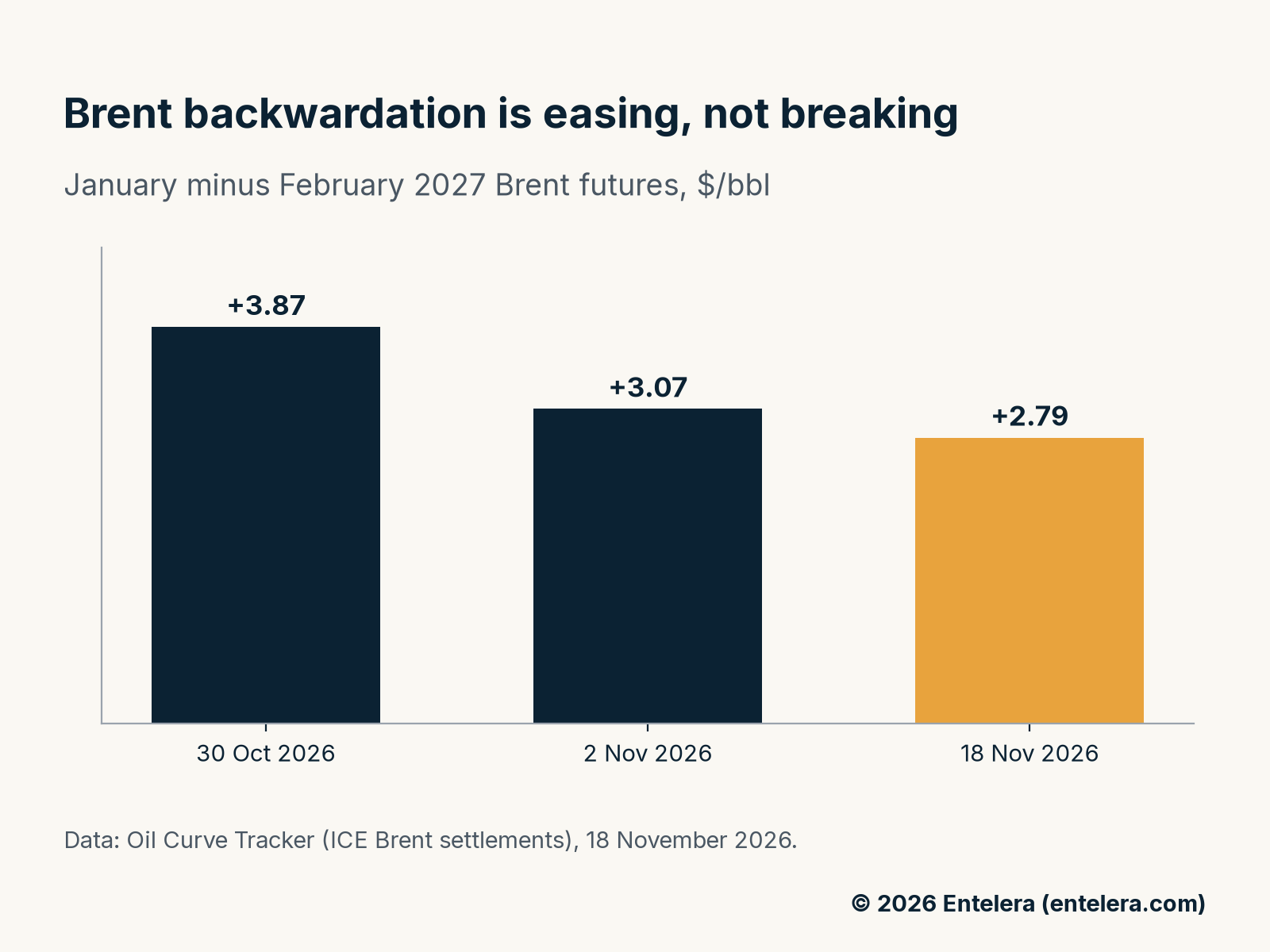
Brent backwardation is easing, not breaking
The curve still pays for prompt barrels. The January-February 2027 Brent spread stood at +$2.79 a barrel on 18 November 2026, Oil Curve Tracker data show. However, the same spread was +$3.87 on 30 October 2026. Over a similar period, the 12-month slope narrowed from +$19.79 on 2 November 2026 to +$15.65.
In other words, the market has stripped out much of the scarcity premium, but it has not priced a glut. Indeed, the IEA says on-land stocks remain at their lowest since at least 2016, GoldSquawk noted. Meanwhile, oil on water rose by 86mn barrels in October 2026. That is how a surplus forecast and Brent backwardation can coexist: the extra oil is at sea, not in tanks.
Hormuz freight: the risk premium is fading
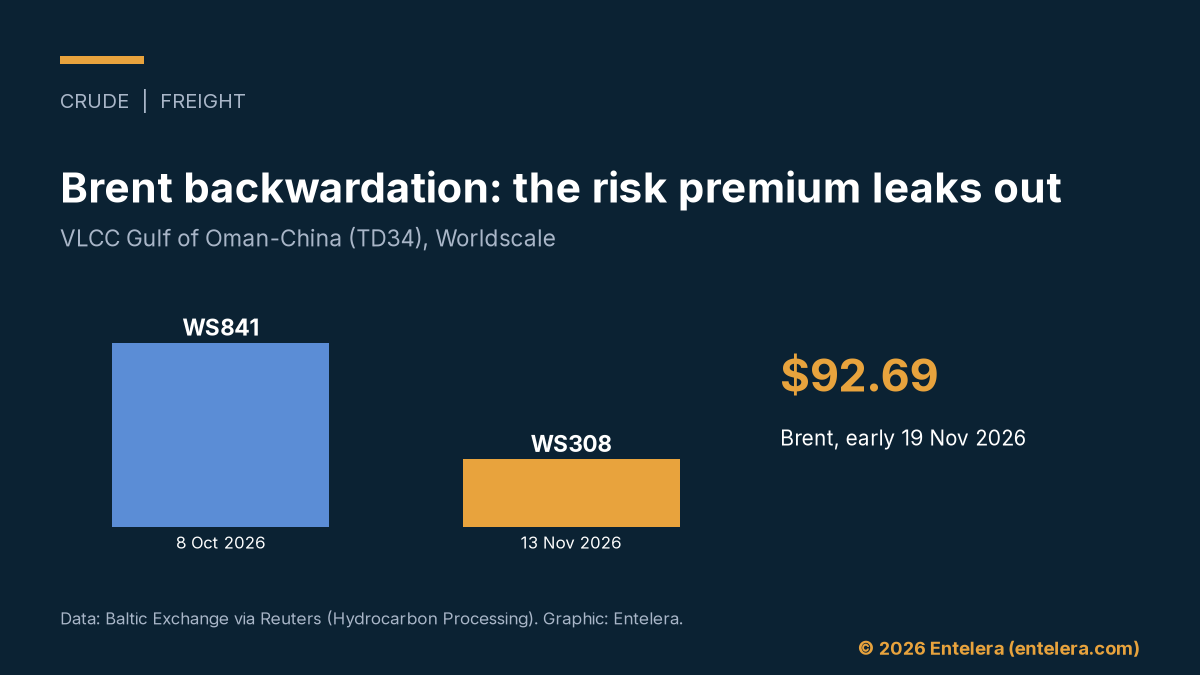
Freight shows the same unwind. VLCC rates on the Baltic Exchange’s Gulf of Oman-to-China route fell to about WS308 on 13 November 2026, down 64% from a record WS841 on 8 October 2026, Hydrocarbon Processing reported. Daily earnings dropped to $307,160 from $912,660, Forbes Middle East said.
Still, the Gulf-to-China route, TD3C, paid ~$1.08mn a day that week. In addition, crude and fuel flows through the Strait of Hormuz rose to 9.1 mmbbl/d in Q3 2026 from 5.1 mmbbl/d in Q2 2026, ING said. That recovery explains why freight and the curve have both softened.
What Brent backwardation means for traders, portfolio players and buyers
Traders: a strike headline now moves the flat price more than the spreads. If the January-February 2027 spread climbs back above $3, the market is pricing real supply loss. If it keeps narrowing, the rally is noise.
Spread traders: selling the 12-month slope has worked since early November 2026. However, a renewed Hormuz disruption is the key upside risk, ING warned.
Portfolio players: Brent’s premium to front-month WTI was ~$8.69 a barrel at the 18 November 2026 settlements, on our sums. That keeps US crude exports competitive into Europe and Asia.
Buyers: refiners still pay up for prompt cargoes. By contrast, December 2027 Brent sits ~$15.65 below January 2027, so deferred cover looks cheap.
What to watch next
Any US decision on new Iran strikes, and whether Brent backwardation widens again.
The January-February 2027 Brent spread against the $3 mark.
Gulf freight, especially TD3C, as a gauge of Hormuz risk.
The next weekly EIA stocks report, after two straight crude builds, and extra supply such as Kirkuk crude exports.
Sources
Investing.com (Reuters), Oil prices rise as report says Trump considering more Iran strikes, 19 November 2026: investing.com
Angel One, Crude oil prices gain as Middle East attacks offset supply glut concerns, 19 November 2026: angelone.in
Oil Curve Tracker, Brent and WTI futures curves, 18 November 2026: tbysmll.github.io
FXStreet (ING), Oil: supply recovery weighs on prices, 17 November 2026: fxstreet.com
GoldSquawk, Volatility and backwardation still outstrip outright crude positioning, November 2026: goldsquawk.com
Hydrocarbon Processing (Reuters), Supertanker rates plunge more than 60% from record highs, November 2026: hydrocarbonprocessing.com
Forbes Middle East, Supertanker rates slide as geopolitical risk premium eases, November 2026: forbesmiddleeast.com
Free account
Sign up free to read the full analysis
Create a free Entelera account to read every analysis in full. It takes less than a minute; no payment details needed.
Entelera Research is the editorial team behind Entelera. We cover crude, LNG, power, renewables, policy and geopolitics, looking at energy the way companies have to: supply, demand, margins, policy and risk, with every number linked to its source and a close eye on India and its place in global markets.
Mexico fuel imports barely moved as Pemex runs fell ~210,000 b/d in September 2026, while crude exports jumped. What it means for USGC cracks and Maya.