
The Brent crude price touched $110 a barrel on Friday 16 October, for the first time since May. At first glance, the headline suggests tight supply. However, the more useful reading is narrower. The market is pricing the risk that oil cannot move, not the risk that oil runs out. That difference shapes who suffers most, which policy tools work and what investors should watch.
What happened to the Brent crude price this week
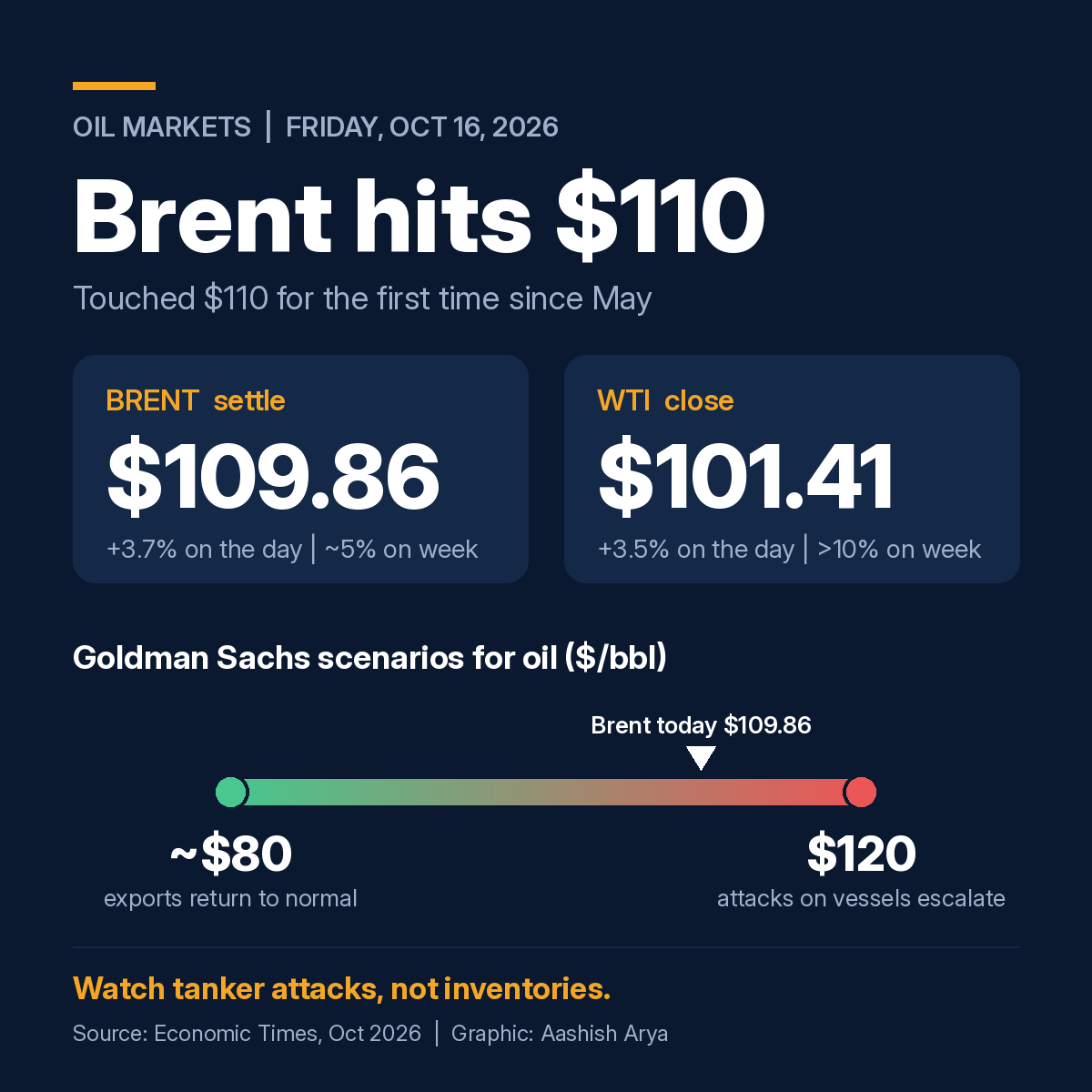
Brent futures crossed $110 during Friday’s session. They then eased to settle at $109.86, up 3.7% on the day and nearly 5% on the week. Meanwhile, US West Texas Intermediate (WTI) rose 3.5% to close at $101.41. Over the week, WTI gained more than 10%, according to ETMarkets.
Three separate sources of risk built up in the same week:
- The Strait of Hormuz. Citing CNBC, ETMarkets said at least nine tankers and cargo ships had come under attack since the previous Sunday. This came as Iran sought to disrupt exports through the waterway. In addition, US Central Command said Iran sank the container ship GFS Pride on Wednesday.
- Saudi Arabia. Iran-backed Houthi militants in Yemen launched repeated attacks on the kingdom. On Friday, Saudi Arabia intercepted several missiles over the Red Sea. One was heading towards Yanbu, a key oil export terminal. Earlier in the week, an attack hit one of Aramco’s administrative buildings in Dhahran.
- Russia and Ukraine. The energy ceasefire that US President Donald Trump sought to broker quickly fell apart. Moscow continued strikes on Ukrainian infrastructure. Meanwhile, President Volodymyr Zelenskyy pledged renewed attacks on Russian refineries.
How governments responded with emergency stocks
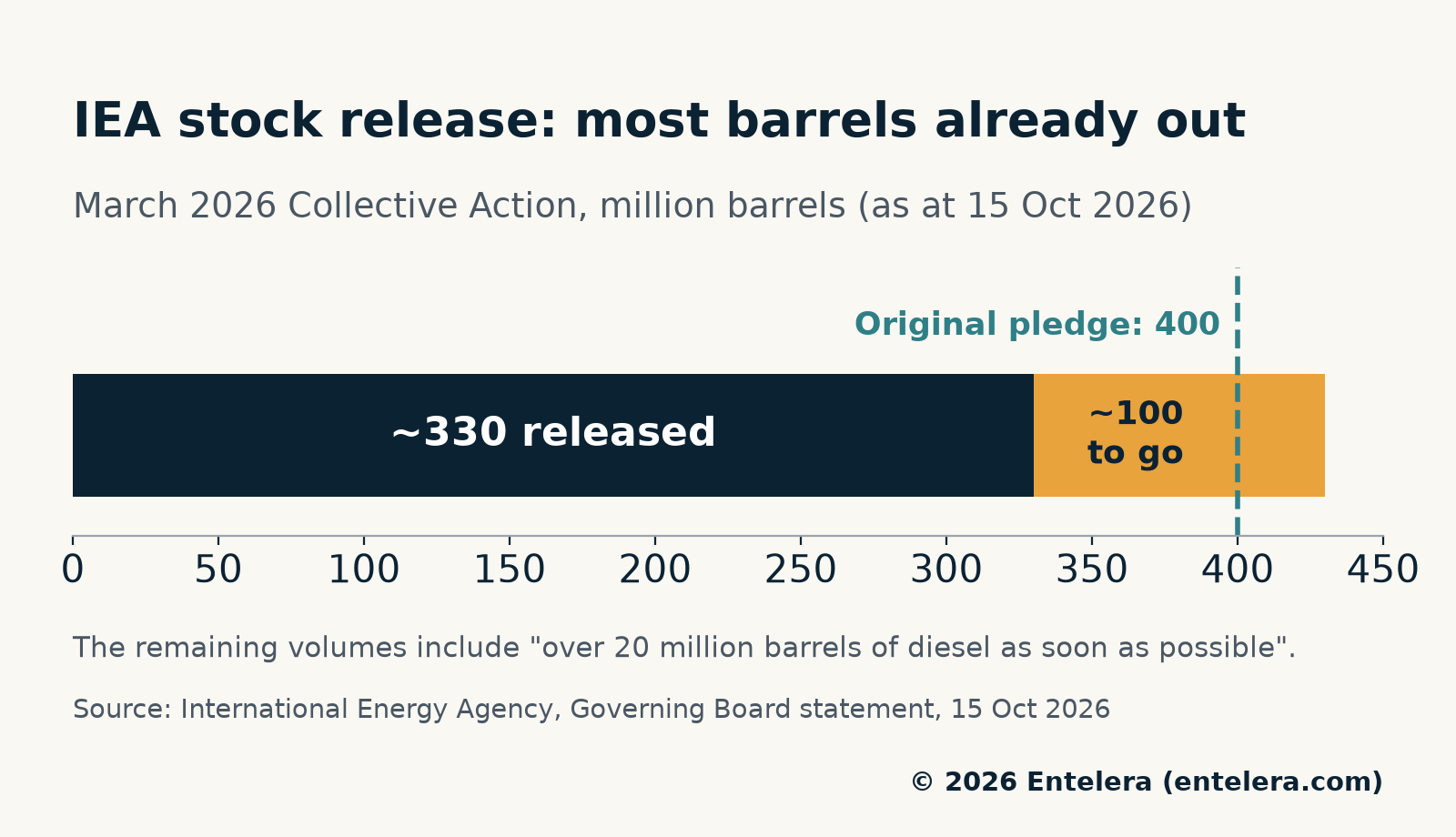
Governments responded with stocks. On 15 October, the Governing Board of the International Energy Agency (IEA) agreed to speed up remaining releases. These fall under its March 2026 Collective Action. The decision covers the remaining volumes, “including over 20 million barrels of diesel as soon as possible”.
A day later, the US Department of Energy issued a request for proposals. It seeks to exchange up to 17 million barrels from the Strategic Petroleum Reserve (SPR).
Why the Brent crude price carries a transit premium
Every risk listed above concerns routes and infrastructure: a strait, an export terminal and a refinery fleet. None of them involves reservoirs running dry or demand suddenly surging. Daan Struyven, co-head of global commodities research at Goldman Sachs, made a similar point. He said recent attacks underscored how disruptions to shipping could spread and intensify. In his view, shipping risks had become a major driver of oil prices.
This matters because a shortage premium and a transit premium behave differently. A shortage premium fades slowly, as new supply arrives and demand adjusts. By contrast, a transit premium can collapse quickly if routes reopen. It can also spike without warning if a single high-profile attack lands. That is why the price distribution now looks wide and two-sided, rather than gently skewed.
The numbers behind the Brent crude price
- $109.86: the Brent settlement on 16 October, after touching $110.
- $101.41: the WTI close, up more than 10% on the week.
- $120 and about $80: Goldman Sachs’ scenario range. Prices could rise to $120 if attacks on vessels in the Middle East escalate. However, a return to normal export levels could bring them down towards $80.
- About 330 million barrels: emergency stocks already released under the March 2026 Collective Action, according to the IEA. A further 100 million barrels or so will follow. The IEA board also said total releases will exceed the original 400 million barrels.
- 17 million barrels: the size of the latest US SPR exchange offer.
- $6.33 a gallon: the average US diesel price on Friday. That is more than 70% higher than a year earlier, according to the CNBC report cited by ETMarkets.
The gap between Goldman’s two scenarios is $40 a barrel. With the Brent crude price at $109.86, the market sits much closer to the stress case than the relief case. In effect, traders are paying for the possibility that shipping gets worse.
Why emergency stocks have limited reach
Strategic stocks are a bridge, not a solution. They add barrels in consuming regions. However, they do nothing to make a tanker safer in the Gulf. Two details from the policy response underline the point.
First, the IEA’s diesel figure appears to speed up commitments made in March, rather than add new supply. Its statement framed the 20 million barrels as part of “the remaining volumes”. The board also encouraged members with production and refining capacity to boost supply of crude and products, particularly diesel.
Second, the US exchange terms matter. According to The Times of India, an earlier attempt to offer the remaining US barrels met limited demand. In June, companies agreed to borrow only about 500,000 barrels. The terms required them to return extra crude, with premiums of up to 24%.
An exchange is a loan, not a gift. Therefore, if the terms are unattractive, the headline volume overstates what actually reaches the market.
Emergency stocks buy time. They do not reopen shipping lanes. The variable to watch is tanker attacks, not inventories.
Products may hurt more than crude
Goldman Sachs also expects natural gas and refined fuel prices to rise. In its view, supply shocks will hit gas and refined products harder than crude. The diesel data supports that view. Ukrainian strikes on Russian refineries hit product supply directly, and so do attacks on Middle East energy infrastructure. This explains why the IEA put diesel at the centre of its response.
Businesses whose costs track middle distillates feel it first. These include freight operators, farmers, airlines and diesel-importing economies. For them, a Brent crude price of $110 understates the pressure. This is because the products they buy are under tighter strain than the crude itself.
What the Brent crude price means for India, Europe and the US
India: As a large crude importer, India faces risk on both price and logistics. Every dollar added to Brent feeds into the import bill. On top of that, a transit premium raises freight and insurance costs. The lesson is that diversifying suppliers helps less when the risk sits in shared shipping lanes. Instead, diversifying routes, holding storage and cutting oil intensity all carry more weight in a crisis like this.
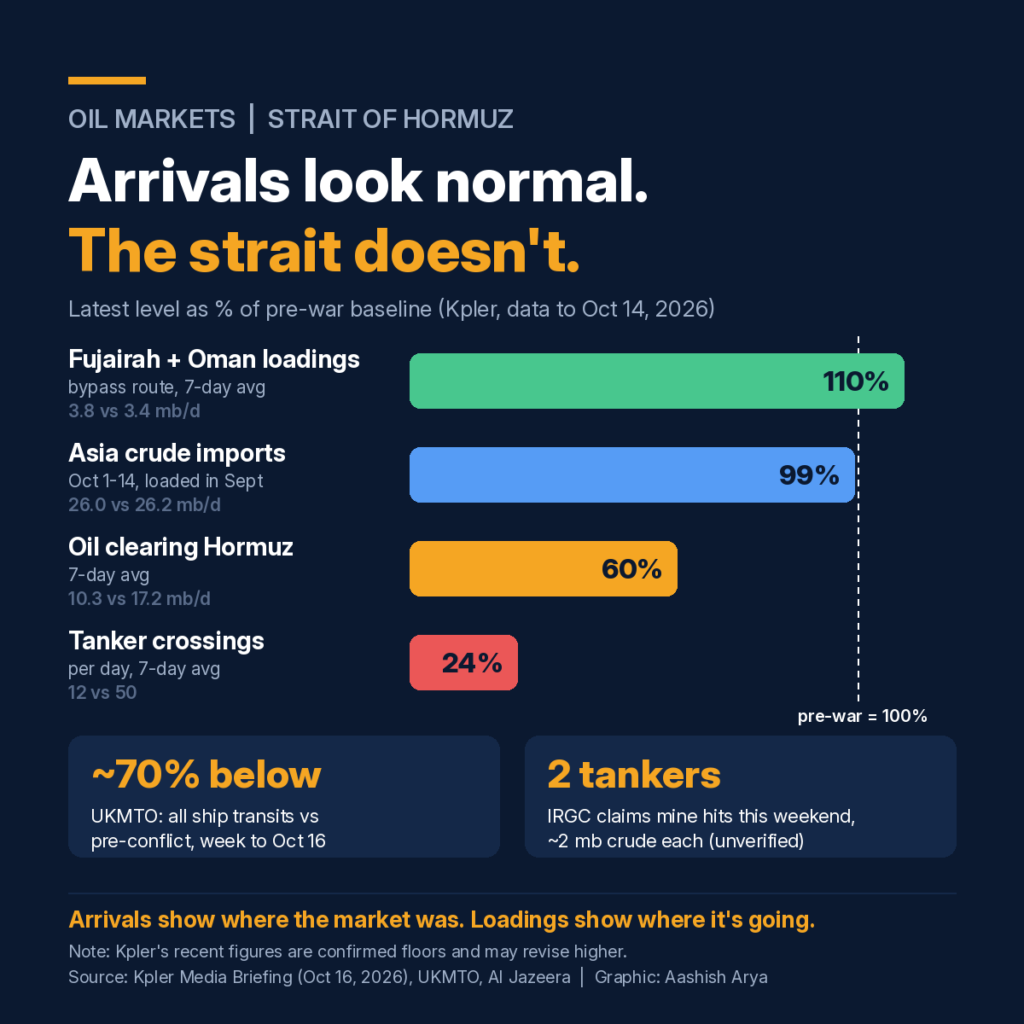
For a closer look at the tanker data, read our analysis of Strait of Hormuz flows and Asian crude arrivals.
Europe: Europe’s exposure runs mainly through diesel. The IEA’s focus on diesel points to continued pressure on middle-distillate prices. So does the collapse of the Russia-Ukraine energy truce. In turn, that pressure feeds into transport and industrial costs.
United States: WTI’s weekly gain of more than 10% shows that US production does not shield consumers from a global transit shock. The administration is leaning on SPR exchanges and on pressure on IEA partners. Yet the June experience shows the limits of exchanges when borrowing terms are steep.
Producers: The relative winners are producers whose export routes avoid contested chokepoints. They capture high prices without carrying the same transit risk.
What to watch next
- Attack frequency around Hormuz and the Red Sea. This is the largest swing factor in the $80 to $120 range.
- Delivery of the remaining IEA barrels. In particular, watch how quickly the 20 million-plus barrels of diesel reach the market.
- Uptake of the US SPR exchange. Weak bidding would signal that the terms, not the volume, are the real constraint.
- Russian refinery outages, now that Ukraine has said it will resume strikes.
- Product cracks relative to crude. A widening gap would confirm Goldman’s view that products carry the larger shock.
The year-end question is simple to state but hard to answer. Will the Brent crude price move towards $120 or towards $80? The answer depends less on how much oil exists than on whether tankers can sail safely.
Sources
- The Economic Times (ETMarkets), “Brent crude oil prices hit $110 for first time since May as Iran attacks continue, Ukraine eyes Russia energy infra”, 17 October 2026: economictimes.indiatimes.com
- The Times of India, “US seeks bids to exchange 17 million barrels of crude from strategic reserve”, 16 October 2026: timesofindia.indiatimes.com
- International Energy Agency, “IEA Governing Board statement on energy markets and security”, 15 October 2026: iea.org